All Astronauts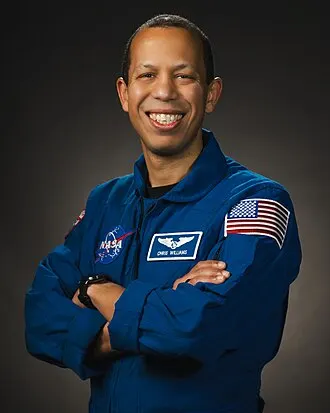 VETERANActiveNASA
VETERANActiveNASANASA·🇺🇸 United States·Born 1980
Christopher Williams
Medical physicist with an MD and PhD from Harvard, specializing in radiation oncology.
Days in Space
1
Missions
0
EVAs
—
EVA Time
What they aspire to
He hopes his background in medical physics and astrophysics will contribute new science to ISS research.
Biography
Medical physicist with an MD and PhD from Harvard, specializing in radiation oncology. Selected in NASA's 2021 astronaut class.
Before NASABoard-certified medical physicist at Harvard Medical School and Dana-Farber Cancer Institute who led MRI-guided radiation therapy research before NASA selected him in 2021.
Life & career
Christopher Williams was born in 1980 and raised in Potomac, Maryland, and reached space through an unusual door — not the cockpit, but the physics laboratory and the cancer clinic. He earned a bachelor's degree in physics from Stanford University and then a doctorate in physics from the Massachusetts Institute of Technology, where his research was in astrophysics: he helped build and analyze data from the Murchison Widefield Array, a low-frequency radio telescope in the Western Australian outback designed to probe the 'epoch of reionization,' the era when the first stars and galaxies lit up the early universe. After completing his PhD, Williams pivoted from studying the cosmos to fighting disease, training as a board-certified medical physicist during a residency at Harvard Medical School and then joining the faculty as a clinical physicist and researcher affiliated with Brigham and Women's Hospital and the Dana-Farber Cancer Institute. He became a lead physicist for an MRI-guided radiation-therapy program, developing new image-guidance techniques to target tumors more precisely. NASA selected him for its 2021 astronaut candidate class, and he reported for training in January 2022.
Williams made his first spaceflight on 27 November 2025, launching aboard the Russian Soyuz MS-28 spacecraft from the Baikonur Cosmodrome in Kazakhstan — a reflection of the ongoing seat-exchange agreement that places NASA astronauts on Soyuz and Roscosmos cosmonauts on U.S. commercial vehicles to ensure both partners always have crew aboard the station. He flew alongside Roscosmos cosmonauts Sergey Kud-Sverchkov, who commanded the Soyuz, and Sergey Mikayev. Serving as a flight engineer with Expedition 74 for a planned stay of roughly six to eight months, Williams joined a station research program broad enough to draw on his own background, contributing to physical- and life-science investigations conducted in the unique microgravity environment of the orbiting laboratory.
An Eagle Scout with a scientist's temperament, Williams embodies the growing role of the researcher-astronaut, bringing deep expertise in radiation physics, medical imaging, and cosmology to the space station rather than a piloting or military background. His hope, expressed before flight, was that his experience in medical physics and astrophysics would help generate new science aboard the ISS and advance the kind of cancer-treatment research he pursued on the ground. As an active NASA astronaut who has now completed his first mission, he is part of the cohort that will carry NASA's human-spaceflight program through the final years of the International Space Station and toward the agency's future exploration goals, and his path from radio telescopes to the radiation-oncology clinic to low Earth orbit illustrates how varied the routes into the modern astronaut corps have become.
Mission Timeline
- Flight Engineer
Soyuz MS-28
Soyuz MS-28 / Expedition 73/74
Launch: Nov 27, 2025Landing: OngoingDuration: 180 days- First spaceflight, launching on Soyuz from Baikonur
Beyond the Mission
Hobbies & Interests
scouting
Causes They Champion
Cancer treatment research
Languages
English
Awards & Honors
- Eagle Scout
Fun fact
He earned a PhD in physics from MIT studying the early universe with the Murchison Widefield Array radio telescope before pivoting to medical physics.
Learn More
More Astronauts
Other space travelers from NASA