All Astronauts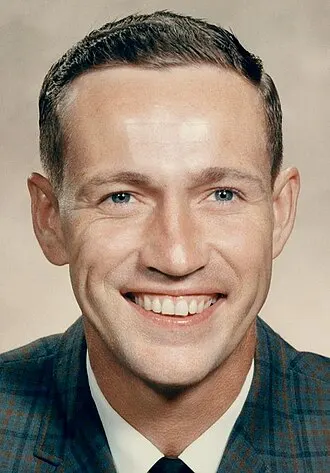 ROOKIEIn MemoriamNASA
ROOKIEIn MemoriamNASANASA·🇺🇸 United States·Born 1930
Donn Eisele
Command Module Pilot of Apollo 7, the first crewed Apollo flight, which restored confidence in the program after the Apollo 1 fire.
Hours in Space
1
Missions
0
EVAs
—
EVA Time
Biography
Command Module Pilot of Apollo 7, the first crewed Apollo flight, which restored confidence in the program after the Apollo 1 fire. He died in 1987.
Before NASAU.S. Air Force interceptor pilot and experimental test pilot at Kirtland Air Force Base who logged over 4,200 flight hours, including 3,600 in jet aircraft, and held an M.S. in astronautics from the Air Force Institute of Technology.
Life & career
Donn Fulton Eisele was born on June 23, 1930, in Columbus, Ohio, and grew up there before entering the United States Naval Academy, from which he graduated in 1952. Rather than take a Navy commission, he transferred to the U.S. Air Force, where he built a career as an interceptor pilot and then an experimental test pilot at Kirtland Air Force Base in New Mexico. He earned a master's degree in astronautics from the Air Force Institute of Technology in 1960 and accumulated more than 4,200 flight hours, the great majority of them in jet aircraft. In October 1963 NASA selected him among its third group of astronauts, the cohort brought in to carry the Gemini and Apollo programs forward toward the Moon.
Eisele made a single spaceflight, but it was one of the most consequential of the era. He served as Command Module Pilot of Apollo 7, launched on October 11, 1968 — the first crewed Apollo mission and the flight that had to prove the redesigned spacecraft was safe after the fatal Apollo 1 cabin fire of January 1967 had killed three astronauts and grounded the program. Flying with commander Wally Schirra and Lunar Module Pilot Walt Cunningham, Eisele spent eleven days in Earth orbit rigorously testing the Command and Service Module's systems, rendezvous capabilities, and engine restarts. The mission was a near-flawless engineering success that restored confidence in Apollo and cleared the path to the Moon, though it is also remembered for the crew's irritable exchanges with mission control after Schirra developed a head cold that spread to his crewmates in the cramped cabin. Eisele logged about 260 hours in space and never flew again.
After leaving both NASA and the Air Force in 1972, Eisele took an unusual second act, serving as the Peace Corps country director in Thailand before moving into private business. He died on December 2, 1987, at the age of 57, suffering a heart attack while on a business trip to Tokyo, and his ashes were later buried with full military honors at Arlington National Cemetery. His candid, sometimes wry recollections of the pressures inside the Apollo program were published posthumously in 2017 as the memoir Apollo Pilot, giving later generations an unvarnished first-hand view of the mission that put the Moon within reach.
Mission Timeline
- Command Module Pilot
Apollo CSM / Saturn IB
Apollo 7
Launch: Oct 11, 1968Landing: Oct 22, 1968Duration: 11 days- First crewed Apollo flight, testing the redesigned spacecraft
Beyond the Mission
Languages
English
Fun fact
After leaving NASA, Eisele served as director of the Peace Corps in Thailand — an unusual second act for a test pilot — and posthumously left behind a candid memoir, Apollo Pilot, published in 2017, in which he described his frustrations and quirky sense of humor during the Apollo program.
More Astronauts
Other space travelers from NASA