All Astronauts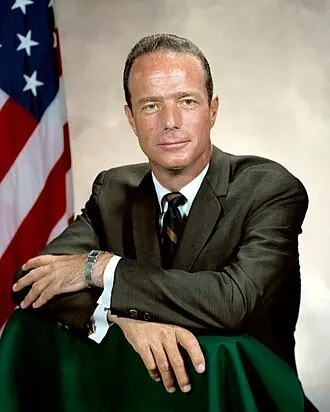 ROOKIEIn MemoriamNASA
ROOKIEIn MemoriamNASANASA·🇺🇸 United States·Born 1925
Scott Carpenter
Second American to orbit Earth, flying three orbits aboard Aurora 7 in 1962.
Hours in Space
1
Missions
0
EVAs
—
EVA Time
Inspirations
Jacques Cousteau
Biography
Second American to orbit Earth, flying three orbits aboard Aurora 7 in 1962. Later became an aquanaut on the Navy's SEALAB II, the only American to explore both space and the deep ocean. He died in 2013.
Before NASAU.S. Navy aviator who flew P2V Neptune reconnaissance and anti-submarine missions during the Korean War, then became a test pilot in the Electronics Test Division at NAS Patuxent River before joining NASA's Mercury program in 1959.
Life & career
Malcolm Scott Carpenter was born on May 1, 1925, in Boulder, Colorado, the son of a research chemist. He earned a bachelor's degree in aeronautical engineering from the University of Colorado and was commissioned in the U.S. Navy in 1949, winning his wings as a naval aviator in 1951. During the Korean War era he flew P2V Neptune patrol aircraft on reconnaissance and anti-submarine missions in the Pacific, then honed his skills as a test pilot in the Electronics Test Division at Naval Air Station Patuxent River. In April 1959 NASA chose Carpenter as one of the Mercury Seven, the first American astronauts, selected from an elite pool of military test pilots to open the frontier of human spaceflight.
Carpenter became the second American to orbit Earth when he flew Mercury-Atlas 7 on May 24, 1962. He named his capsule Aurora 7 and had been elevated to the flight only weeks earlier, after doctors grounded prime crew member Deke Slayton for a heart irregularity. Over three orbits Carpenter carried out an ambitious slate of science: he photographed Earth, studied liquid behavior in weightlessness, and famously investigated the mystery of John Glenn's 'fireflies,' concluding that the glowing specks were frozen condensation shed by the spacecraft. His absorption in these experiments, however, drew down his attitude-control fuel, and a late, misaligned retrofire sent Aurora 7 splashing down roughly 250 miles beyond its target. Carpenter waited calmly in a life raft for over an hour before recovery forces reached him. The overshoot triggered lasting friction within Mission Control, and Carpenter would never fly in space again.
Grounded from a second mission, Carpenter turned to the ocean. In 1965, on leave from NASA, he joined the Navy's SEALAB program, spending 28 days living on the sea floor off California as part of SEALAB II — making him the first person to be both an astronaut and an aquanaut. An arm injury sustained in a 1964 accident during his ocean training never fully healed and, together with later knee problems, ended his hopes of returning to orbit. He resigned from NASA in 1967 and retired from the Navy in 1969. In later decades he championed ocean exploration and environmental causes and co-authored books, including a memoir of Aurora 7. He liked to describe himself simply as both an astronaut and an aquanaut, a man who had reached into two of Earth's great unknowns. Scott Carpenter died on October 10, 2013, at the age of 88; his passing left John Glenn as the last surviving member of the Mercury Seven, a pioneer of humanity's reach into both space and the deep sea.
Mission Timeline
- Pilot
Mercury capsule Aurora 7
Mercury-Atlas 7 (Aurora 7)
Launch: May 24, 1962Landing: May 24, 1962Duration: 1 day- Second American orbital flight, with pioneering science observations
Beyond the Mission
Hobbies & Interests
clarinetoceanographyscuba diving
Languages
English
Fun fact
During his Aurora 7 flight in 1962, Carpenter solved the mystery of John Glenn's 'fireflies' — the glowing particles that had puzzled Glenn — identifying them as frozen condensation from the spacecraft and playfully renaming them 'frostflies.'
More Astronauts
Other space travelers from NASA