All Astronauts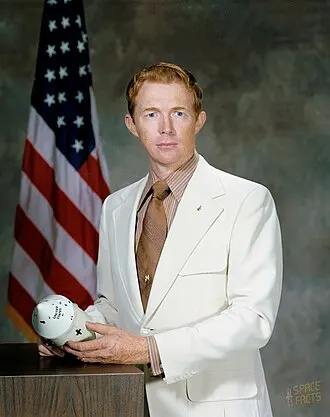 ROOKIEIn MemoriamNASA
ROOKIEIn MemoriamNASANASA·🇺🇸 United States·Born 1933
Stu Roosa
Command Module Pilot of Apollo 14 who carried hundreds of tree seeds to lunar orbit — later planted worldwide as 'Moon Trees.
Hours in Space
1
Missions
0
EVAs
—
EVA Time
Biography
Command Module Pilot of Apollo 14 who carried hundreds of tree seeds to lunar orbit — later planted worldwide as 'Moon Trees.' He died in 1994.
Before NASAU.S. Forest Service smokejumper who parachuted into active wildfires, then transitioned to become a U.S. Air Force fighter and test pilot flying F-84F, F-100, and F-101 Voodoo aircraft before joining NASA.
Life & career
Stuart Allen Roosa was born on August 16, 1933, in Durango, Colorado, and grew up in Oklahoma with an early taste for danger and the outdoors. Before he ever flew a jet, he served as a U.S. Forest Service smokejumper, parachuting directly into active wildfires across Oregon and California during the 1953 fire season. That appetite for calculated risk carried him into the U.S. Air Force, where he became a fighter and test pilot flying the F-84F, F-100, and F-101 Voodoo. In 1966 NASA chose him among its fifth group of astronauts, and he was ultimately assigned as Command Module Pilot for Apollo 14, the mission that would restore confidence in the lunar program after the near-disaster of Apollo 13.
Apollo 14 launched on January 31, 1971, carrying Roosa alongside commander Alan Shepard and lunar module pilot Ed Mitchell. While his two crewmates descended to explore the Fra Mauro highlands, Roosa remained in lunar orbit as the sole pilot of the Command Module Kitty Hawk, orbiting the Moon 34 times over roughly two days. His job demanded flawless solo operation of the spacecraft, scientific observation, and the critical rendezvous that would bring the returning lander safely back aboard. Drawing on his roots as a former smokejumper, Roosa agreed to carry hundreds of tree seeds tucked inside his personal kit as part of a joint U.S. Forest Service and NASA project. The single nine-day flight was his only trip to space, spanning about 216 hours, without a spacewalk given his role inside the capsule.
Those seeds became Roosa's most enduring monument. After splashdown, the U.S. Forest Service germinated them, and the resulting seedlings, drawn from loblolly pine, sycamore, sweetgum, redwood, and Douglas fir, were planted as 'Moon Trees' at courthouses, schools, and parks across the United States and beyond, many timed to the nation's 1976 bicentennial. Living things that had circled the Moon, they grew for decades, largely indistinguishable from their earthbound counterparts save for the small plaques marking their history. Roosa continued in the Air Force after NASA and later worked in private industry, retiring as a colonel. He died on December 12, 1994, at the age of 61, but the Moon Trees, and a second generation grown from their seeds, continue to stand as quiet memorials to a smokejumper who carried a forest to the Moon and back.
Mission Timeline
- Command Module Pilot
Apollo CSM Kitty Hawk
Apollo 14
Launch: Jan 31, 1971Landing: Feb 9, 1971Duration: 9 days- Carried the seeds that became the worldwide 'Moon Trees'
Beyond the Mission
Hobbies & Interests
huntingsailingexploration
Languages
English
Fun fact
Roosa carried hundreds of tree seeds in his personal kit on Apollo 14; upon return, those seeds were germinated by the Forest Service and planted across the United States as 'Moon Trees' — living monuments that grew from seeds that orbited the Moon 34 times.
More Astronauts
Other space travelers from NASA