All Astronauts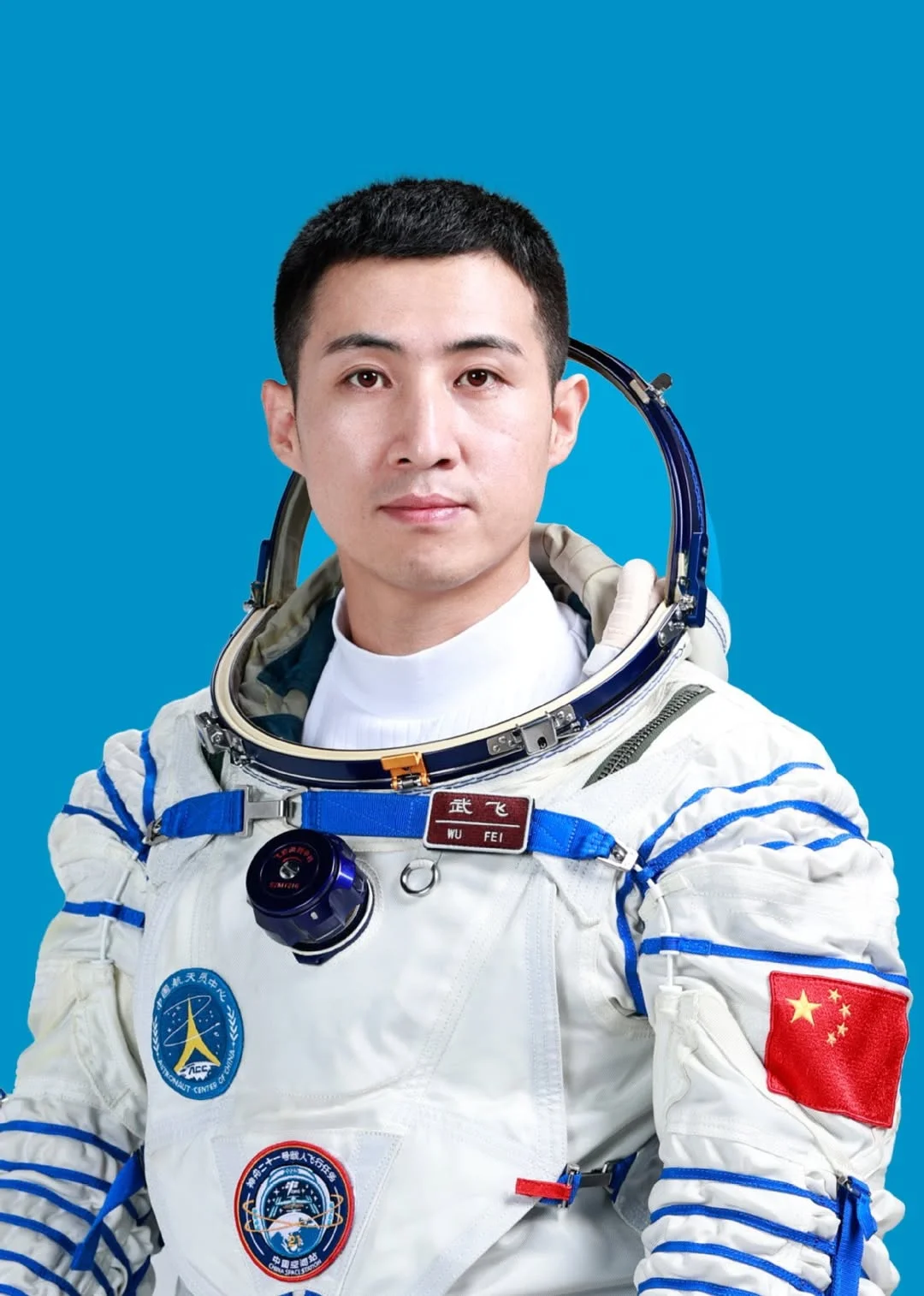 ELITEActiveCNSA
ELITEActiveCNSACNSA·🇨🇳 China·Born 1993
Wu Fei
Aerospace engineer and member of China's third taikonaut selection.
Days in Space
1
Missions
0
EVAs
—
EVA Time
Inspirations
What they aspire to
He hopes to make routine human spaceflight a normal part of his generation's career.
Biography
Aerospace engineer and member of China's third taikonaut selection. Made his first spaceflight aboard Shenzhou-21 to the Tiangong space station as China's youngest astronaut in space.
Before NASAAerospace engineer at China Aerospace Science and Technology Corporation (CASC) with a master's degree from Beihang University before joining as a flight engineer astronaut.
Life & career
Wu Fei represents the new face of China's human-spaceflight program: born in October 1993 in Baotou, Inner Mongolia, he reached orbit not as a fighter pilot but as an engineer. He studied at Beihang University — the Beijing University of Aeronautics and Astronautics, one of the country's premier aerospace schools — earning his bachelor's degree in 2014 and a master's in 2017 with a focus on aircraft design and life-support systems. He then went to work as an aerospace engineer at the China Aerospace Science and Technology Corporation (CASC), the state contractor at the center of nearly every Chinese launch. When China opened its third astronaut selection in 2020 — the first to recruit flight engineers and payload specialists rather than only military pilots — Wu was chosen as a flight-engineer candidate, part of a deliberate broadening of who gets to fly.
His first spaceflight came remarkably early in his career. Wu launched aboard Shenzhou 21 on 31 October 2025 from the Jiuquan Satellite Launch Center in the Gobi Desert, and at 32 years old he became the youngest Chinese astronaut ever to fly in space. He served as the mission's flight engineer under commander Zhang Lu, on a long-duration expedition to the Tiangong space station that ran to roughly 210 days. Aboard the station he handled the hands-on engineering that his selection track was built for: operating and maintaining station systems, supporting the extensive slate of microgravity experiments, and helping care for the mission's noted biological payload — a group of laboratory mice carried up for space life-science research. His youth made him a focal point of the mission's public profile, cast as evidence that spaceflight in China was becoming a career open to a scientifically trained generation, not just to test pilots.
For Wu Fei, the significance lies in what his flight signals more than in any single record beyond his age. He embodies the ambition, which he has voiced publicly, of making routine human spaceflight a normal part of his generation's professional life — a shift from the rare, heroic sortie toward the sustained, workmanlike occupation of a permanent orbital station. As an engineer-astronaut who reached orbit in his early thirties, he uses his platform to promote aerospace-engineering careers and to reach Chinese youth. He remains an active taikonaut early in what could be a long career, and having completed a demanding first expedition, he is positioned to fly again as China expands both the tempo and the scientific breadth of its Tiangong operations.
Mission Timeline
- Flight Engineer
Shenzhou spacecraft
Shenzhou 21
Launch: Oct 31, 2025Landing: May 29, 2026Duration: 210 days- Youngest Chinese astronaut to fly in space, at age 32
Beyond the Mission
Causes They Champion
Promoting aerospace engineering careersPublic outreach to Chinese youth
Languages
Mandarin Chinese
Fun fact
At 32 years old at launch, he became one of the youngest Chinese astronauts ever to fly in space on Shenzhou 21.
More Astronauts
Other space travelers from CNSA