All Astronauts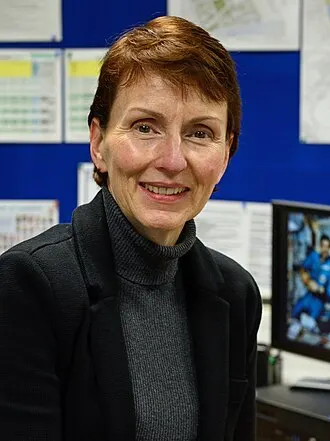 LEGENDRetired—
LEGENDRetired—Other·🇬🇧 United Kingdom·Born 1963
Helen Sharman
It wasn't so much going to space as the training that appealed.
Hours in Space
1
Missions
0
EVAs
—
EVA Time
There's this suggestion nothing can match going to space — and I'm not saying it isn't fantastic — but there are equally enjoyable things on Earth.
What they aspire to
She hopes human spaceflight will be seen as both useful for science and the economy and inspirational for future generations.
Biography
First British astronaut and first Western European woman in space. Chemist selected from 13,000 applicants for the Anglo-Soviet Project Juno mission to Mir.
Before NASAResearch chemist at GEC and at Mars Confectionery, where she worked on the flavour properties of chocolate before responding to a radio advertisement seeking Britain's first astronaut.
Life & career
Helen Patricia Sharman was born in 1963 in Sheffield, England, and trained not as a pilot or a military officer but as a chemist. She earned a B.Sc. in chemistry from the University of Sheffield and later a Ph.D. from Birkbeck College, University of London, and by her mid-twenties she was working in industry — first as a research and development technologist at the electronics firm GEC and then at Mars Confectionery, where she studied the flavour properties of chocolate. Her path to orbit began not with an application to a space agency but with a radio advertisement she heard in her car: a call for applicants to become 'the first British astronaut.' She jotted down the phone number at a red light and applied. From a field of nearly 13,000 hopefuls she was selected, live on television in November 1989, for Project Juno — a cooperative Anglo-Soviet venture, part-funded by British companies, intended to send a Briton to the Soviet Union's Mir space station in the closing years of the Cold War. She then spent some 18 months in intensive training at Star City near Moscow, learning Russian and the Soyuz systems.
On 18 May 1991, at the age of 27, Sharman launched aboard Soyuz TM-12 alongside Soviet cosmonauts Anatoly Artsebarsky and Sergei Krikalev, becoming the first British person in space. She spent most of her roughly eight-day flight aboard Mir, where her work as a research cosmonaut included medical and agricultural experiments, photographing the British Isles from orbit, and a licensed amateur-radio link-up with British schoolchildren — a fitting task for a lifelong radio enthusiast. She returned to Earth on 26 May 1991 aboard a different capsule, Soyuz TM-11, together with the departing Mir crew of Viktor Afanasyev and Musa Manarov, the standard crew-rotation swap of the Soyuz program. It was her only spaceflight, but a historic one: she remains the first Briton and the first Western European woman to fly in space, and the first woman to visit Mir.
Sharman's mission made her a national figure, and she was appointed an Officer of the Order of the British Empire (OBE) in 1992, later becoming a Companion of the Order of St Michael and St George (CMG) in 2018 for services to science and technology outreach; she is also an Honorary Fellow of the Royal Society of Chemistry. Now retired from spaceflight, she has devoted much of her career to public engagement — writing her 1993 autobiography 'Seize the Moment,' lecturing widely, and championing STEM education, particularly for girls. She has been notably candid in resisting the mythology of astronauts, remarking that it was the training rather than the flight itself that first drew her, and that there are 'equally enjoyable things on Earth.' More than three decades on, she remains a touchstone in British spaceflight history and an advocate for seeing human spaceflight as both scientifically and economically useful and a source of inspiration for future generations.
Records & Firsts
Notable accomplishments by Helen Sharman
- First British astronaut (1991)
- First Western European woman in space
Mission Timeline
- Research Cosmonaut
Soyuz TM-12
Project Juno / Soyuz TM-12
Launch: May 18, 1991Landing: May 26, 1991Duration: 8 days- First Briton to reach space; visited Mir space station
Beyond the Mission
Hobbies & Interests
hikinglanguagesamateur radio
Causes They Champion
Science and technology outreachSTEM education for girls
Languages
EnglishRussian
Awards & Honors
- Order of the British Empire (OBE)
- Companion of the Order of St Michael and St George (CMG)
- Honorary Fellow of the Royal Society of Chemistry
Authored
- Seize the Moment: The Autobiography of Britain's First Astronaut(1993)
Fun fact
She heard the call for Britain's first astronaut on her car radio and jotted the phone number down at a red light, then beat nearly 13,000 other applicants to win the seat.
Learn More
More Astronauts
Other space travelers from Other and United Kingdom