
Europe · ESAmissionrobotic
April 14, 2023
JUICE launches to Jupiter's icy moons
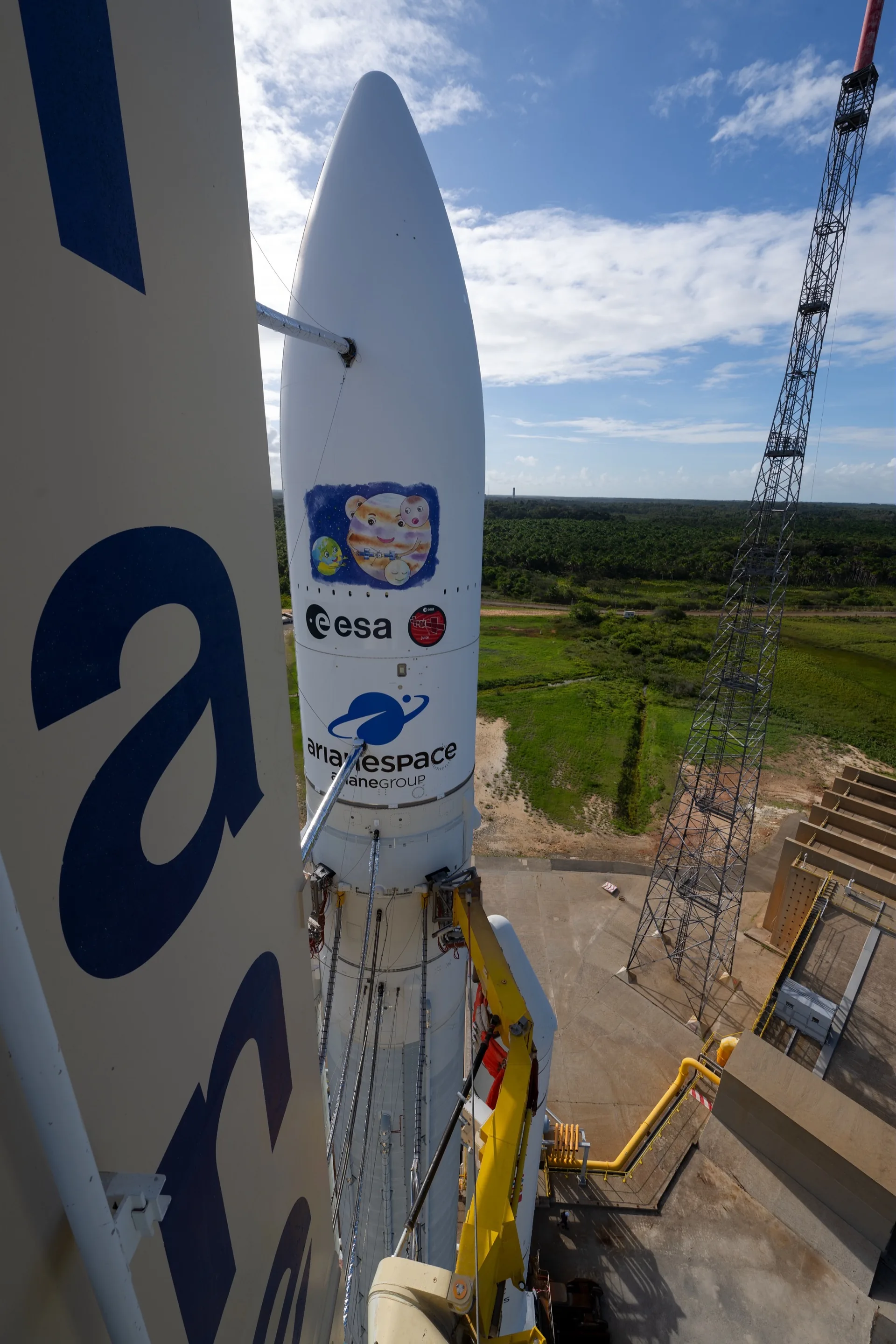
On the morning of 14 April 2023, under a heavy Guianese sky, Europe's biggest planetary mission left Earth on the second-to-last Ariane 5 ever to fly. The day before, lightning risk had stopped the countdown minutes from launch; now the rocket punched through the clouds above Kourou at 09:14 local time carrying the Jupiter Icy Moons Explorer, Juice, a six-tonne robotic emissary bound for worlds where vast oceans hide beneath kilometres of ice. Some twenty-seven minutes after liftoff the spacecraft separated, and within the hour its signal reached home: Europe was on its way to Jupiter.
Juice is built for an environment that punishes spacecraft. At Jupiter, sunlight is roughly 25 times weaker than at Earth, so the probe spreads 85 square metres of solar array, among the largest ever sent into deep space. Its eight-year route is a masterpiece of celestial billiards: in August 2024 it performed the world's first lunar-Earth double flyby, skimming the Moon and then Earth a day apart, with a Venus flyby and further Earth passes to follow before arrival in July 2031. Ten instruments will then dissect Ganymede, Europa and Callisto across 35 close flybys.
The cruise nearly began with heartbreak. Weeks after launch, the 16-metre antenna of RIME, the ice-penetrating radar meant to sound the moons' hidden oceans, jammed against a stuck pin only millimetres across. For a month, controllers shook the spacecraft with its thrusters and rolled it to warm the mount in sunlight. On 12 May 2023 they fired a mechanical actuator inside the bracket; the jolt shifted the pin and the antenna sprang open. The mission's grandest ambition survived: around 2034, Juice is to settle into orbit around Ganymede, the first spacecraft ever to orbit the moon of another planet.
“ESA, with its international partners, is on its way to Jupiter.”
Mission Data
Launch
14 Apr 2023 (Ariane 5, Kourou)
Launch mass
~6 t
Science instruments
10
Solar array area
85 m²
Jupiter arrival
Jul 2031
Ganymede orbit
planned 2034
Key Facts
Juice flew on the penultimate Ariane 5; Europe's veteran heavy-lifter retired for good less than three months later.
A pin just a few millimetres long nearly crippled the mission: the 16-metre radar antenna stayed jammed for a month until engineers freed it with a precisely aimed mechanical shock.
In August 2024 Juice threaded the world's first lunar-Earth double gravity assist, using the Moon and then Earth back to back to bend its path toward Venus.
Its 85 square metres of solar panels are sized for Jupiter, where sunlight is about 25 times fainter than at Earth.
If all goes to plan, in 2034 it becomes the first spacecraft in history to orbit another planet's moon, and it will end its days on Ganymede.
Why It Mattered
Juice is ESA's first mission to the outer Solar System under its own leadership, and it carries Europe's stake in one of the central scientific questions of the age: whether the ingredients for life exist in the buried oceans of the outer planets' moons. Its planned capture into Ganymede orbit will be a first in spaceflight, and its instruments will map potentially habitable environments thought to hold more liquid water than all of Earth's oceans. Alongside NASA's Europa Clipper, it makes the icy moons the defining destination of the 2030s.
ESA (CC BY-SA 3.0 IGO)
Official sourceContinue your journey
Mission
JUICE (Jupiter Icy Moons Explorer)
The mission behind this moment

Moment
DART impacts Dimorphos — first asteroid deflection test
From the same era

Moment
Artemis I — uncrewed Moon-orbit test flight
From the same era

Moment
Chandrayaan-3 — first soft landing near lunar south pole
From the same era
Moment
Aditya-L1 — India's first dedicated solar observatory
From the same era