Japan · JAXAfirstrobotic
June 13, 2010
Hayabusa returns first asteroid sample to Earth
Just before midnight local time on 13 June 2010, the sky over the Woomera Prohibited Area in South Australia tore open. A brilliant fireball fragmented into glowing shards as the Hayabusa mothership, which had no heat shield and was never meant to survive, burned up beside the small capsule it had released hours earlier. The 40-centimetre capsule streaked ahead of the debris, deployed its parachute, and settled onto the red outback soil. Inside were a few thousand microscopic grains of asteroid, the first ever brought home, ending a seven-year, roughly six-billion-kilometre odyssey that had nearly failed a dozen times.
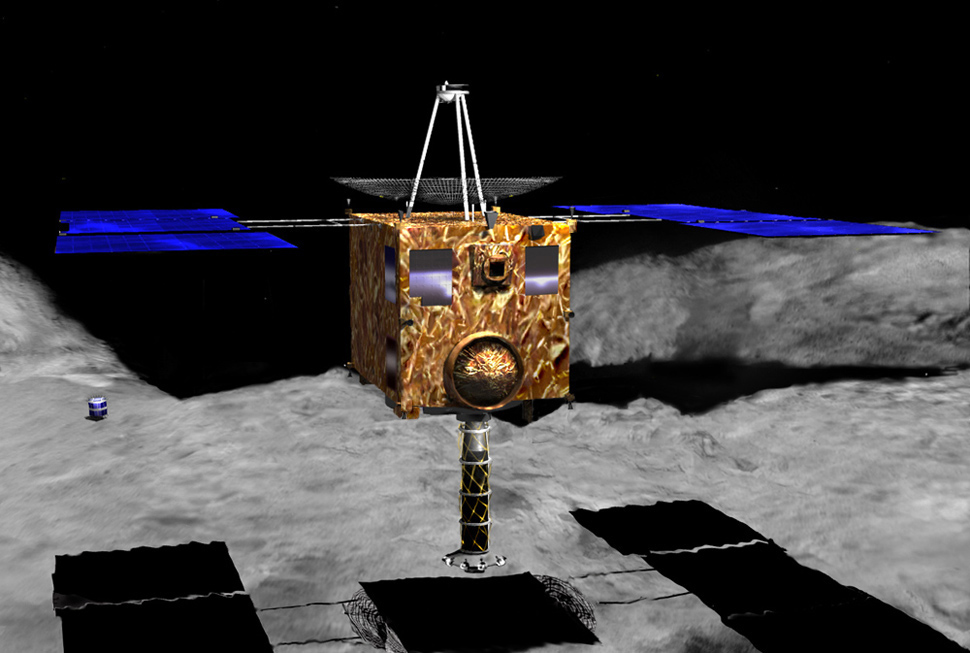
Hayabusa had launched on 9 May 2003 aboard an M-V rocket and reached the 535-metre asteroid Itokawa on 12 September 2005, propelled by experimental microwave-discharge ion engines. That November it descended twice to the rubble-pile surface. The sampling system, a gun designed to fire pellets into the regolith and blast fragments into a collection horn, almost certainly never fired. During the first attempt the spacecraft unexpectedly settled onto the asteroid and sat there for about half an hour, becoming the first craft ever to land on an asteroid and take off again. Dust kicked up during the touchdowns drifted into the horn anyway.
Then came the ordeal. A fuel leak in December 2005 sent the spacecraft tumbling, and ground stations lost it entirely for seven weeks. Reaction wheels failed. Batteries degraded. The return slipped three years. In November 2009, with two of four ion engines dead and two half-broken, engineers executed one of spaceflight's great improvisations: they wired the working neutralizer of thruster A to the working ion source of thruster B, creating a single virtual engine from two corpses, and it carried Hayabusa home.
Recovery teams retrieved the capsule the next day. In November 2010, JAXA announced that about 1,500 rocky grains inside, most smaller than a tenth of a millimetre, were confirmed material from Itokawa. The grains tied S-type asteroids directly to the ordinary chondrite meteorites in museum drawers, and the mission's against-all-odds homecoming made Hayabusa a national hero in Japan, inspiring feature films and its more ambitious successor, Hayabusa2.
Mission Data
Launch
9 May 2003, M-V rocket, Kagoshima
Arrival at Itokawa
12 Sep 2005
Surface touchdowns
Nov 2005 (two attempts)
Capsule return
13 Jun 2010, Woomera, Australia
Particles identified
~1,500 grains, mostly <10 µm
Round trip
7 years, ~6 billion km
Key Facts
The sampler gun designed to blast fragments off the asteroid almost certainly never fired; the roughly 1,500 grains that came home were dust kicked into the collection horn during the touchdowns themselves.
During its first sampling attempt Hayabusa unexpectedly sat on Itokawa's surface for about half an hour, making it the first spacecraft in history to land on an asteroid and lift off again.
A fuel leak in December 2005 sent the spacecraft tumbling and ground stations heard nothing for seven weeks; controllers eventually recovered it and nursed it home three years behind schedule.
In November 2009 engineers combined the working neutralizer of one failed ion engine with the working ion source of another, creating a single 'virtual engine' from two broken ones to finish the voyage.
The mothership burned up as a spectacular fireball alongside its own surviving capsule; airborne NASA and JAXA observers photographed the spacecraft's fiery funeral over the outback.
Why It Mattered
Hayabusa proved that sample return from an asteroid was possible, validated ion propulsion on a deep-space round trip, and directly linked S-type asteroids to ordinary chondrite meteorites, calibrating decades of meteorite science. Just as important was the lesson in persistence: a mission that suffered solar-flare damage, fuel leaks, dead reaction wheels and a seven-week blackout still came home. It opened the era of small-body sample return, paving the way for Hayabusa2 at Ryugu and NASA's OSIRIS-REx at Bennu, missions that now anchor our understanding of the solar system's raw materials.
JAXA / ISAS (illustration by J.R.C. Garry)
Official source


