International · NASA / OKB-1firsthuman
July 17, 1975
Apollo-Soyuz — first international docking in space
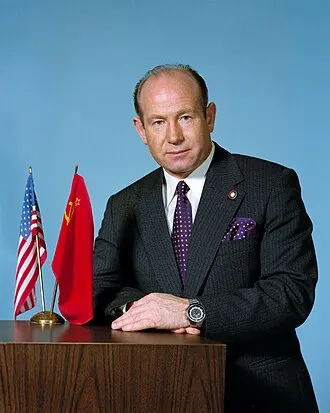
On the morning of 15 July 1975, a Soyuz rose from the steppe at Baikonur. Seven and a half hours later, a Saturn IB climbed away from Florida. For two decades the two nations had raced each other into space; now, for the first time, they were flying toward each other. On 17 July, in low Earth orbit, Apollo commander Tom Stafford eased his ship toward Soyuz 19 while Alexei Leonov, the first human ever to walk in space, watched it grow in his window. Contact, then capture. Two machines built by rival superpowers were suddenly one.
Nothing about the meeting was simple. Apollo flew a pure-oxygen cabin at a third of an atmosphere; Soyuz breathed a mixed atmosphere near sea-level pressure, so the Soviets lowered their cabin pressure and NASA built a docking module that worked as an airlock between the two worlds. The port itself, the jointly designed APAS-75, was deliberately androgynous: identical halves on each ship, so that neither nation would have to play the symbolically passive role. The crews had trained in each other's languages and countries for two years before a single engine lit.
Hours after docking, the hatches opened and Stafford and Leonov clasped hands. For roughly 47 hours the five men passed between ships, ran joint experiments, held press conferences, shared meals and traded gifts; Leonov, ever the joker, handed the Americans tubes labelled as vodka that actually held borsch. Among them floated Deke Slayton, one of the original Mercury Seven, grounded in 1962 by a heart irregularity and finally in orbit at age 51 after a sixteen-year wait.
The flight nearly ended in tragedy. During reentry on 24 July, toxic nitrogen tetroxide fumes from the thrusters seeped into the Apollo cabin, and the crew needed oxygen masks and two weeks of recovery in a Honolulu hospital. It was the last flight of an Apollo spacecraft, the last of the Saturn rockets, and the last American crewed launch until the Shuttle in April 1981. But the handshake endured: the cooperation rehearsed that week became the blueprint for Shuttle-Mir and, eventually, the International Space Station.
“Soyuz and Apollo are shaking hands now!”
Mission Data
Soyuz 19 launch
15 Jul 1975, Baikonur Cosmodrome
Apollo launch
15 Jul 1975, Saturn IB from Pad 39B
First docking
17 Jul 1975
Time docked
~47 hours, over two dockings
Crew
5 (3 American, 2 Soviet)
Apollo splashdown
24 Jul 1975, Pacific Ocean
Key Facts
The APAS-75 docking port was deliberately androgynous, with identical halves on both ships, so neither superpower would have to take the symbolically 'passive' role in the docking.
Leonov pranked the Americans with tubes labelled as vodka that actually contained borsch and juice.
Deke Slayton, grounded from his Mercury flight in 1962 over a heart irregularity, finally reached orbit at 51 after a sixteen-year wait.
Reentry nearly killed the Apollo crew: toxic nitrogen tetroxide fumes entered the cabin during descent, sending all three astronauts to a Honolulu hospital for about two weeks.
It was the final flight of both the Apollo spacecraft and the Saturn rocket family, and the last US crewed launch until the first Space Shuttle flight on 12 April 1981.
Why It Mattered
Apollo-Soyuz closed the space race and opened the era of spaceflight as diplomacy. It proved that rival space programs could co-engineer hardware, harmonise mission control procedures and trust each other's life-support systems, problems that were as much political as technical. The androgynous docking interface pioneered for the mission shaped every international docking standard that followed, and the working relationships it built between Houston and Moscow lay dormant through the late Cold War before being revived almost intact for Shuttle-Mir in the 1990s and the International Space Station, where Russian and American spacecraft still dock using descendants of the same ideas.
Mission Crew
Thomas P. StaffordVance D. BrandDonald K. "Deke" SlaytonAlexei A. LeonovValery N. Kubasov
NASA, AST-01-053
Official source