
On 18 February 2021, in a Jet Propulsion Laboratory control room thinned out by pandemic protocols, masked engineers listened as the calls came in: parachute deploy, heat shield separation, radar lock. Seven minutes earlier, a spacecraft moving at about 20,000 kilometers per hour had hit the Martian atmosphere; by the time its radio signals reached Earth, the outcome was already decided. Then Swati Mohan's steady voice cut through: touchdown confirmed. The room erupted in fist bumps where hugs should have been.
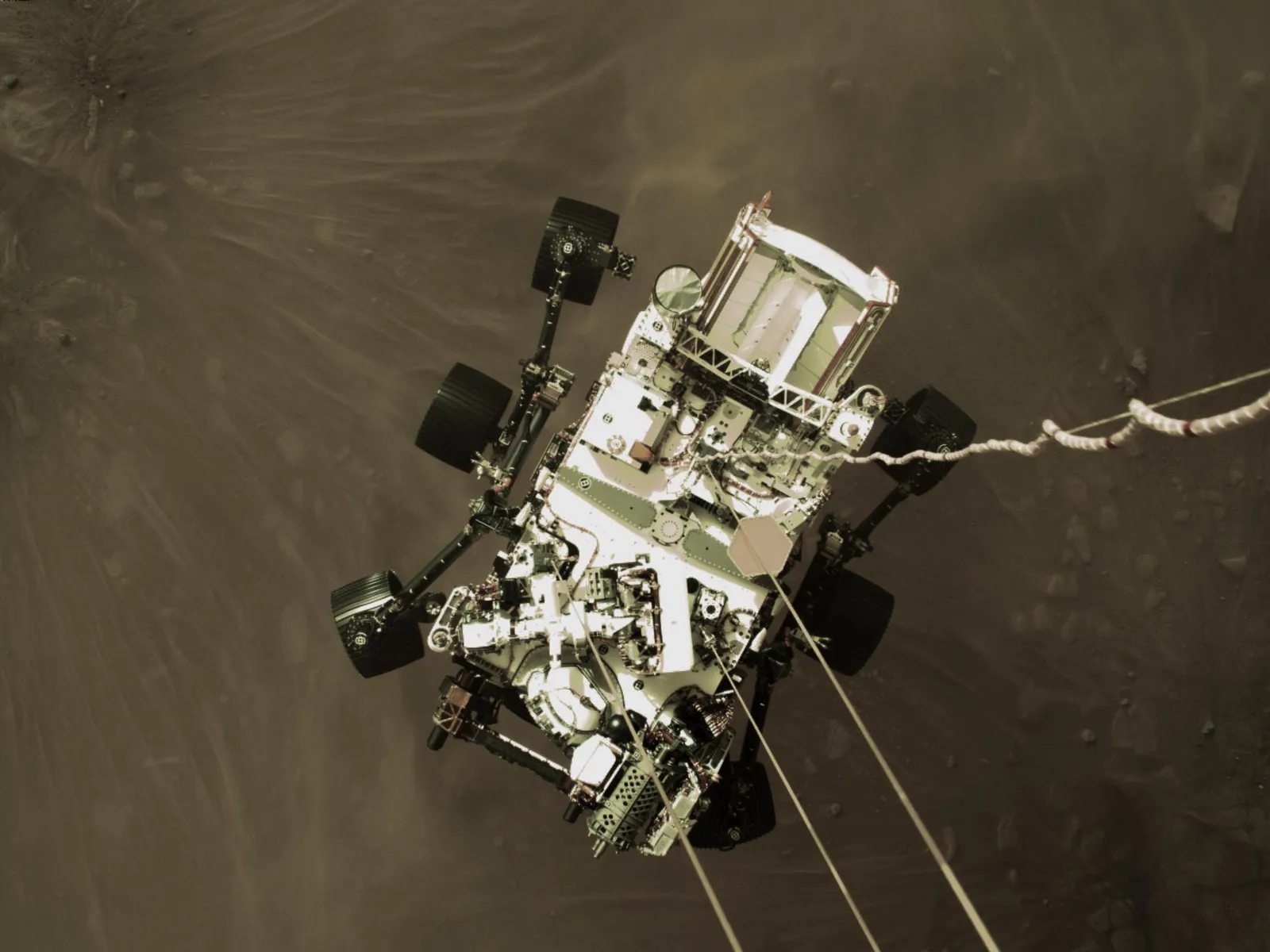
Perseverance had just landed in Jezero Crater, an ancient lake bed considered too dangerous for any previous rover. It got there using terrain-relative navigation, photographing the ground during descent and matching the images against orbital maps to steer itself away from boulder fields, a first in planetary exploration. Its parachute carried a secret: 'Dare Mighty Things,' JPL's motto, woven into the canopy in binary code, along with the lab's GPS coordinates. And for the first time ever, cameras filmed the entire landing, giving humanity a real video of arrival on Mars.
The one-ton rover was built around a single audacious goal: find signs of ancient life and cache the evidence. It carries 43 sample tubes for a future Mars Sample Return campaign, microphones that recorded the first audio from another planet, and MOXIE, a toaster-sized device that on 20 April 2021 produced about five grams of oxygen from Martian carbon dioxide, the first resource ever extracted from another planet for human use. Bolted to its belly rode a small helicopter named Ingenuity.
From its landing site, named for science-fiction author Octavia E. Butler, Perseverance has spent the years since exploring Jezero's river delta and crater rim, sealing samples, including a 2024 rock called Cheyava Falls bearing potential biosignatures that may be the most tantalizing clue yet in the search for past Martian life.
“Touchdown confirmed. Perseverance is safely on the surface of Mars, ready to begin seeking the signs of past life.”
Mission Data
Launch
30 Jul 2020, Atlas V 541, Cape Canaveral
Landing
18 Feb 2021, Jezero Crater
Rover mass
1,025 kg
Cruise
203 days, ~472 million km
Sample tubes
43 for future return to Earth
Power
Plutonium radioisotope generator (MMRTG)
Key Facts
The parachute concealed 'Dare Mighty Things' and JPL's GPS coordinates in binary code, decoded by internet sleuths within hours of the landing video's release.
It returned the first true video of a Mars landing and the first audio recordings ever made on another planet.
MOXIE produced about 5 grams of oxygen from Martian CO2 on 20 April 2021, the first extraction of a natural resource from another planet for human use.
The rover carries a piece of a Martian meteorite found on Earth, making that rock the first object to complete a round trip to Mars.
Its landing site was named Octavia E. Butler Landing, after the pioneering science-fiction author who grew up near JPL in Pasadena.
Why It Mattered
Perseverance turned the search for life on Mars from inference into evidence collection. It is the first leg of Mars Sample Return, caching rocks that laboratories on Earth may one day interrogate atom by atom, and its terrain-relative navigation opened previously unlandable terrain to every future mission. With MOXIE it performed the first resource extraction on another world, a foundational step for human exploration, and with Ingenuity in its belly it delivered the next milestone in this timeline.
NASA/JPL-Caltech
Official sourceContinue your journey
Experience
Perseverance
Experience this mission

Moment
Chang'e 5 returns first lunar samples since 1976
From the same era

Moment
Hope — UAE becomes the first Arab nation at Mars
From the same era

Moment
Ingenuity — first powered flight on another planet
From the same era

Moment
Tianhe — Tiangong space station core module launched
From the same era