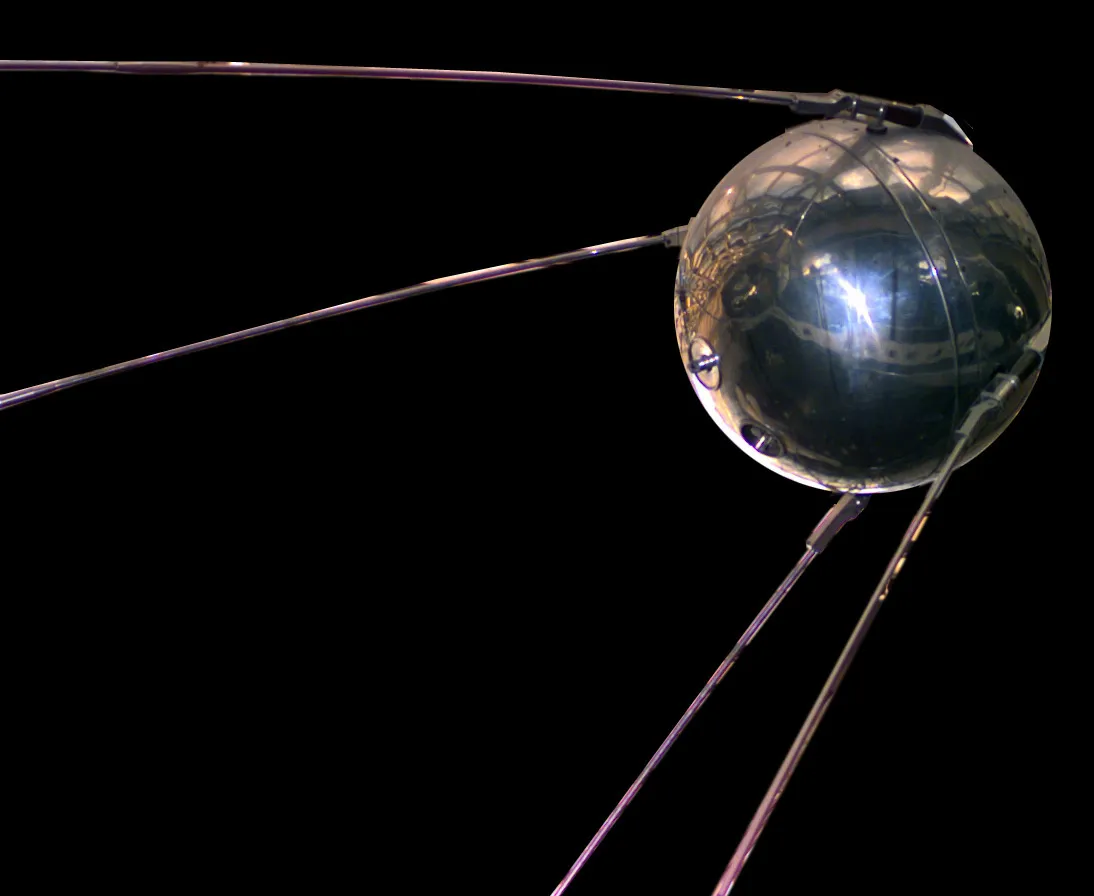
Just after 5:30 in the morning Moscow time on 3 November 1957, an R-7 rocket climbed away from the Tyuratam range carrying a three-year-old stray dog from the streets of Moscow. Her name was Laika, "Barker," though her trainers had first called her Kudryavka, "Little Curly." One month earlier, Sputnik 1 had stunned the world with a simple beeping sphere. Now the Soviet Union was placing a heartbeat in orbit, and telemetry showed that heartbeat racing at three times its normal rate as the rocket accelerated toward space.
02 / 04
Sputnik 2 was improvised at a sprint. Nikita Khrushchev wanted a spectacular for the fortieth anniversary of the Bolshevik Revolution on 7 November, and Sergei Korolev's engineers designed and built the 508-kilogram cone in under four weeks. There was no time to develop a recovery system, so the mission was one way by design. A pressurized cabin held Laika in a harness, with a food dispenser, a television camera watching her, and sensors recording her pulse, breathing, and blood pressure as she circled the planet roughly every 103 minutes.
03 / 04
The hurried thermal control system failed her. Cabin temperatures climbed past 40 degrees Celsius, and by the fourth orbit, five to seven hours into the flight, Laika was dead of overheating and stress. The Soviet Union admitted nothing for decades, claiming she had survived for days and been painlessly euthanized. The truth emerged only in 2002, when scientist Dimitri Malashenkov presented the telemetry record to the World Space Congress in Houston. Sputnik 2 kept circling until 14 April 1958, when it burned up in the atmosphere with Laika's remains aboard after 162 days in orbit.
04 / 04
Her handlers had known her fate. Days before launch, physician Vladimir Yazdovsky took Laika home to play with his children, writing later that he wanted to do something nice for a dog with so little time left to live. Yet her telemetry proved the essential point: a living creature had survived launch and functioned in weightlessness. In Moscow today a small monument shows Laika standing proudly atop a rocket shaped like a cupped human hand.
“
The more time passes, the more I'm sorry about it. We shouldn't have done it. We did not learn enough from the mission to justify the death of the dog.
Oleg Gazenko · Soviet space medicine scientist who selected and trained Laika, speaking in 1998
By the numbers
Launch
3 Nov 1957, 02:30 UT, Baikonur (Tyuratam)
Spacecraft mass
508.3 kg
Passenger
Laika, ~6 kg stray mongrel
Orbit
212 × 1,660 km
Laika's survival
~5–7 hours (4th orbit)
Reentry
14 Apr 1958, after 162 days
Why it mattered
Sputnik 2 transformed human spaceflight from speculation into a schedule. Laika's heartbeat, transmitted from orbit, was the first proof that a complex living organism could survive launch and function in weightlessness, and it convinced engineers on both sides of the Cold War that a person could follow. It also pushed the United States deeper into crisis, one month after Sputnik 1 and weeks before Vanguard's televised failure. And it forced spaceflight's first ethical reckoning: the dog sent up with no way home became a permanent reminder, acknowledged decades later by the program's own scientists, of the cost paid by the first orbital traveler.
▸The entire spacecraft was designed and built in under four weeks so it could fly before the Bolshevik Revolution's 40th anniversary on 7 November.
▸The truth about Laika's death was hidden for 45 years; Soviet accounts claimed she survived for days, until telemetry revealed in 2002 showed she died of overheating by the fourth orbit.
▸Days before launch, physician Vladimir Yazdovsky took Laika home to play with his children, because, he wrote, she had so little time left to live.
▸A television camera inside the cabin watched Laika in flight, and her pulse tripled during ascent before settling in weightlessness, the first biomedical data from orbit.
▸Watching the launch, future NASA Manned Spacecraft Center director Robert Gilruth concluded a human spaceflight program was now inevitable.