Full mission transcript
Every chapter of Dawn of the Space Age, in sequence.
Day 0
The Opening Shot
October 4, 1957 · 19:28 UTC
At 22:28 on the night of October 4, 1957, Moscow time — past midnight already at the launch site, where the calendar had turned to October 5 — a converted intercontinental ballistic missile lifted off from a secret range called NIIP-5, near the rail stop of Tyuratam in Soviet Kazakhstan. The world would be told it flew from 'Baikonur.' That was misdirection by design: the real Baikonur was a town hundreds of kilometres away, the name borrowed to keep Western maps wrong. The rocket, an R-7 variant designated 8K71PS, carried no warhead. In its nose rode a polished aluminium-alloy sphere 58 centimetres across and 83.6 kilograms in weight, trailing four whip antennas. Liftoff came at 19:28:34 UTC, and minutes later the sphere was circling the Earth every 96.2 minutes on an orbit of 215 by 939 kilometres — the first artificial object ever placed around the planet.
Then it spoke. On 20.005 and 40.002 megahertz, in pulses about three-tenths of a second long, Sputnik 1 beeped — and any amateur radio operator on Earth could tune it in. The satellite carried no scientific instruments beyond temperature and pressure switches keyed into that tone, but the signal was an experiment in itself: tracking how the beeps bent and faded taught researchers about the ionosphere, and watching the orbit decay revealed the density of the upper atmosphere. Millions went out at dawn and dusk to look for it; what most of them actually saw gliding among the stars was the spent booster, a 26-metre core stage shining at first magnitude. The sphere itself, at sixth magnitude, sat at the very edge of naked-eye visibility.
The man who had willed it into orbit could not be named. Sergei Korolev appeared in print only as 'the Chief Designer,' an anonymity he would carry to his grave. In Washington, President Eisenhower tried to shrink the moment at his October 9 news conference, allowing that the Soviets 'have put one small ball in the air' and insisting that 'so far as the satellite itself is concerned, that does not raise my apprehensions, not one iota.' America disagreed — the press called what followed the 'Sputnik crisis.' The little sphere transmitted for 22 days, falling silent on October 26, and burned up on January 4, 1958, after 1,440 orbits. The Space Age was three months old, and it had already outlived its first machine.
Day 30
A Dog Named Laika
November 3, 1957 · 02:30 UTC
In the small hours of November 3, 1957 — thirty days after the first Sputnik — the Soviet Union launched a second, and this one had a heartbeat aboard. Sputnik 2 was thrown together in under a month so that something spectacular would fly before November 7, the fortieth anniversary of the Revolution. The haste showed: the 508.3-kilogram payload reached a 212-by-1,659-kilometre orbit, but the rocket's core stage failed to separate, and with it went the spacecraft's thermal control. Sealed in the padded cabin was a small mongrel taken off the streets of Moscow — a calm, even-tempered stray the technicians called Laika.
Her telemetry told the story her handlers could not. A heart rate of 103 beats per minute on the pad surged to 240 during the violence of ascent, then took three hours of weightlessness to settle back near 102 — proof, for the first time, that a living creature could endure launch and orbit. But the cabin was overheating, and there was no way to cool it. Somewhere between five and seven hours into the flight, by the fourth orbit, the biomedical signals ceased. Laika died of overheating and stress within hours of becoming the first animal to orbit the Earth.
The Soviet Union spent forty-five years telling other endings — that she survived nearly a week, that she was painlessly euthanized before her oxygen ran out. The cover stories themselves conceded what the design made plain: there had never been a way to bring her home. The truth waited until October 2002, when Dimitri Malashenkov of the Institute for Biological Problems presented the real timeline to the World Space Congress. The spacecraft circled with her body aboard until April 14, 1958, when it burned up in the atmosphere. Of the scientists who sent her, it was Oleg Gazenko who said aloud, decades later, what the mission had cost.
Day 120
America Stumbles, Then Answers
February 1, 1958 · 03:47 UTC
America's first answer lasted two seconds. On December 6, 1957 — Day 63 of the Space Age — the Navy's Vanguard TV-3 rocket lit its engine before live television cameras, rose about 1.2 metres off the stand, lost thrust, and collapsed into a fireball that consumed the pad while its grapefruit-sized satellite was thrown clear, still transmitting where it fell. The press needed no prompting: 'Flopnik,' the headlines ran. 'Kaputnik.' 'Stayputnik.' The humiliation was total, public, and — as it turned out — brief.
Fifty-seven days later, on February 1, 1958, at 03:47:56 UTC, Wernher von Braun's Army team and the Jet Propulsion Laboratory made good with hardware they had been ready to fly for a year. A Juno I rocket placed Explorer 1 — a pencil-slim 13.97-kilogram cylinder, 203 centimetres long — into a high ellipse of 358 by 2,550 kilometres, circling every 114.8 minutes. At the National Academy of Sciences around 3:30 that morning, von Braun, James Van Allen, and William Pickering hoisted a full-scale model of the satellite overhead for the cameras — the photograph that told America it was finally in orbit.
Then the satellite did something stranger than fly: it discovered. Van Allen's cosmic-ray counter ticked along at about thirty counts per second on the low arcs of the orbit, then went inexplicably silent whenever the spacecraft climbed above 2,000 kilometres. The instrument wasn't failing — it was saturating, overwhelmed by radiation trapped in belts around the Earth that no one had known existed. Confirmed by Explorer 3 that spring, the Van Allen belts were the first scientific discovery ever made from space: the answer to Sputnik was not just a satellite, but science. Eight months later the response became an institution — the Space Act was signed on July 29, 1958, and on October 1 a new civilian agency called NASA opened its doors.
Day 733
The Race for a Man
October 7, 1959 · 03:30 UTC
By 1959 the race had two new finish lines: the Moon, and a man. The Moon fell first. On September 13, 1959, at 21:02:24 UTC, after a flight of about thirty-six hours, the Soviet probe Luna 2 struck the lunar surface — the first object made by human hands ever to reach another world. Khrushchev, who by most accounts had greeted the original Sputnik almost casually, as just another of Korolev's rocket launches, had long since learned better: he handed President Eisenhower a copy of Luna 2's pennants days after the impact.
Then, on October 4, 1959 — two years to the day after Sputnik — Luna 3 left Earth on a trajectory that bent around the Moon in what was also the first gravity assist ever flown. On the morning of October 7, between 03:30 and 04:10 UTC and from a range of 63,500 to 66,700 kilometres, its cameras photographed the side of the Moon that no human eye had ever seen. Twenty-nine frames were exposed; about seventeen usable images were scanned and radioed home, covering roughly seventy percent of the hidden hemisphere. The pictures were grainy, streaked, almost abstract — and they redrew the map of the nearest world, with the Soviets naming what they found, including a dark plain christened Mare Moscoviense: the Sea of Moscow.
The race for a man ran quieter. America introduced its champions in a blaze of flashbulbs on April 9, 1959 — the Mercury Seven, instant celebrities with their names in every paper. The Soviet Union selected twenty air force pilots in total secrecy, then in May 1960 culled them to an accelerated training group the program itself called the 'Vanguard Six': Gagarin, Titov, Nelyubov, Nikolayev, Popovich, Bykovsky. On January 18, 1961, an examination board ranked the leading three — Gagarin first, Titov second, Nelyubov third. Behind both rosters stood the real duel: an anonymous Chief Designer in Moscow and a famous German-born rocket builder in Huntsville, each racing to put the first human being above the sky.
Day 1,286
Poyekhali!
April 12, 1961 · 06:07 UTC
The morning of April 12, 1961, at the same range where the Space Age began, a 27-year-old pilot rode the elevator up to a spherical capsule named Vostok. Yuri Gagarin — born March 9, 1934, all of 1.57 metres tall, with a fighter pilot's calm and a famous smile — answered to the callsign Kedr, 'Cedar.' The voice on the other end of the loop, where Korolev waited, was Zarya: 'Dawn.' At 06:07 UTC — the engines lit at 06:06:59.7 — the 4,725-kilogram spacecraft and its booster rose from Site No. 1, and Gagarin answered the moment with a single word of cheerful Russian slang that became the first words of human spaceflight.
The man in the capsule was, officially, a passenger. Vostok flew itself; no one knew whether a human mind would hold together in weightlessness, so the manual controls were locked behind a three-digit logic code — 1-2-5 — sealed in an envelope he was to open only in an emergency. The precaution dissolved on the ground: Kamanin and others quietly told him the code before he flew. The automation held, and minutes after liftoff Vostok 1 was in orbit — 181 by 327 kilometres, inclined 64.95 degrees, one circuit of the Earth in 89.1 minutes — and a human being was in space.
Moscow did not wait for him to come home. At 10:02 Moscow time — 07:02 UTC, fifty-five minutes after liftoff, with Gagarin still over the ocean — the wartime voice of Soviet radio, Yuri Levitan, broke into programming to read the TASS bulletin (translated): 'The world's first satellite space ship Vostok, with a man on board, was placed in an around-the-earth orbit in the Soviet Union...' The announcement went out mid-flight, before anyone knew how the story would end. The world learned a man was in orbit while he was still up there.
Air-to-ground · Vostok 1 stenogram (translated) - 06:07 UTC Gagarin (Kedr): Poyekhali! — 'Off we go!'
Day 1,286
One Orbit: What Gagarin Saw
April 12, 1961 · 07:25 UTC
Six minutes into orbit, at 06:13 UTC, Gagarin radioed down a pilot's report (translated): 'The flight is continuing well. I can see the Earth. The visibility is good.' What he actually said over that single orbit survives in the declassified flight transcript — plain, alert, wonder-struck observations of clouds and shadows and the colours of the horizon. The two lines history most loves to give him are not there: the poetic declaration that the Earth is blue and amazing appears nowhere in the transcript, and 'I see no God up here' was grafted onto him later by Khrushchev's anti-religious campaign. The closest he came, in his post-flight report (translated): 'The Earth is surrounded by a characteristic blue halo, particularly visible at the horizon.'
Coming up on the coast of Africa, the machine took over the ending. At 07:25 UTC, near Angola, the TDU braking engine fired for about forty-two seconds — the only burn of the flight, and the one that had to work. Then came the flight's most dangerous minutes, and the part the bulletins never mentioned: the descent module and its service module failed to separate cleanly, and the joined craft tumbled violently for some ten minutes, gyrating end over end with the pilot still strapped inside. Around 07:35, over Egypt, the modules finally parted and the capsule steadied into its reentry attitude.
Why they hung together is still argued. One line of accounts blames a bundle of cables that failed to release; RussianSpaceWeb's reconstruction points instead to an anomaly in the braking engine's burn — and notes that numerous Russian and Western accounts disagree. The record supports both tellings and settles neither. What is certain is the ride that followed: deceleration building toward eight g as the capsule fell into the atmosphere, a fireball outside the windows, and a pilot who stayed conscious and kept reporting through all of it.
Air-to-ground · Vostok 1 stenogram (translated) - In orbit Gagarin (Kedr): Zarya-1, this is Kedr. I observe clouds over the Earth — small cumulus ones, and their shadows. Beautiful. What beauty!
- 06:13 UTC Gagarin (Kedr): The flight is continuing well. I can see the Earth. The visibility is good.
Day 1,286
The Landing Nobody Mentioned
April 12, 1961 · 07:55 UTC
Seven kilometres above the Volga steppe, the capsule's hatch blew and Gagarin's ejection seat fired him into the morning air — exactly as designed, for him and for every Vostok pilot who followed. His main parachute opened at about 2,500 metres, and he drifted down into a ploughed collective-farm field near the village of Smelovka, some twenty-six kilometres southwest of the city of Engels in Saratov Oblast, at 51°16′ north, 45°59′ east. The first humans to greet a man back from space were a forester's wife named Anna Takhtarova and her granddaughter Rita, who had been weeding potatoes when an orange-suited figure came walking across the furrows under a deflating canopy.
The parachute was the part nobody mentioned. The rules of the FAI — the world body that certifies aviation records — required in 1961 that a pilot land inside his craft, and Vostok's pilots could not. So the Soviet Union simply said nothing about the ejection, and kept saying nothing until 1971. The deception protected the paperwork, not the achievement: when the truth emerged, the FAI revised its rules and let the record stand, reasoning that the first human flight into space outgrew the technicality of how it touched the grass. The official flight time, as filed with the FAI: 108 minutes, landing at 07:55 UTC — though modern reconstructions from declassified documents put it at 106 minutes, with the landing at 07:53.
He never flew in space again. Yuri Gagarin — the farm boy who became, for one morning, the most famous human being alive — died on March 27, 1968, when the MiG-15UTI he was flying with Vladimir Seryogin crashed during a routine training flight. He was thirty-four.
Day 1,329
What It Started
May 25, 1961 · 00:00 UTC
Eight days after Gagarin landed — Day 1,294 of the Space Age — President Kennedy sent a memorandum to Vice President Johnson that read less like policy than like a man checking the scoreboard: 'Do we have a chance of beating the Soviets by putting a laboratory in space, or by a trip around the moon...? Is there any other space program which promises dramatic results in which we could win?' The answers that came back all pointed to the same place: the Moon — the only first still far enough away to win.
Five weeks later, on May 25, 1961 — Day 1,329 — Kennedy stood before a joint session of Congress to deliver a special message on 'urgent national needs.' This was not the famous Rice University speech; 'We choose to go to the Moon' came later, in September 1962, selling a decision already made. May 25 was the decision: a request for $531 million in the coming fiscal year and an estimated seven to nine billion dollars over five years, hung on one sentence committing the United States to put a man on the Moon and bring him home before 1970. Congress said yes. The goal was met on Day 4,307 — July 20, 1969.
The Soviet Union celebrated its triumph at the top of its lungs. Khrushchev, by telephone to the cosmonaut, in the words Pravda printed on April 13 (translated): 'Let the whole world behold what our country is capable of, what our great people, our Soviet science can do.' Gagarin's reply ran in the same column: 'Let the capitalist countries catch up with our country.' The man who had built it all kept his silence. Sergei Korolev — the Chief Designer of the opening shot, of Laika's ride, of the Lunas and of Vostok — remained anonymous until the day he died, January 14, 1966, when his name finally appeared beneath his obituary.
April 12 never faded. The Soviet Union made it Cosmonautics Day in 1962; the world's space community has kept it as Yuri's Night since 2000; the United Nations declared it the International Day of Human Space Flight in 2011. Gagarin flew on the 1,287th day of the Space Age — and everything in this catalog descends from those days.
Sources: NASA NSSDCA — Sputnik 1 (1957-001B) · NASA NSSDCA — Vostok 1 (1961-012A) · NASA History — NASA's Origins and the Dawn of the Space Age (Monograph 10) · NASA History — James Harford on Korolev and Sputnik · RussianSpaceWeb — Vostok 1 Mission · American Presidency Project — JFK, Special Message to Congress on Urgent National Needs, May 25, 1961 · Kommersant-Vlast — Declassified Vostok 1 Flight Transcript (Russian) · BBC News (2002) — First Dog in Space Died Within Hours · Internet Archive — JFK Address to Congress, May 25, 1961 (audio)
Answers come only from the Dawn of the Space Age mission record above.
Continue your journey
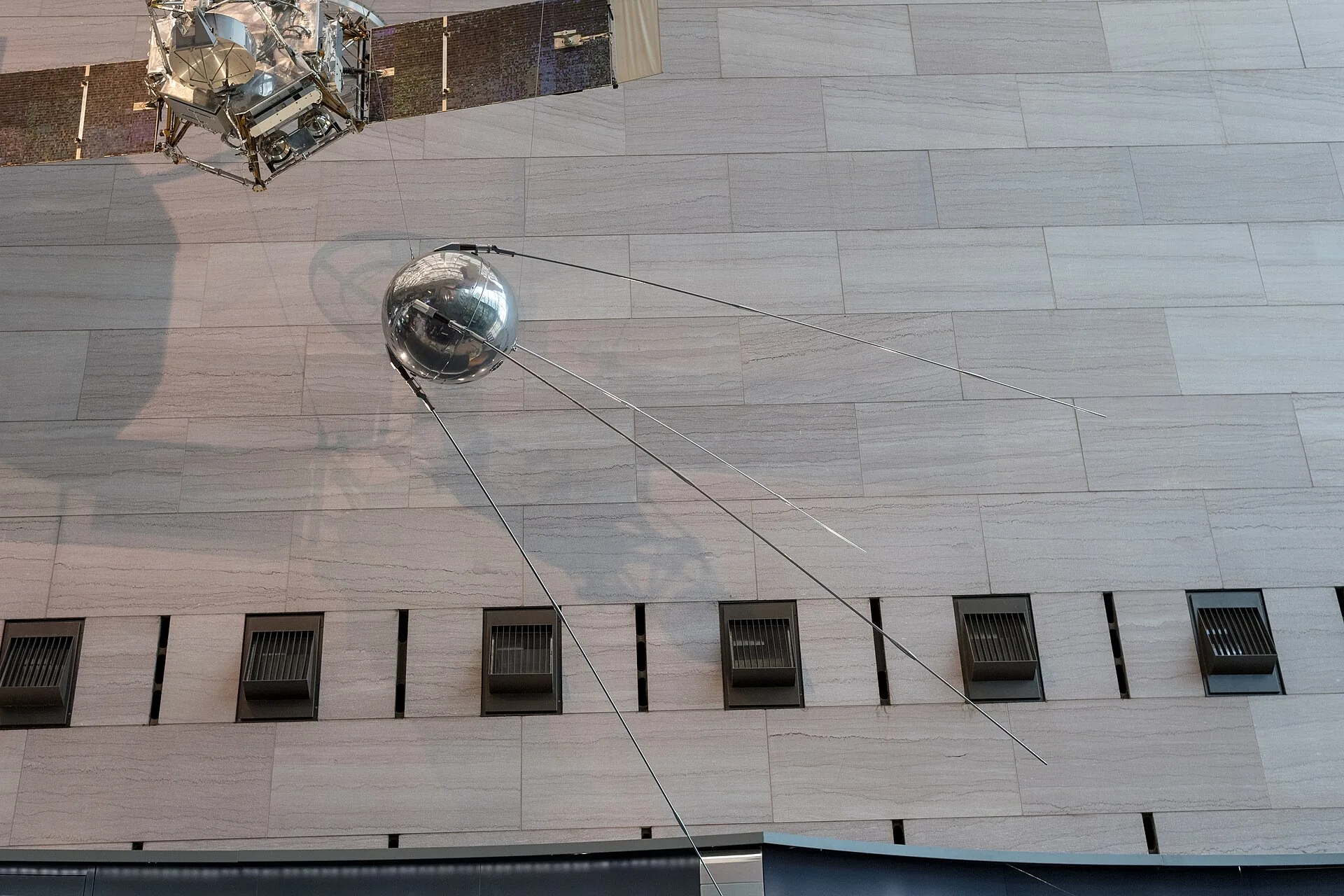
The moment in history
Moment
Sputnik 1 — first artificial satellite
The moment in history

Continue your journey
Moment
Sputnik 2 — first animal in orbit
Continue your journey
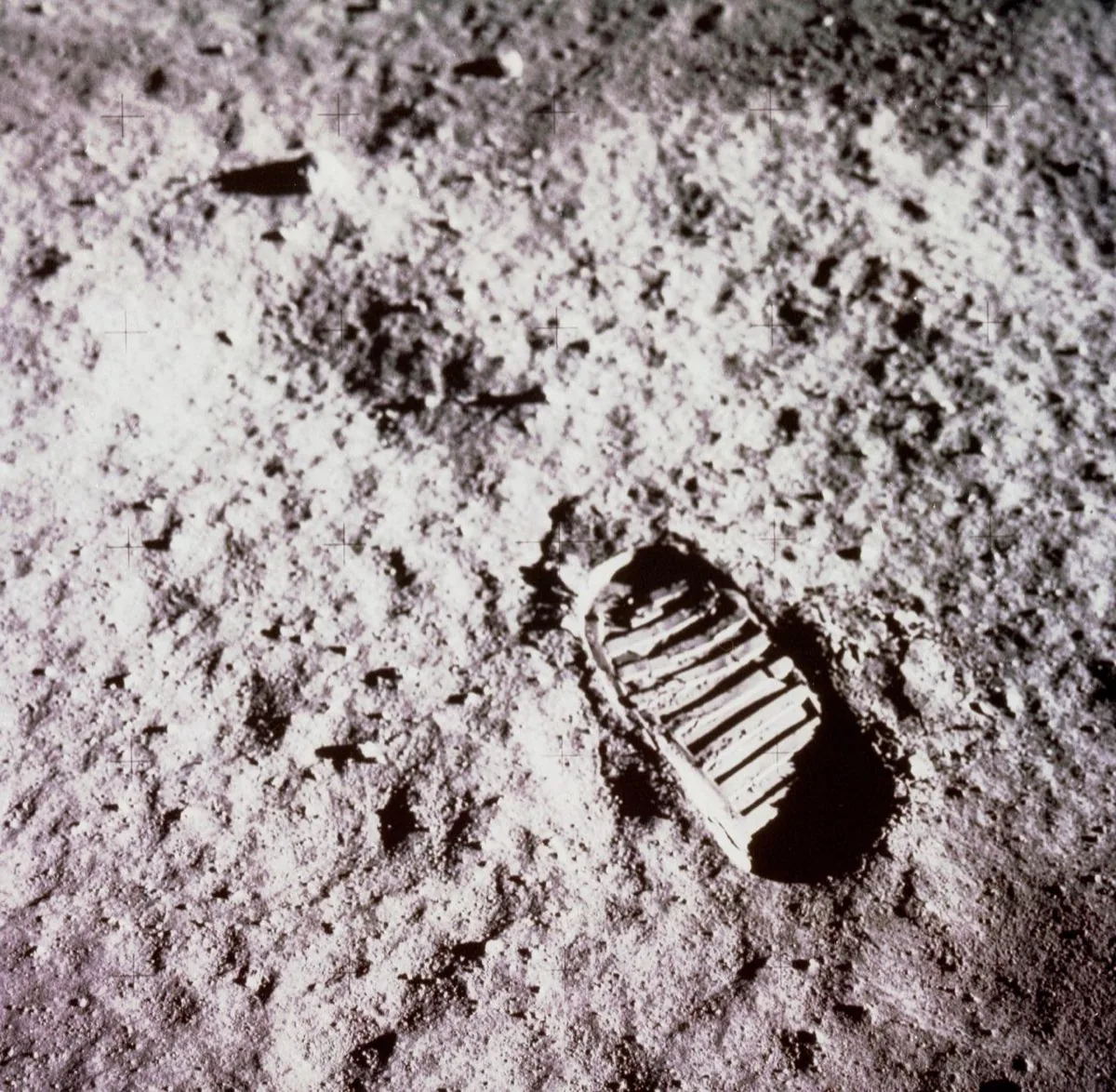
From the same era
Experience
Apollo 11
From the same era
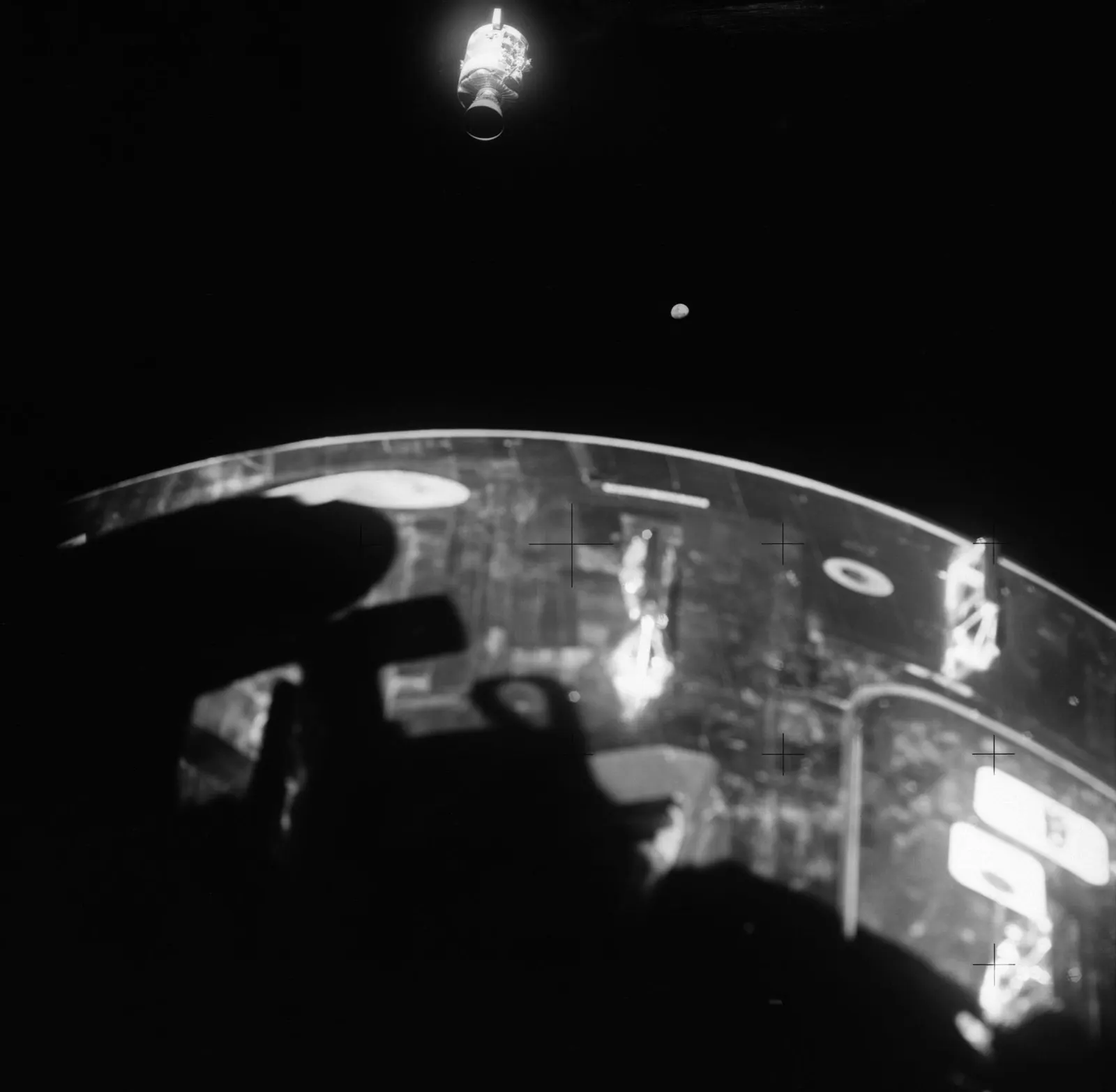
From the same era
Experience
Apollo 13
From the same era

Continue your journey
Moment
Explorer 1 — first US satellite, discovers Van Allen belts
Continue your journey

Continue your journey
Moment
Vostok 1 — Yuri Gagarin becomes the first human in space
Continue your journey