Time Machine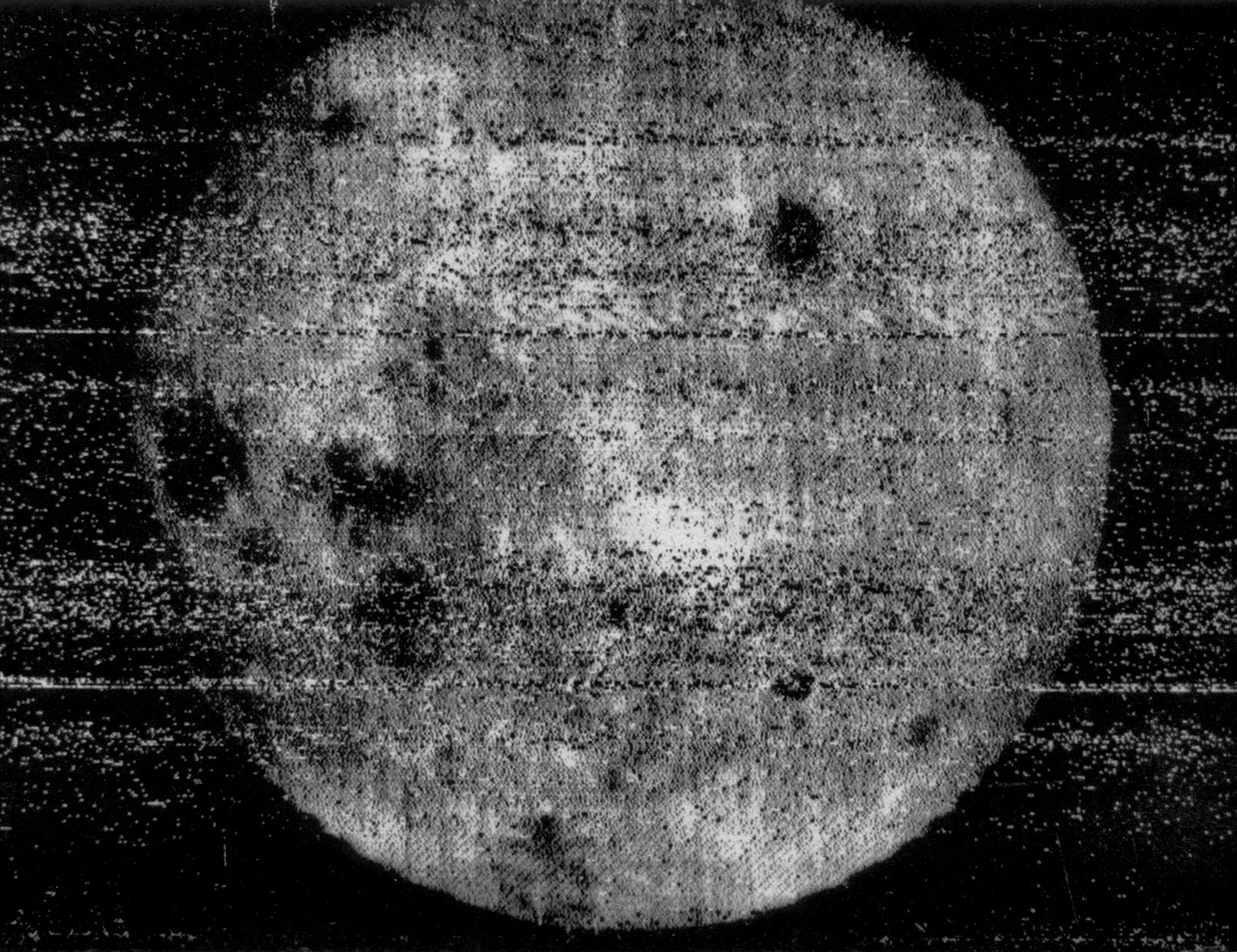
You have arrived · The Dawn
Luna 3
first images of the Moon's far side
October 7, 1959OKB-1
OKB-1 / USSR Academy of Sciences (public domain)
The world that day
2.9 billion
People on Earth
0
Nations to launch a human
0
Humans to walk on the Moon
0
Known worlds beyond the Sun
The Moon keeps one face turned forever away from Earth. Every human who had ever lived, every astronomer with every telescope, had seen only the same half. On 7 October 1959, a Soviet probe swung beyond the Moon, looked back at the hidden hemisphere lit by the Sun, and at 03:30 Universal Time began taking pictures. Over the next forty minutes, from roughly 63,500 kilometres away, Luna 3 exposed 29 frames of film across terrain no eye had ever seen.
What followed was one of the most audacious engineering feats of the decade. Luna 3 carried an automated darkroom: the 35-millimetre film was developed, fixed, and dried on board, then scanned line by line with a moving spot of light and radioed home like a fax sent across hundreds of thousands of kilometres. The probe used the Moon's own gravity to bend its trajectory back toward Earth for transmission, the first gravity assist ever flown. According to accounts from Soviet engineers, the radiation-resistant film itself had been salvaged from American Genetrix spy balloons downed over Soviet territory.
The pictures were grainy, noisy, almost abstract. They were also revolutionary. About seventeen usable frames reached Earth, covering some seventy percent of the far side, and they showed a world startlingly unlike the familiar face: a bright, battered highland landscape almost devoid of the dark lava seas that pattern the near side. Soviet scientists claimed the discoverer's naming rights, charting the Sea of Moscow and the dark-floored crater Tsiolkovsky. Launched on 4 October 1959, two years to the day after Sputnik 1, Luna 3 turned the Moon from a flat icon into a three-dimensional world.
By the numbers
- Launch
- 4 Oct 1959, Baikonur
- Mass
- 278.5 kg
- Photo session
- 7 Oct 1959, 29 frames in ~40 minutes
- Imaging distance
- ~63,500 km from the Moon
- Far-side coverage
- ~70%
- Usable images returned
- ~17
Why it mattered
Luna 3 gave humanity its first new view of the Moon in the species' entire history and revealed a genuine scientific puzzle: the two faces of the Moon are profoundly different, and the far side's missing maria remain an active research question more than six decades later. Technically, the mission pioneered both the gravity assist and the transmission of images across deep space, two techniques on which all planetary exploration since has depended. It also closed a devastating Soviet trifecta in 1959, impact, far-side photography, and propaganda, that pushed the United States toward the urgency culminating in Apollo.
- Luna 3 flew the first gravity assist in history, using the Moon's gravity to swing its path back toward Earth so it could radio its pictures home.
- It carried an automated darkroom that developed, fixed, and dried photographic film in space, then scanned each frame with a light beam like a fax machine.
- According to accounts from Soviet engineers, the hardened film stock was salvaged from American Genetrix reconnaissance balloons shot down over the USSR.
- The images revealed the far side has almost none of the dark maria covering a third of the near side, a hemispheric asymmetry scientists are still explaining today.
- It launched on 4 October 1959, exactly two years to the day after Sputnik 1 opened the Space Age.
Keep travelling
People also explored

From the same era
Moment
Explorer 1 — first US satellite, discovers Van Allen belts
From the same era

From the same era
Moment
Luna 2 — first lunar impact
From the same era

From the same era
Moment
Sputnik 5 — Belka and Strelka return safely from orbit
From the same era

From the same era
Moment
Vostok 1 — Yuri Gagarin becomes the first human in space
From the same era