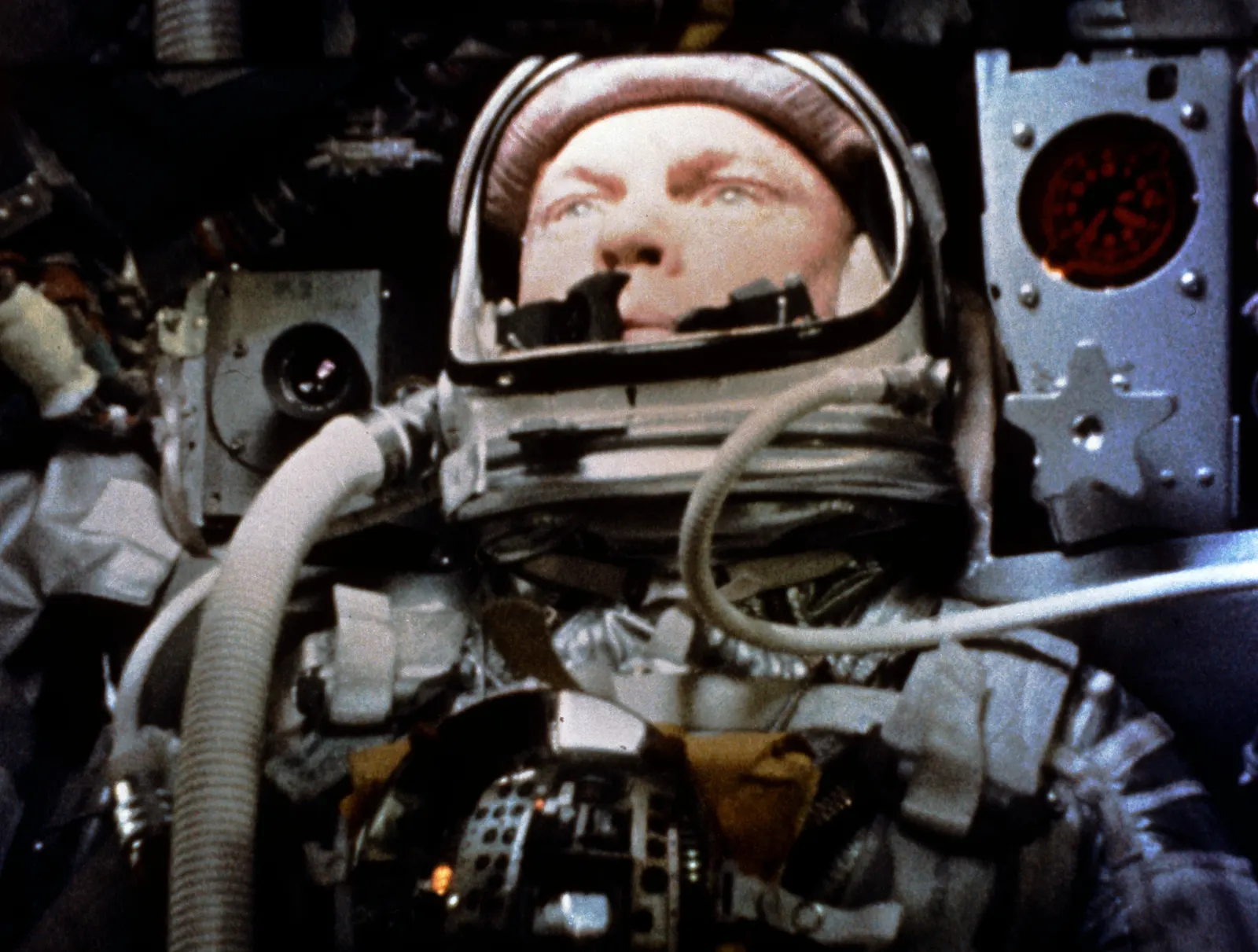
Before today, no American had circled the Earth. After today, one had.
Scroll to begin
NASA (public domain)
The world that day
3.1 billion
People on Earth
2
Nations to launch a human
0
Humans to walk on the Moon
0
Known worlds beyond the Sun
01 / 04
By 20 February 1962, the United States had waited a long time for this morning. The mission had been postponed again and again through the winter while two Soviet cosmonauts sat in the record books overhead. At 9:47 a.m., as John Glenn's Atlas booster lit beneath him at Cape Canaveral, backup pilot Scott Carpenter keyed his microphone and spoke a benediction into the loop: "Godspeed, John Glenn." Five minutes later the Marine combat veteran from New Concord, Ohio, was in orbit, the first American to circle the Earth.
02 / 04
Glenn's first report from orbit became famous on arrival: zero g, and he felt fine, and the view was tremendous. Crossing the Indian Ocean in darkness he spotted a glow ahead; the city of Perth, Australia had switched on its lights for him, earning its lasting nickname, the City of Light. At each orbital sunrise the capsule was engulfed by thousands of glowing specks Glenn called fireflies, a mystery later traced to ice crystals shed by the spacecraft. He ate applesauce from an aluminium tube, the first American meal in space, settling fears that swallowing might fail in weightlessness.
03 / 04
Then telemetry turned the flight tense. A sensor reading called Segment 51 suggested Friendship 7's heat shield and landing bag had come loose, which during reentry would mean incineration. Mission Control ordered Glenn to keep his spent retrorocket pack strapped on as a clamp over the shield. He flew home watching flaming chunks of the retropack streak past his window, unsure whether he was watching the pack burn or the shield, and reported afterward that it had been a real fireball. The sensor proved faulty; the shield had been secure all along.
04 / 04
After three orbits and 4 hours, 55 minutes, 23 seconds, Friendship 7 splashed down in the Atlantic about 800 miles southeast of Bermuda and was hoisted aboard the destroyer USS Noa. Glenn received one of the largest ticker-tape parades in New York's history. The capsule's name had been chosen by his two children. Thirty-six years later, at age 77, Glenn flew again aboard space shuttle Discovery, becoming the oldest person to orbit the Earth and bookending the American space age within a single lifetime.
“
Zero G and I feel fine. Capsule is turning around. Oh, that view is tremendous!
John H. Glenn Jr. · Mercury astronaut, radio transmission upon reaching orbit (NASA mission transcript)
By the numbers
Launch
20 Feb 1962, 9:47 a.m. EST, Cape Canaveral LC-14
Orbits
3
Duration
4 h 55 min 23 s
Orbit
100 × 162.2 statute miles (161 × 261 km)
Velocity
17,544 mph (28,234 km/h)
Recovery
USS Noa, ~800 mi SE of Bermuda
Why it mattered
Friendship 7 erased the most painful asymmetry of the early Space Race: at last an American had orbited the Earth, in the open, broadcast live, with the failures and the fixes visible to everyone. The flight validated the Mercury-Atlas system, demonstrated an astronaut's value when automation faltered, and produced in Glenn a national figure whose credibility carried NASA through the budget battles that built Apollo. The heat shield scare also taught Mission Control its defining discipline, real-time engineering judgment under uncertainty, which would later save Apollo 13. America's path to the Moon runs directly through these three orbits.
▸The people of Perth, Australia turned on their lights so Glenn could see the city from orbit in darkness, and it has been called the City of Light ever since.
▸Glenn flew his fiery reentry not knowing whether his heat shield was loose; the alarming Segment 51 reading turned out to be a faulty sensor switch.
▸The luminous 'fireflies' swarming the capsule at every orbital sunrise were a genuine mystery, later traced to ice crystals venting from the spacecraft.
▸Glenn squeezed applesauce from an aluminium tube to become the first American to eat in space, proving swallowing works in weightlessness.
▸His children chose the name Friendship 7, and in 1998, at age 77, Glenn returned to orbit aboard shuttle Discovery as the oldest person ever to fly in space.