Time Machine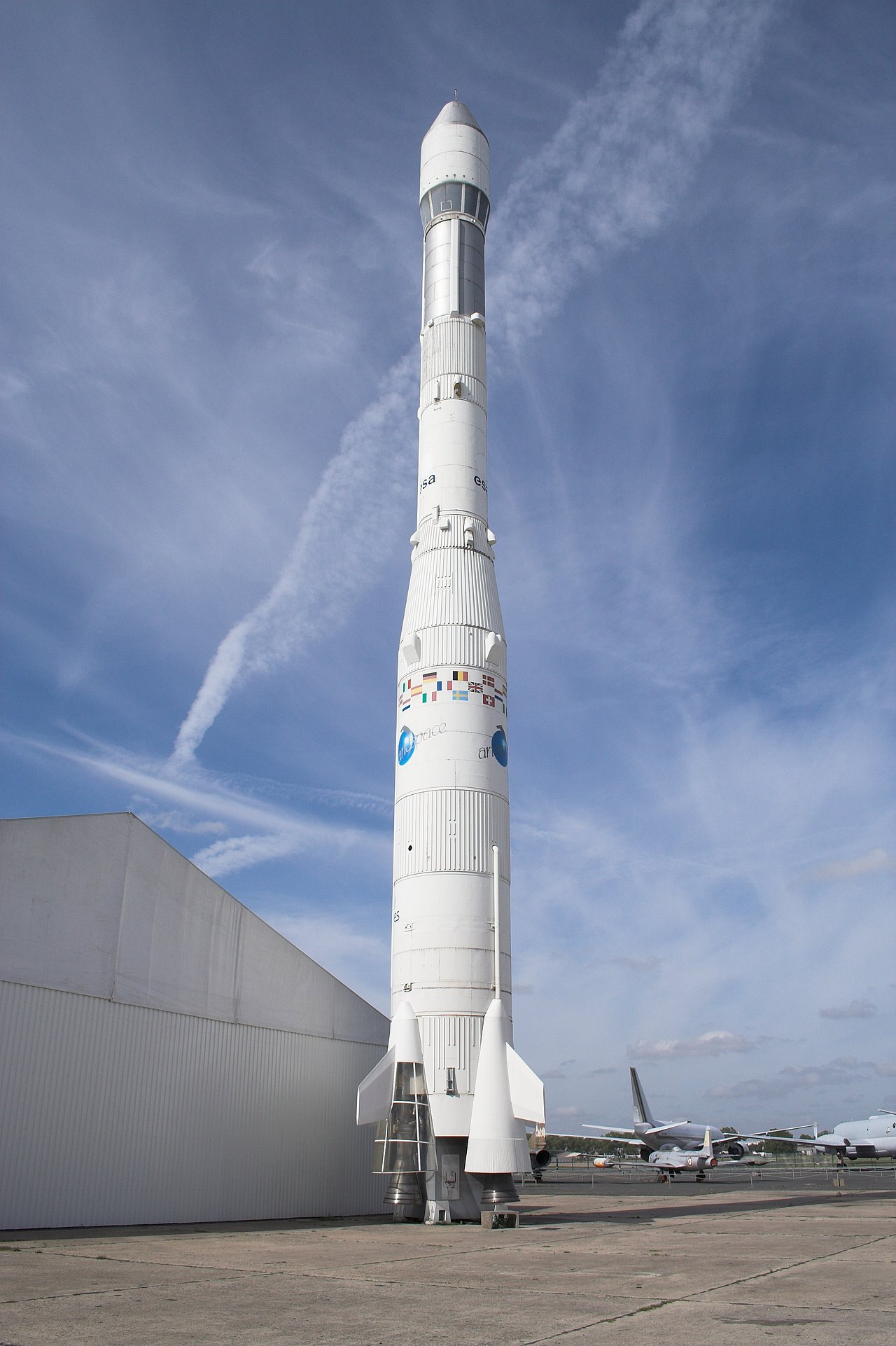
You have arrived · Outward Bound
Ariane 1
Europe's first independent launch vehicle
December 24, 1979ESA / Arianespace
Ignis / Wikimedia Commons (CC BY-SA 3.0)
The world that day
3.6 billion
People on Earth
2
Nations to launch a human
12
Humans to walk on the Moon
0
Known worlds beyond the Sun
On Christmas Eve 1979, at 14:14 local time, a slender white rocket climbed out of the South American rainforest at Kourou and carried Europe's independence to orbit with it. Nine days earlier the first attempt had ended in the cruellest way a countdown can: the engines ignited at zero, roared into life, and then went out with the rocket still on the pad. A second try was scrubbed by weather and small faults. On the third attempt Ariane L01 flew, and flew perfectly, placing its CAT-1 technology capsule into orbit and ending the American monopoly on the West's access to space.
Behind that launch lay a decade of European frustration. The continent's first joint rocket programme, Europa, had failed repeatedly through the 1960s and early 1970s and never produced an operational launcher, while reliance on US rockets came with conditions that chafed commercially and politically. In 1973 European governments approved a new launcher, led by France through the space agency CNES under the newly forming ESA. The result stood 47.4 metres tall and weighed 210 tonnes at liftoff, and its third stage burned cryogenic liquid hydrogen, a technology only the United States had flown before.
What followed turned a rocket into an industry. In 1980 Europe created Arianespace, the world's first commercial launch services company, to sell Ariane flights on the open market. Ariane 1 and its upgraded siblings, Ariane 2 and 3, flew 28 times between 1979 and 1989 and placed 38 satellites in orbit, and by the late 1980s the family had captured a major share of the world's commercial launches to geostationary orbit. An Ariane 1 also gave Europe its first deep-space mission, lofting the comet probe Giotto in July 1985. The line that began that Christmas Eve runs unbroken to Ariane 6 today.
By the numbers
- First launch
- 24 Dec 1979, 14:14 local, Kourou, French Guiana
- Height
- 47.4 m
- Liftoff mass
- 210 tonnes
- Payload to GTO
- 1.83 tonnes
- L01 payload
- CAT-1 technology capsule
- Ariane 1–3 record
- 28 launches, 38 satellites orbited (1979–1989)
Why it mattered
Ariane 1 transformed access to space from a two-superpower privilege into a competitive market. Born of Europe's frustration with failed joint rockets and restrictive American launch terms, it gave the continent guaranteed, sovereign access to orbit and then went further, creating through Arianespace the very concept of a commercial launch industry. The Ariane family went on to dominate commercial geostationary launches for decades, carrying much of the world's communications infrastructure to orbit and proving that launch vehicles could be a business as well as an instrument of state power, an idea every commercial launcher since has built upon.
- The first launch attempt on 15 December 1979 got as far as ignition: the engines roared to life at zero and then shut down with the rocket still clamped to the pad.
- Ariane 1's third stage burned cryogenic liquid hydrogen and oxygen, making Europe only the second spaceflight power after the United States to fly the technology.
- Success directly spawned Arianespace in 1980, the world's first commercial launch services company.
- Kourou's location near the equator gives launches an extra velocity boost from Earth's rotation, a geographic advantage that helped Ariane undercut competitors for geostationary missions.
- Europe's first deep-space probe, the Halley's Comet explorer Giotto, rode an Ariane 1 to space in July 1985.
Keep travelling
People also explored

From the same era
Moment
Voyager 2 launches — only spacecraft to visit Uranus and Neptune
From the same era

From the same era
Moment
Voyager 1 launched on grand tour
From the same era

From the same era
Moment
Rohini-1 — India joins the orbital-launch club
From the same era

From the same era
Moment
STS-1 Columbia — first Space Shuttle flight
From the same era