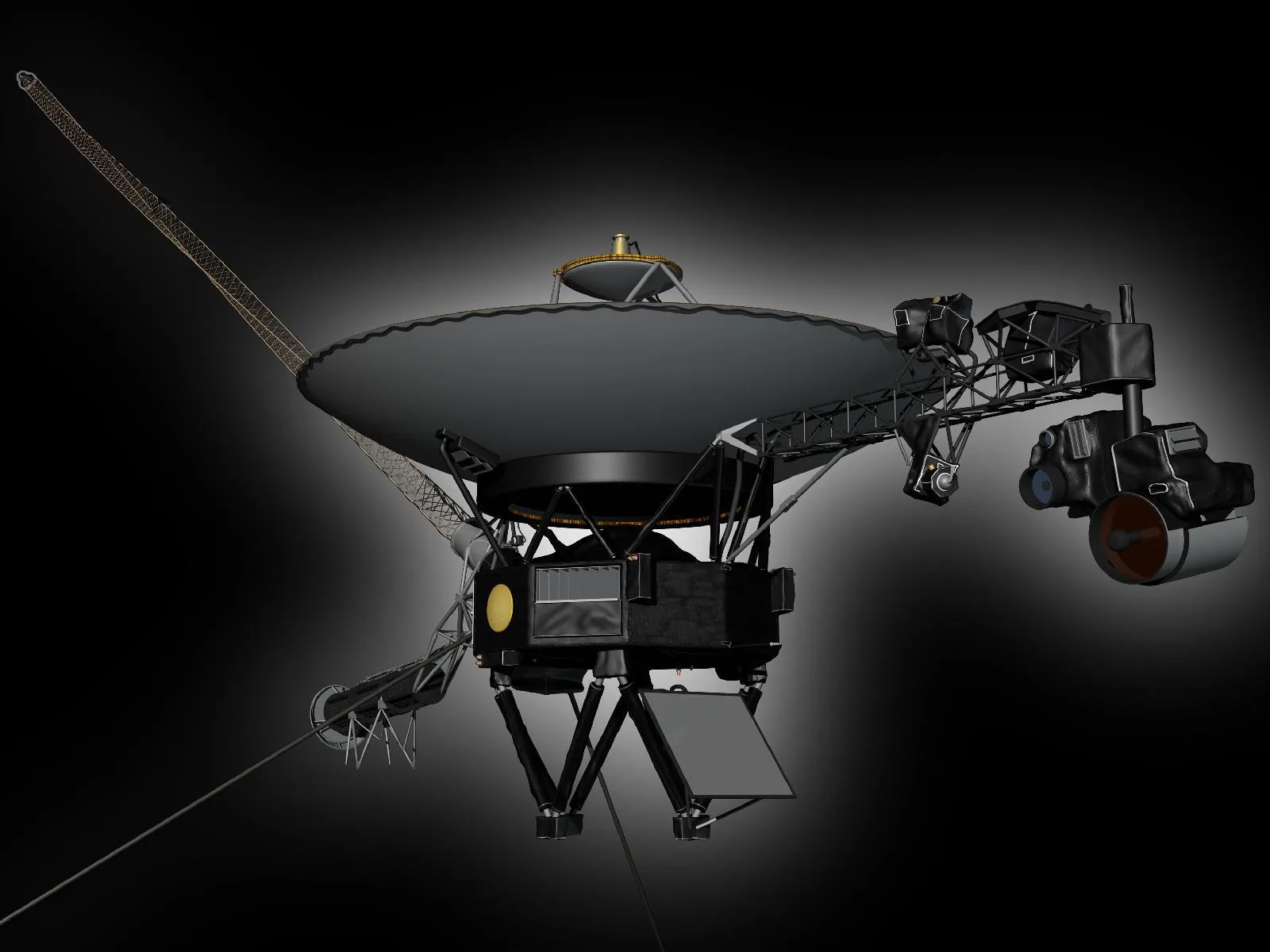
On 5 September 1977, sixteen days after its twin, Voyager 1 left Earth on a faster, shorter arc and never looked back. By mid-December it had overtaken Voyager 2, justifying its number, and in March 1979 it swept past Jupiter. There, in an overexposed navigation frame, engineer Linda Morabito noticed a faint crescent rising off the limb of the moon Io: a volcanic plume hundreds of kilometres high, the first active volcanoes ever seen beyond Earth. The discovery announced that the outer solar system was not a museum of frozen relics but a collection of violent, living worlds.
02 / 03
At Saturn on 12 November 1980, mission planners spent their spacecraft on a single moon. Voyager 1 dived close to haze-shrouded Titan, the only moon with a thick atmosphere, and the trajectory that bought the encounter flung it up and out of the plane of the planets, ending its planetary tour. The reward for that sacrifice came a decade later. On 14 February 1990, at Carl Sagan's urging, the cameras turned back one last time and photographed Earth from about six billion kilometres away: a pale blue dot, smaller than a single pixel, suspended in a scattered sunbeam.
03 / 03
On 25 August 2012 Voyager 1 crossed the heliopause and became the first human-made object in interstellar space. It was already the farthest, having passed Pioneer 10's distance in February 1998. By August 2024 it was 164.7 astronomical units from Earth, so remote that its radio signals, travelling at light speed, needed nearly a full day to arrive. Bolted to its side rides the Golden Record, a gold-plated copper disc carrying greetings in 55 languages, the sounds of Earth and ninety minutes of music, a message in a bottle cast into the galactic sea.
“
Look again at that dot. That's here. That's home. That's us.
Carl Sagan · Voyager imaging scientist, writing about Voyager 1's Pale Blue Dot image in his 1994 book of the same name
By the numbers
Launch
5 Sep 1977, Titan IIIE-Centaur, Cape Canaveral
Jupiter / Saturn flybys
5 Mar 1979 / 12 Nov 1980
Entered interstellar space
25 Aug 2012
Distance from Earth
164.7 AU (Aug 2024), farthest human-made object
One-way signal time
~23 hours (2024)
Spacecraft mass
722 kg
Why it mattered
Voyager 1 redefined the scale of human reach. Its Jupiter and Saturn encounters revolutionised understanding of moons as active worlds, its Titan data seeded decades of later exploration including Cassini-Huygens, and its 2012 heliopause crossing made it the first emissary of our species to interstellar space. As the most distant human-made object, still transmitting nearly fifty years after launch, it functions simultaneously as a working physics observatory in untouched space and as a cultural artifact, carrying the Golden Record outward as a deliberate message to deep time. Few single machines have so completely merged scientific achievement with collective human meaning.
▸It launched second but was named first, and duly overtook Voyager 2 in December 1977 on its faster trajectory.
▸Io's volcanoes, the first active volcanism seen beyond Earth, were spotted by navigation engineer Linda Morabito in an overexposed engineering image, not a science frame.
▸The close Titan flyby at Saturn deliberately bent Voyager 1 out of the plane of the planets, trading any further planetary encounters for a look at the one moon with a thick atmosphere.
▸The Pale Blue Dot image of 14 February 1990 caught Earth at less than a pixel in size, in one of the last photographs Voyager 1's cameras ever took.
▸Its Golden Record carries greetings in 55 languages, 90 minutes of music and the sounds of Earth, curated by a committee chaired by Carl Sagan.