Time Machine
You have arrived · The New Space Age
Tianwen-1 / Zhurong
first Chinese soft landing on Mars
May 15, 2021CNSA
CNSA / China News Service (CC BY 4.0)
The world that day
7.0 billion
People on Earth
3
Nations to launch a human
12
Humans to walk on the Moon
4,000
Known worlds beyond the Sun
In the early morning of 15 May 2021, Beijing time, the control hall at the Beijing Aerospace Control Center fell silent. Hundreds of millions of kilometres away, a capsule had separated from the Tianwen-1 orbiter and was falling toward Mars. Radio signals took roughly seventeen minutes to cross that gulf, so the entire descent, from atmospheric entry through parachute, retrorocket burn and a final hovering hazard scan, had already succeeded or failed before anyone on Earth could know. Nine minutes after entry, the landing legs of China's first Mars lander settled into the dust of southern Utopia Planitia.
No nation had ever attempted what China was attempting. The United States and Soviet Union built up to Mars landings across decades of separate orbiters and landers; Tianwen-1, launched on a Long March 5 from Wenchang on 23 July 2020, carried an orbiter, a lander and a rover on China's very first independent try. After entering Mars orbit in February 2021, the spacecraft spent three patient months photographing the landing zone before committing. On 22 May the 240-kilogram, solar-powered Zhurong rover, named for an ancient god of fire, rolled down its ramps onto the rust-coloured plain.
Zhurong was designed for ninety Martian days. It worked for 358, driving 1,921 metres south toward what some scientists interpret as the shoreline of an ancient northern ocean, and returning data that pointed to surprisingly recent water activity in Utopia Planitia. It even dropped a small wireless camera onto the soil, backed away, and posed beside its landing platform for a group portrait. In May 2022, with winter closing in and dust storms rising, the rover put itself to sleep. It was due to wake in December. It never did; dust on its solar panels had sealed its fate.
By the numbers
- Launch
- 23 Jul 2020 (Long March 5, Wenchang)
- Mars landing
- 15 May 2021, Utopia Planitia
- Rover mass
- 240 kg
- Design life
- 90 sols
- Surface operations
- 358 days
- Distance driven
- 1,921 m
Why it mattered
Zhurong made China only the second nation to operate a rover on the Martian surface, and the only one to succeed with an orbiter, lander and rover on its first independent attempt. It ended an era in which the United States alone sustained long-lived machines on the Martian ground, validated CNSA's deep-space navigation, autonomous landing and relay infrastructure in a single stroke, and set the stage for China's planned Tianwen-3 Mars sample return. After 15 May 2021, Mars surface exploration was no longer a one-nation enterprise.
- China is the only country to have succeeded with an orbiter, a lander and a rover in a single first attempt at Mars; NASA needed decades of separate missions to assemble the same feats.
- Zhurong is named for the god of fire in Chinese mythology, a nod to Mars's Chinese name Huoxing, 'the fire star'.
- The rover dropped a detachable wireless camera on the soil, reversed several metres, and took a colour 'family portrait' of itself standing beside the landing platform.
- By its first anniversary the mission had returned about 940 gigabytes of data, and the rover had outlived its 90-sol design life nearly fourfold.
- NASA's Mars Reconnaissance Orbiter later photographed Zhurong motionless and dust-darkened in the same spot for months, the quiet end of a hibernation it never woke from.
Keep travelling
People also explored
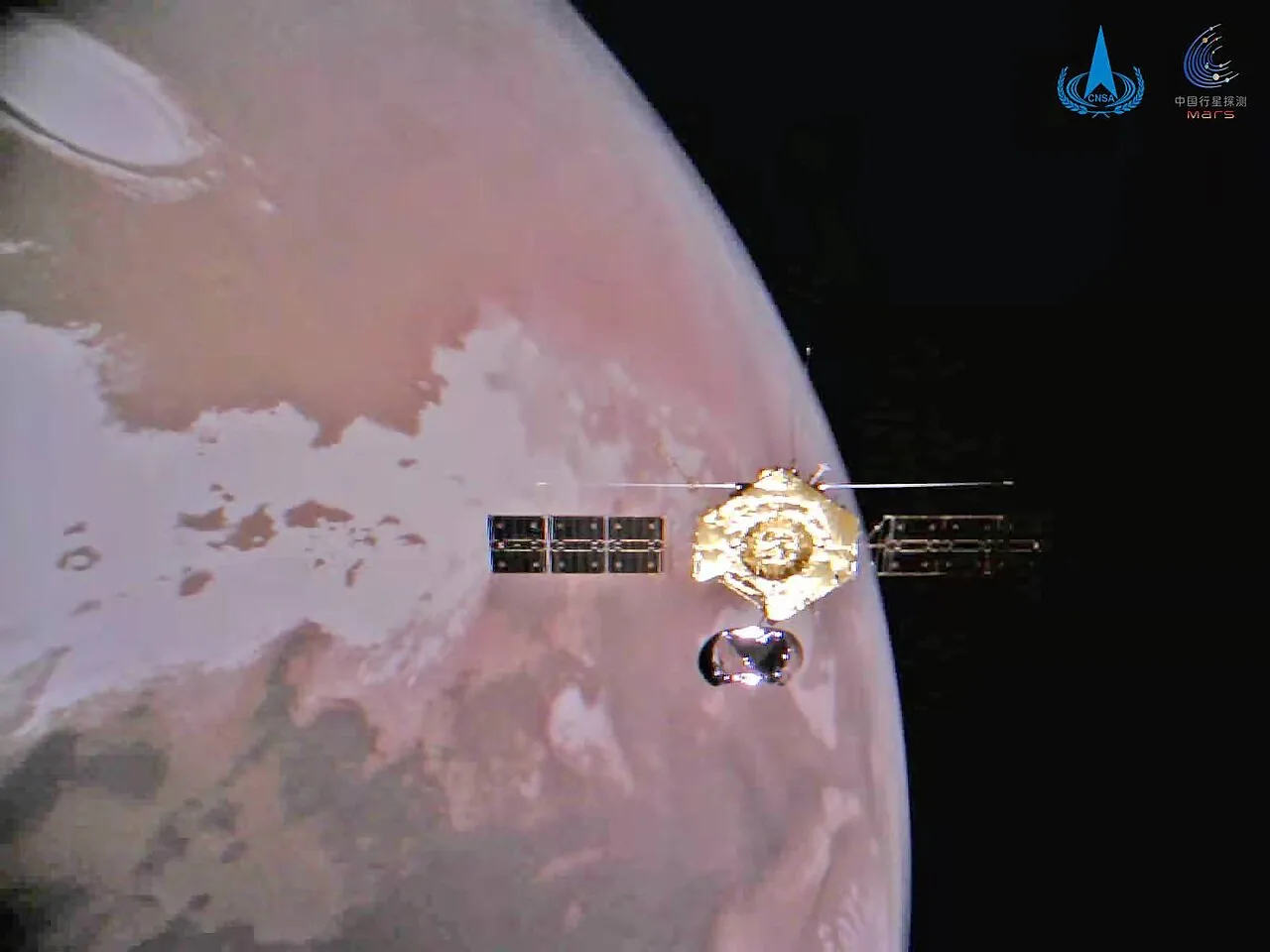
The mission behind this moment
Mission
Tianwen-1
The mission behind this moment

From the same era
Moment
Ingenuity — first powered flight on another planet
From the same era

From the same era
Moment
Tianhe — Tiangong space station core module launched
From the same era
From the same era
Moment
James Webb Space Telescope releases first science images
From the same era

From the same era
Moment
Nuri / KSLV-II — South Korea's first indigenous orbital launch
From the same era