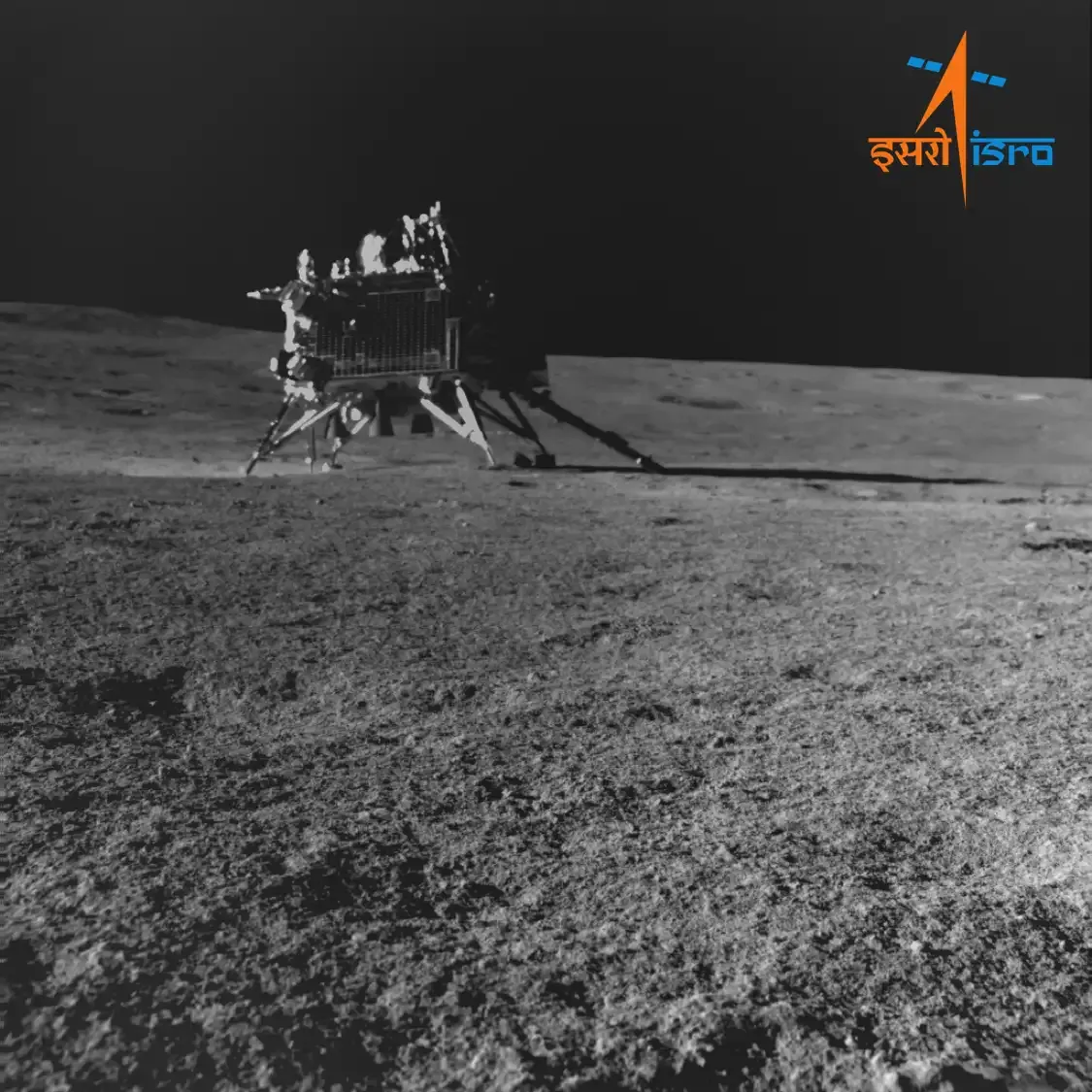
In the final minutes before touchdown at 6:04 p.m. India time on 23 August 2023, more than eight million people were watching a single YouTube stream, the largest live audience the platform had ever recorded. In mission control at Bengaluru, engineers who had watched Chandrayaan-2's lander crash four years earlier now followed Vikram's descent toward terrain no spacecraft had ever survived: the cratered, deep-shadowed country at 69 degrees south. The velocity readouts fell, gently, all the way to zero. Cheers tore through the room, and Prime Minister Narendra Modi, watching by video link from the BRICS summit in Johannesburg, waved the Indian tricolour.
02 / 03
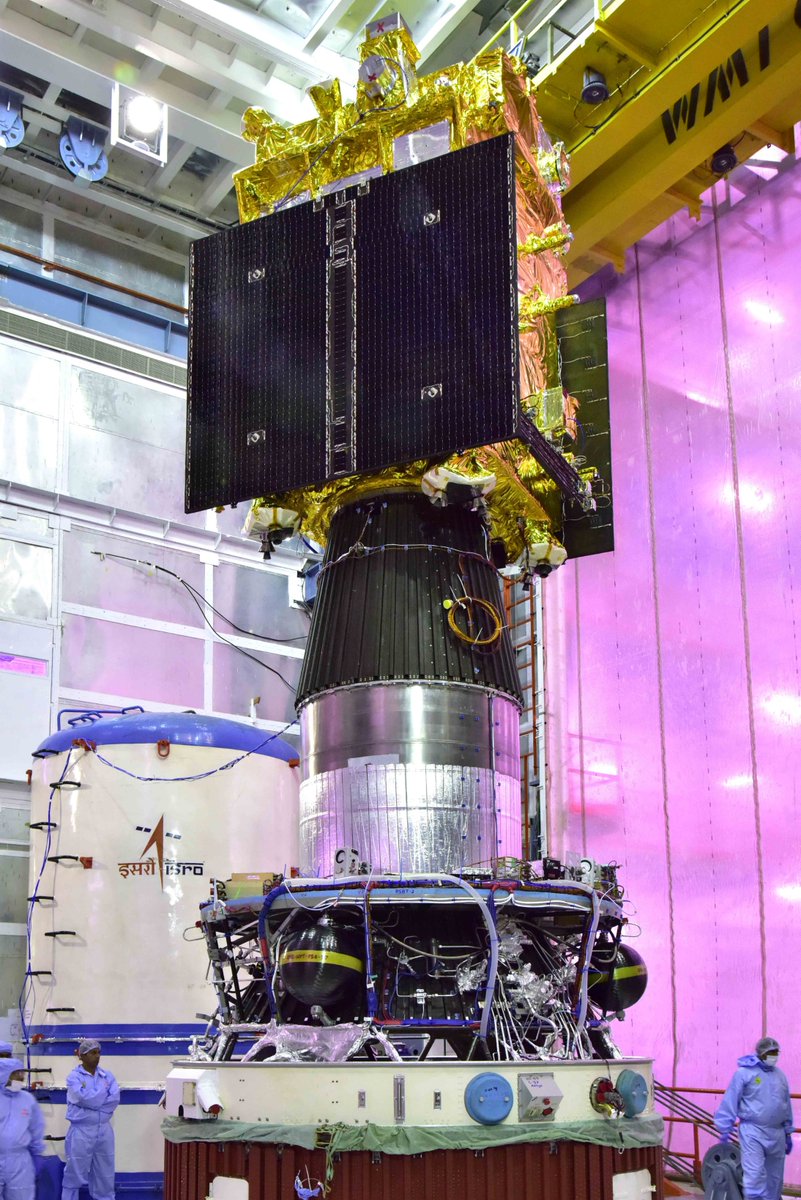
The triumph was engineered out of grief. After the 2019 failure, ISRO rebuilt the mission around what chairman S. Somanath called a failure-based design, strengthening the lander's legs, widening the landing zone and adding margin so Vikram could land safely even if sensors or an engine misbehaved. Launched on 14 July 2023 aboard an LVM3 rocket from Sriharikota, the spacecraft took a slow, fuel-efficient route, looping through ever-larger Earth orbits before sliding into lunar orbit on 5 August. The entire mission cost about 615 crore rupees, roughly 75 million US dollars, less than many Hollywood films.
03 / 03
For one lunar day, the landing site, since named Statio Shiv Shakti, became India's laboratory. The 26-kilogram Pragyan rover rolled down the ramp and made the first on-the-spot measurement of sulfur in the soil near the lunar south pole, while Vikram's thermal probe recorded how sharply temperatures change within centimetres of the surface. Before the lunar night fell, Vikram fired its engines one last time and hopped, rising about 40 centimetres and setting down a short distance away, a tiny rehearsal for the sample-return missions India now plans. Neither machine woke from the two-week polar night, but their work was complete.
“
We have achieved soft landing on the Moon. India is on the Moon.
S. Somanath · Chairman, ISRO
By the numbers
Launch
14 Jul 2023 (LVM3 M4, Sriharikota)
Landing
23 Aug 2023, 18:04 IST
Landing site
69.37° S — Statio Shiv Shakti
Stack mass
3,900 kg (lander 1,752 kg)
Rover mass
26 kg (Pragyan)
Mission cost
₹615 crore (~US$75 million)
Why it mattered
Chandrayaan-3 made India the fourth nation to soft-land on the Moon and the first to do so in the south polar region, where permanently shadowed craters may hold the water ice on which future lunar bases depend. It proved that frontier-class exploration could be done at start-up prices, reshaping assumptions about the economics of deep space. At home it electrified a generation, and the landing gave ISRO the confidence and political backing for the Gaganyaan human spaceflight programme and the Chandrayaan-4 sample-return mission.
▸The landing's live stream peaked at 8.06 million concurrent viewers, the most-watched live stream in YouTube history.
▸Total mission cost was about US$75 million, famously less than the production budget of the film Interstellar.
▸Pragyan's laser spectroscope made the first in-situ detection of sulfur near the lunar south pole, chemistry no orbiter could have confirmed remotely.
▸Ten days after landing, Vikram flew again, hopping about 40 centimetres upward in a test ISRO called a 'kick-start' for future sample-return and human missions.
▸The touchdown point is now formally Statio Shiv Shakti, a name approved by the International Astronomical Union in March 2024, and 23 August is India's National Space Day.