Time Machine
You have arrived · The New Space Age
Shenzhou 21 launches crew to Tiangong
October 31, 2025CNSA / CMSA
China News Service (中国新闻社), CC BY 4.0, via Wikimedia Commons
The world that day
8.1 billion
People on Earth
3
Nations to launch a human
12
Humans to walk on the Moon
5,500
Known worlds beyond the Sun
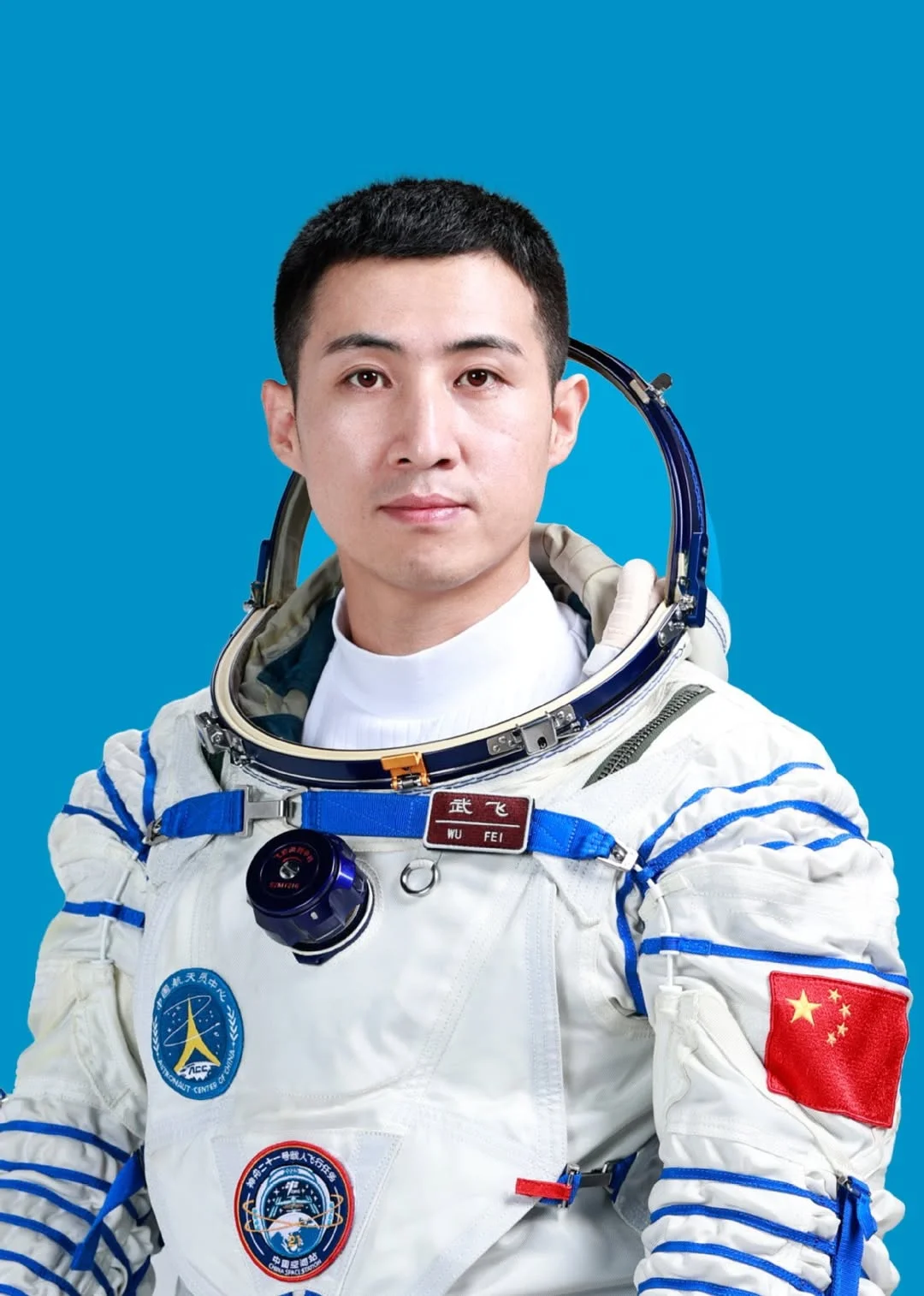
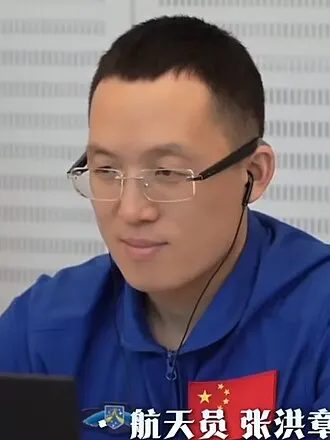
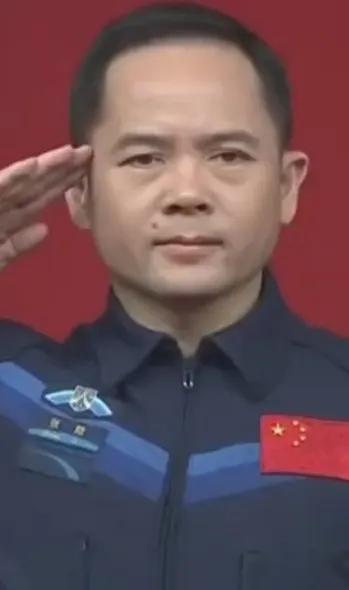
The Jiuquan Satellite Launch Center sits deep in the Gobi Desert, and at 11:44 p.m. on 31 October 2025 its floodlit pad turned night into noon. A Long March 2F climbed away carrying commander Zhang Lu, a veteran of Shenzhou 15, and two rookies: flight engineer Wu Fei, who at 32 became the youngest Chinese astronaut ever to fly, and payload specialist Zhang Hongzhang, a researcher from the Dalian Institute of Chemical Physics. Sharing their ride were four mice, two male and two female, the first mammal research subjects China had ever sent to orbit.
The spacecraft then did something no crewed Shenzhou had done. Instead of the usual six-and-a-half-hour chase, it executed a fast autonomous rendezvous and docked with Tiangong's Tianhe core module just three and a half hours after liftoff, at 3:22 a.m. Beijing time, the quickest docking in Shenzhou history. It was the 37th flight of China's human spaceflight program, and the crew settled in for a six-month expedition built around 27 new experiments spanning life science, space medicine, materials, fluid physics, and combustion.
Nobody aboard could know their spacecraft was about to become famous for a different reason. On 5 November, hours before the outgoing Shenzhou 20 crew was due to fly home, inspections revealed fine cracks in that capsule's window, the suspected work of orbital debris. Mission managers ruled the ship unsafe for reentry. On 14 November the Shenzhou 20 crew came home instead aboard the brand-new Shenzhou 21 capsule, the first time Chinese astronauts had ever landed in a different spacecraft than the one they launched in. Zhang Lu's crew stayed in orbit, temporarily without a lifeboat of their own.
The expedition stretched far past its plan. When the trio finally landed on 29 May 2026, riding the replacement Shenzhou 22 capsule to the Dongfeng landing site, they had logged 210 days in space, the longest single mission in Chinese history. A flight that began as routine crew rotation ended up touching three different spacecraft and proving that China's station program could absorb its first genuine in-orbit emergency.
By the numbers
- Launch
- 31 Oct 2025, 15:44 UTC (23:44 Beijing)
- Rocket
- Long March 2F
- Launch site
- Jiuquan Satellite Launch Center
- Docking
- 3.5 hours after liftoff — fastest in Shenzhou history
- Crew
- 3 astronauts (plus 4 mice)
- Eventual mission length
- 210 days — Chinese record
Why it mattered
Shenzhou 21 began as China's most routine kind of mission and ended as the stress test that proved the station program's depth. Its record 3.5-hour docking showed operational confidence, its capsule's reassignment as a rescue vehicle showed architectural flexibility, and its crew's record 210-day stay showed human resilience. The mission demonstrated that Tiangong's rotation system could bend through a debris emergency without breaking, a credential no number of nominal flights could have provided.
- Flight engineer Wu Fei, aged 32, became the youngest Chinese astronaut ever to fly.
- Four mice, two male and two female, rode up with the crew for China's first mammal experiments in orbit, on a planned stay of five to seven days.
- The 3.5-hour rendezvous nearly halved the previous 6.5-hour standard, the fastest docking ever achieved in the history of Shenzhou missions.
- The capsule the crew rode uphill became someone else's ride home: the Shenzhou 20 crew landed in it on 14 November after debris cracked their own spacecraft's window.
- Zhang Lu's crew ultimately spent a record 210 days in space and came home in a third spacecraft, Shenzhou 22.
Keep travelling

People also explored
Flew on this mission
Astronaut
Wu Fei
Flew on this mission
Flew on this mission
Astronaut
Zhang Hongzhang
Flew on this mission
The mission behind this moment
Mission
Shenzhou 21
The mission behind this moment

From the same era
Moment
SpaceX Crew-11 launches to the ISS
From the same era

From the same era
Moment
Starship Flight 10 — first fully successful mission
From the same era
Flew on this mission
Astronaut
Zhang Lu
Flew on this mission