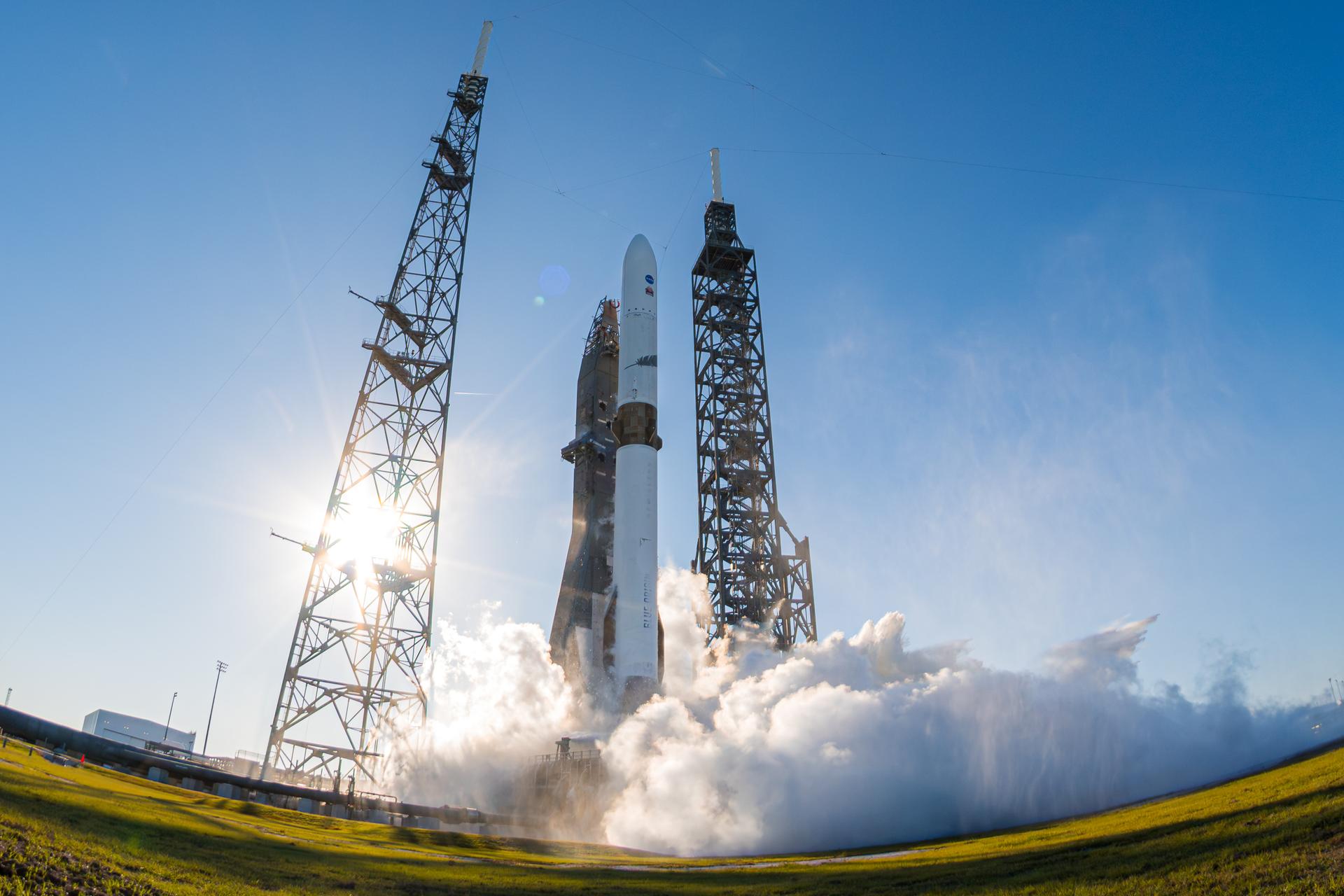
New Glenn NG-2 sends ESCAPADE to Mars and lands the booster
November 13, 2025Blue Origin / NASA
Scroll to begin
Senior Airman Samuel Becker / U.S. Space Force, public domain, via Wikimedia Commons
The world that day
8.1 billion
People on Earth
3
Nations to launch a human
12
Humans to walk on the Moon
5,500
Known worlds beyond the Sun
01 / 04
Launch Complex 36 at Cape Canaveral had seen one New Glenn fly before, in January 2025, and that booster died in a failed descent over the Atlantic. So when the second New Glenn rose at 3:55 p.m. Eastern on 13 November 2025, Blue Origin had given its first stage a defiant name borrowed from Han Solo: Never Tell Me The Odds. Riding on top were NASA's two smallest Mars orbiters, the twin ESCAPADE probes, the agency's first interplanetary payload entrusted to Jeff Bezos's rocket.
02 / 04
Nine minutes and fifteen seconds after liftoff, the giant first stage descended toward the deck of Jacklyn, a landing ship named for Bezos's mother stationed about 620 miles downrange in the Atlantic, and settled onto it intact. Cheers in the control room turned to something closer to disbelief. No organization other than SpaceX had ever recovered an orbital-class booster, and Blue Origin had done it on the rocket's second flight. The upper stage pressed on, performed a second burn, and released ESCAPADE's twins about 33 minutes after launch, thirty seconds apart.
03 / 04
The probes themselves are an experiment in doing Mars on the cheap. Named Blue and Gold for the colors of UC Berkeley, whose Space Sciences Laboratory leads the mission under planetary scientist Rob Lillis, they were built by Rocket Lab for a mission cost of roughly 75 million dollars, a fraction of any previous Mars orbiter. Launched outside a traditional Mars window, they will loiter for a year near the Earth-Sun L2 point, swing past Earth in late 2026, and reach Mars in September 2027 to map how the solar wind strips away the planet's atmosphere.
04 / 04
A Viasat communications demonstration for NASA's Communications Services Project rounded out the manifest, but the night belonged to the booster standing upright on Jacklyn's deck. Almost exactly a decade after SpaceX's first Falcon 9 landing, reusable orbital rocketry finally had a second practitioner, and NASA's bet that commercial heavy lifters could carry science toward other planets had paid off in front of a live audience.
“
Never before in history has a booster this large nailed the landing on the second try.
Dave Limp · CEO, Blue Origin
By the numbers
Launch
13 Nov 2025, 3:55 p.m. EST
Launch site
Launch Complex 36, Cape Canaveral
Booster landing
T+9 min 15 s, ship Jacklyn, ~620 mi downrange
Payload
ESCAPADE twins "Blue" & "Gold" + Viasat demo
ESCAPADE mission cost
≈$75 million
Mars arrival
Sept 2027
Why it mattered
NG-2 broke a decade-long monopoly: until this flight, only SpaceX had ever recovered an orbital-class booster. Landing on the second attempt validated New Glenn as a serious heavy-lift competitor and gave NASA confidence in commercial rockets for planetary science. ESCAPADE itself reset cost expectations, sending twin orbiters toward Mars for tens of millions rather than the hundreds of millions of past missions, and its L2-loiter trajectory showed that Mars science no longer has to wait obediently for biennial launch windows.
▸Blue Origin named the booster Never Tell Me The Odds, a Han Solo line chosen after the first New Glenn booster was lost during descent in January 2025.
▸The landing ship Jacklyn is named after Jeff Bezos's mother.
▸ESCAPADE's twin orbiters are named Blue and Gold for UC Berkeley's school colors; Rocket Lab built both spacecraft for a mission costing roughly $75 million, a fraction of past Mars orbiters.
▸Launched outside a conventional Mars window, the probes take the scenic route: a year loitering near the Earth-Sun L2 point, an Earth swing-by in late 2026, then Mars in September 2027.
▸ESCAPADE had been bumped from New Glenn's debut flight in 2024 over schedule risk; the wait put it on the flight that made booster-recovery history.