Dimorphos
The asteroid moonlet NASA's DART deliberately slammed into in 2022 — the first test of planetary defence.
- Type
- Near-Earth asteroid moonlet
- Diameter
- ≈170 m
- Rotation
- ≈11.4 h (post-impact)
- Orbit
- Moonlet of Didymos · 1.18 AU
- Discovered
- 2003
- Visited by
- DART (2022) · Hera (2026)
DART's impact shortened its orbit around Didymos by 32 minutes — humanity's first deliberate change to a celestial body's motion.
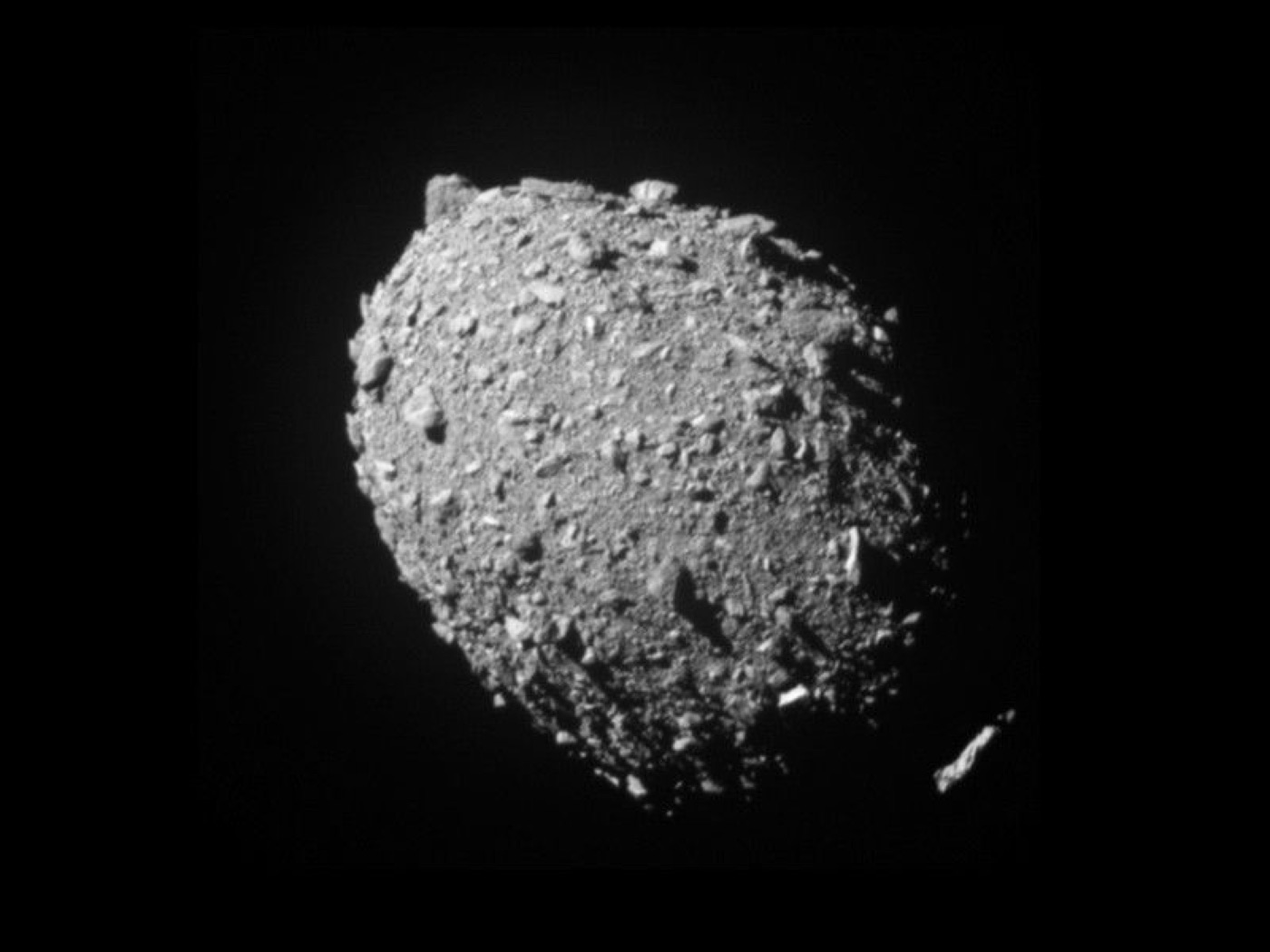
Dimorphos was glimpsed only in the final minutes before DART struck it in 2022. This shape is reconstructed from those last approach images; ESA's Hera mission will map it properly from late 2026.
Can you see it?
Spacecraft onlyInvisible to any amateur gear — a 170 m rock orbiting a 780 m asteroid. We know it only because NASA’s DART flew there and hit it.
- What you need
- No telescope you can buy will ever show it; it is far beyond amateur reach.
Up close
Dimorphos is a ~170 m boulder-strewn rubble pile orbiting the larger asteroid Didymos. DART's impact didn't just nudge it — it reshaped the little moon from a rounded form toward a flattened oval and resurfaced it.
Its orbit around Didymos was shortened from 11 hours 55 minutes to 11 hours 23 minutes — a 32-minute change, measured from Earth.
Discovery & exploration
Didymos was found in 1996; its moonlet was detected in 2003 and named Dimorphos ('having two forms') in 2020 — anticipating that it would be seen both before and after being reshaped.
NASA's DART slammed into Dimorphos on 26 September 2022 at ~24,000 km/h — the first-ever planetary-defence kinetic-impact test. ESA's Hera, launched in 2024, arrives in late 2026 for a detailed survey of the aftermath.
Did you know?
- DART was humanity's first deliberate change to the motion of a celestial body — planetary defence proven in practice.
- The orbit change beat the mission’s minimum success bar by about 25 times.
- The impact flung out over a million kilograms of debris and grew a comet-like dust tail thousands of kilometres long.
Sources: NASA — DART result · Wikipedia — Dimorphos