Ranked by years of continuous operation through May 2026, Voyager 2 leads at ~48.6 years (launched August 1977 and still returning data from interstellar space), Voyager 1 is second at ~48.5 years, Pioneer 6 (a Sun-monitoring probe) operated for ~30 years until contact ended in 2000, and Mars Odyssey is the longest-running planetary orbiter at ~24.6 years. The full top 10 below mixes still-active spacecraft and recently retired missions — every one of them flew for at least 14 years past launch.
Comparison Summary Table
| Rank | Mission | Operator | Launched | Status (May 2026) | Years of Operation |
|---|---|---|---|---|---|
| 1 | Voyager 2 | NASA | Aug 1977 | Active (interstellar) | ~48.6 |
| 2 | Voyager 1 | NASA | Sep 1977 | Active (interstellar) | ~48.5 |
| 3 | International Space Station (continuous human occupation) | NASA / Roscosmos / ESA / JAXA / CSA | Nov 2000 (first crew) | Active | ~25.5 |
| 4 | Mars Odyssey | NASA | Apr 2001 | Active | ~25.0 |
| 5 | Mars Reconnaissance Orbiter (MRO) | NASA | Aug 2005 | Active | ~20.7 |
| 6 | Cassini–Huygens | NASA / ESA / ASI | Oct 1997 | Ended Sept 2017 | 19.9 (operations) |
| 7 | Hubble Space Telescope | NASA / ESA | Apr 1990 | Active | ~36.0 |
| 8 | New Horizons | NASA | Jan 2006 | Active | ~20.3 |
| 9 | Pioneer 10 | NASA | Mar 1972 | Last contact Jan 2003 | ~30.8 |
| 10 | Opportunity (MER-B) | NASA | Jul 2003 | Ended Feb 2019 | ~14.5 (surface ops vs. 90 sol design) |
Mission length is measured from launch to last operational contact, except for ISS which is measured from continuous human occupation (Expedition 1 docking, 2 November 2000). Hubble is included despite not being the longest because it is the longest-operating space telescope by a wide margin.
1. Voyager 2 — Launched August 20, 1977
Years of operation: ~48.6 (still active in interstellar space).
Voyager 2 is the only spacecraft to have flown past all four giant planets — Jupiter (1979), Saturn (1981), Uranus (1986), and Neptune (1989) — using a once-in-176-years planetary alignment. It crossed the heliopause into interstellar space in November 2018 and is currently more than 130 AU from the Sun, returning low-bandwidth data on cosmic-ray flux and plasma waves.
The spacecraft's three radioisotope thermoelectric generators (RTGs) lose roughly four watts of output per year. NASA's Voyager team has progressively powered down instruments since the 1990s to keep the bus alive. As of 2026, four science instruments are still returning data, with end of mission projected around 2030.
NASA's Voyager Mission Status page tracks signal latency (currently about 19 hours one-way) and instrument health in near-real-time. (NASA Voyager)
2. Voyager 1 — Launched September 5, 1977
Years of operation: ~48.5 (still active in interstellar space).
Voyager 1 launched 16 days after Voyager 2 on a faster trajectory, allowing it to reach Jupiter (1979) and Saturn (1980) before its twin. After a close flyby of Saturn's moon Titan, Voyager 1 was deflected northward out of the ecliptic plane, ending its planetary tour. It became the first human-made object to enter interstellar space (heliopause crossing in August 2012) and is now more than 165 AU from the Sun — the most distant artifact humans have ever produced.
In 2024, Voyager 1 suffered a serious flight data system fault that required the JPL team to remotely repair memory on a 47-year-old computer. The fix worked. As of 2026 the spacecraft is again returning science data.
The Pale Blue Dot photo (1990, taken at ~6 billion km from Earth) and the Golden Record carry Voyager 1's cultural legacy. (NASA Voyager 1 Status)
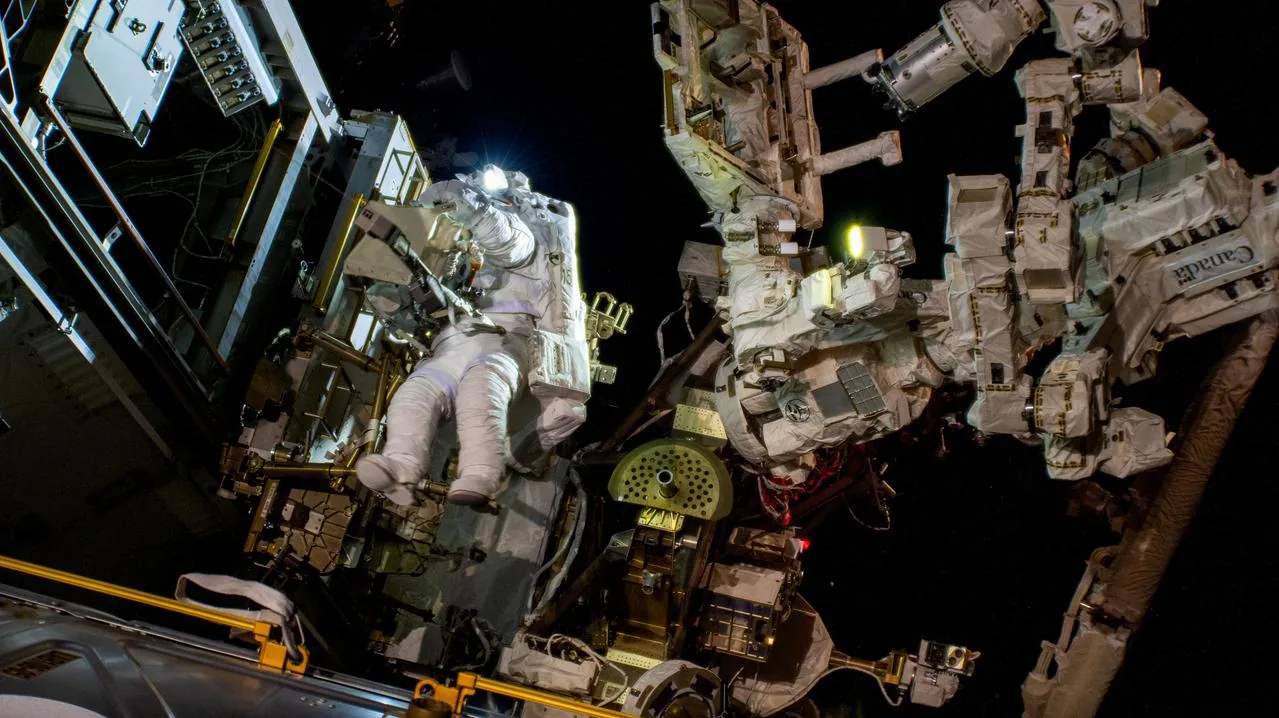
3. International Space Station (Continuous Human Occupation)
Years of operation: ~25.5 (continuously crewed since Nov 2, 2000).
The first ISS module (Russian Zarya) launched November 1998. Expedition 1 docked November 2, 2000 — the day humans began continuously occupying low Earth orbit, a record that has held without interruption ever since. As of May 2026, more than 280 individuals from 23 countries have lived aboard the station.
ISS will be deorbited around 2030 using the SpaceX-built U.S. Deorbit Vehicle. Until then, partner-country crews continue to rotate every six months on Soyuz, Crew Dragon, and now Boeing Starliner. The station's solar arrays generate about 100 kW peak; recent IROSA add-on arrays (2021–2023) have restored generation capacity lost to original-array degradation.
NASA's ISS facts page is the canonical reference. (NASA ISS)
4. Mars Odyssey — Launched April 7, 2001
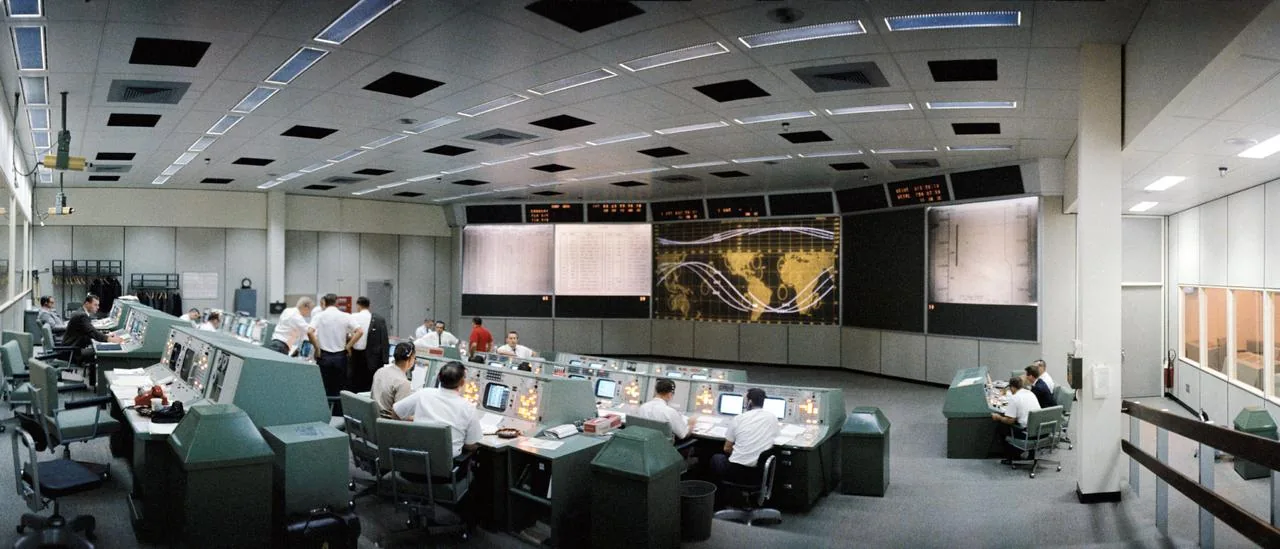
Years of operation: ~25.0 (still active in Mars orbit).
2001 Mars Odyssey is the longest continuously operating Mars orbiter and the longest continuously active spacecraft at another planet, full stop. Launched April 7, 2001, in orbit since October of that year, it has mapped Mars's surface composition with the THEMIS thermal-imaging spectrometer, served as a relay for every NASA Mars surface mission since Spirit (2004), and detected the first hydrogen signatures pointing to subsurface water ice.
Odyssey's longevity is partly an accident of design — its orbit is stable enough that the spacecraft has survived on slow propellant consumption. Estimated end of mission is approximately 2026–2027 as propellant for orbit-trim maneuvers depletes.
The spacecraft's data products are archived at NASA's Planetary Data System. (NASA Mars Odyssey)
5. Mars Reconnaissance Orbiter — Launched August 12, 2005
Years of operation: ~20.7 (still active in Mars orbit).
MRO carries the highest-resolution camera ever sent to another planet — HiRISE, capable of resolving features about 30 cm across. Since arriving at Mars in March 2006, it has imaged almost the entire surface and serves as a primary data relay for surface assets including Curiosity and Perseverance.
MRO's discoveries include direct imaging of recurring slope lineae (briny seasonal flows), confirmation of subsurface water ice deposits in the mid-latitudes, and ongoing site characterization for future crewed landings. The spacecraft's batteries are degraded but functional, and propellant remains adequate for several more years of operation.
NASA's MRO mission page hosts the latest HiRISE imagery. (NASA MRO)
6. Cassini–Huygens — October 15, 1997 to September 15, 2017
Years of operation: 19.9 (mission complete).
Cassini–Huygens is included on this list as the longest-operated outer-planets mission ever flown. The NASA/ESA/ASI joint mission spent seven years in transit to Saturn (arriving 2004), 13 years in orbit, dropped the Huygens probe through Titan's atmosphere (the first landing in the outer solar system, January 2005), and ended deliberately by entering Saturn's atmosphere on September 15, 2017 — the "Grand Finale" — to prevent contamination of potentially habitable moons Enceladus or Titan.
Discoveries included active cryovolcanic geysers on Enceladus, methane lakes on Titan, the structure of Saturn's rings at sub-kilometer resolution, and new moons. ESA's Huygens probe transmitted approximately 90 minutes of surface data after landing.
NASA and ESA both maintain mission archives. (NASA Cassini)
7. Hubble Space Telescope — Launched April 24, 1990
Years of operation: ~36.0 (still active).
Hubble has now operated for more than three and a half decades — far beyond any expectation at launch. Five Space Shuttle servicing missions (1993, 1997, 1999, 2002, 2009) replaced instruments, gyros, batteries, and the original spherically aberrated optics. Each servicing mission effectively rebuilt the telescope.
As of 2026, Hubble is operating in single-gyro mode (after gyro failures in 2024 left only one fully functional unit), but remains scientifically productive. NASA continues to evaluate possible private servicing missions; SpaceX and the Polaris Program have studied a Crew Dragon-based reboost mission.
JWST has not retired Hubble — the two telescopes' wavelength coverage is complementary, with Hubble strong in UV/visible where JWST cannot observe. (NASA Hubble)
8. New Horizons — Launched January 19, 2006
Years of operation: ~20.3 (still active in the Kuiper Belt).
New Horizons launched on the fastest Earth-departure trajectory ever achieved by a spacecraft (~16.26 km/s heliocentric speed at launch — see our companion article on fastest spacecraft). It performed the first close flyby of Pluto in July 2015, returning the iconic heart-shaped Tombaugh Regio image, then continued outward to fly past Kuiper Belt object Arrokoth in January 2019 — the most distant solar-system body ever visited up close.
The spacecraft is now in its second extended mission, conducting heliophysics observations as it traverses the outer Kuiper Belt. Power output from its single RTG is sufficient through approximately 2035. NASA is studying a possible third Kuiper Belt object encounter.
Mission status is published by JHUAPL. (NASA New Horizons)
9. Pioneer 10 — March 3, 1972 to January 23, 2003
Years of operation: ~30.8 (last successful contact).
Pioneer 10 was the first spacecraft to traverse the asteroid belt, the first to fly past Jupiter (December 1973), and for many years the most distant human-made object before being overtaken by Voyager 1 in 1998. It carried a gold-anodized plaque with figures of a man and a woman and a star map showing Earth's location — a precursor to Voyager's Golden Record.
Last successful telemetry was received January 23, 2003, by NASA's Deep Space Network at a distance of approximately 80 AU. Subsequent attempts in 2004–2006 failed, ending the mission. Its trajectory now carries it toward the star Aldebaran — though it will take roughly 2 million years to get there.
NASA's Pioneer mission archive holds the mission record. (NASA Pioneer 10)
10. Opportunity (Mars Exploration Rover B) — January 25, 2004 to February 13, 2019
Years of operation: ~14.5 (vs. 90-sol design lifetime).
Opportunity landed on Meridiani Planum on January 25, 2004 with a planned 90-sol (~92 Earth-day) design lifetime. It operated continuously for 5,352 sols — almost 60 times its design life — before a global Mars dust storm in June 2018 covered its solar panels and the rover never woke up. Final contact attempt was on February 13, 2019.
In its 14.5 years of surface operation, Opportunity drove 45.16 km — a Mars surface distance record at the time, since broken only by Curiosity (and even that took until late 2025). Discoveries included direct mineralogical evidence for ancient liquid water, including hematite "blueberries" and a layered sedimentary sequence in Endurance Crater.
NASA's MER mission page maintains the operational archive. (NASA Opportunity)
Methodology / How We Ranked
We ranked missions by continuous years of operation from launch to last operational contact (or to May 2026 for active missions). ISS is a special case: we use continuous human occupation (Nov 2, 2000) as the start date, since the ISS itself is composed of modules launched at different times and assembled in orbit.
We excluded:
- Earth-orbiting science satellites where the mission is primarily a passive sensor (Landsat, GOES, etc.) — those are categorized differently.
- Missions still in their cruise phase at launch, where surface or destination operations have not yet begun.
- Communications satellites and military assets where operational longevity is not publicly documented.
Some entries (Hubble, ISS) are not on a fundamental discovery trajectory like Voyager but are included because they represent the longest-running missions of their class (telescopes, crewed stations).
FAQ
Are the Voyagers really still working after 48 years? Yes — both spacecraft return data daily through NASA's Deep Space Network. They are limited by RTG power decay (about 4 W lost per year) and aging electronics. Voyager 1's 2024 memory fault was successfully repaired remotely.
Why isn't Apollo on this list? Apollo missions were short crewed flights — Apollo 17 (the longest lunar mission) lasted 12 days. The Apollo Lunar Surface Experiments Packages (ALSEPs) operated on the lunar surface from 1969 to 1977 but were scientific stations, not full missions. They run roughly 8 years.
Is Mars Odyssey older than Hubble? No. Hubble launched in 1990 and has been operating ~36 years; Mars Odyssey launched in 2001. We rank Hubble lower because the question of "longest-running" is often discussed in terms of planetary missions specifically, where Odyssey holds the record.
What about Earth-observing satellites like Landsat? Landsat 5 famously operated for 29 years (1984–2013), longer than most missions on this list. We excluded Earth-observing satellites because there are dozens with comparable longevity, and a separate ranking is more useful than mixing them in.
Will any current mission outlast Voyager 2? Possibly New Horizons, if its third extended mission is funded and its RTG allows operation through ~2055. Beyond that, the Interstellar Probe concept (~2030s launch) is designed for a 50-year mission lifetime explicitly modeled on Voyager's success.
What killed Opportunity? A global Mars dust storm in June 2018 reduced solar panel output below the rover's minimum survival threshold. The dust didn't clear quickly enough, and the rover's electronics likely froze in the Mars winter. Final contact attempt was Feb 13, 2019.
Sources
- NASA Voyager mission: https://voyager.jpl.nasa.gov/
- NASA New Horizons: https://www.nasa.gov/mission/new-horizons/
- NASA Mars Odyssey: https://mars.nasa.gov/odyssey/
- NASA Mars Reconnaissance Orbiter: https://mars.nasa.gov/mro/
- NASA Hubble: https://www.nasa.gov/mission/hubble/
- NASA Cassini: https://solarsystem.nasa.gov/missions/cassini/overview/
- NASA International Space Station: https://www.nasa.gov/international-space-station/
- NASA Opportunity (MER): https://mars.nasa.gov/mer/
- NASA NSSDCA Pioneer 10 record: https://nssdc.gsfc.nasa.gov/nmc/spacecraft/display.action?id=1972-012A
- ESA Cassini–Huygens: https://www.esa.int/Science_Exploration/Space_Science/Cassini-Huygens