STEP 1 · propulsion
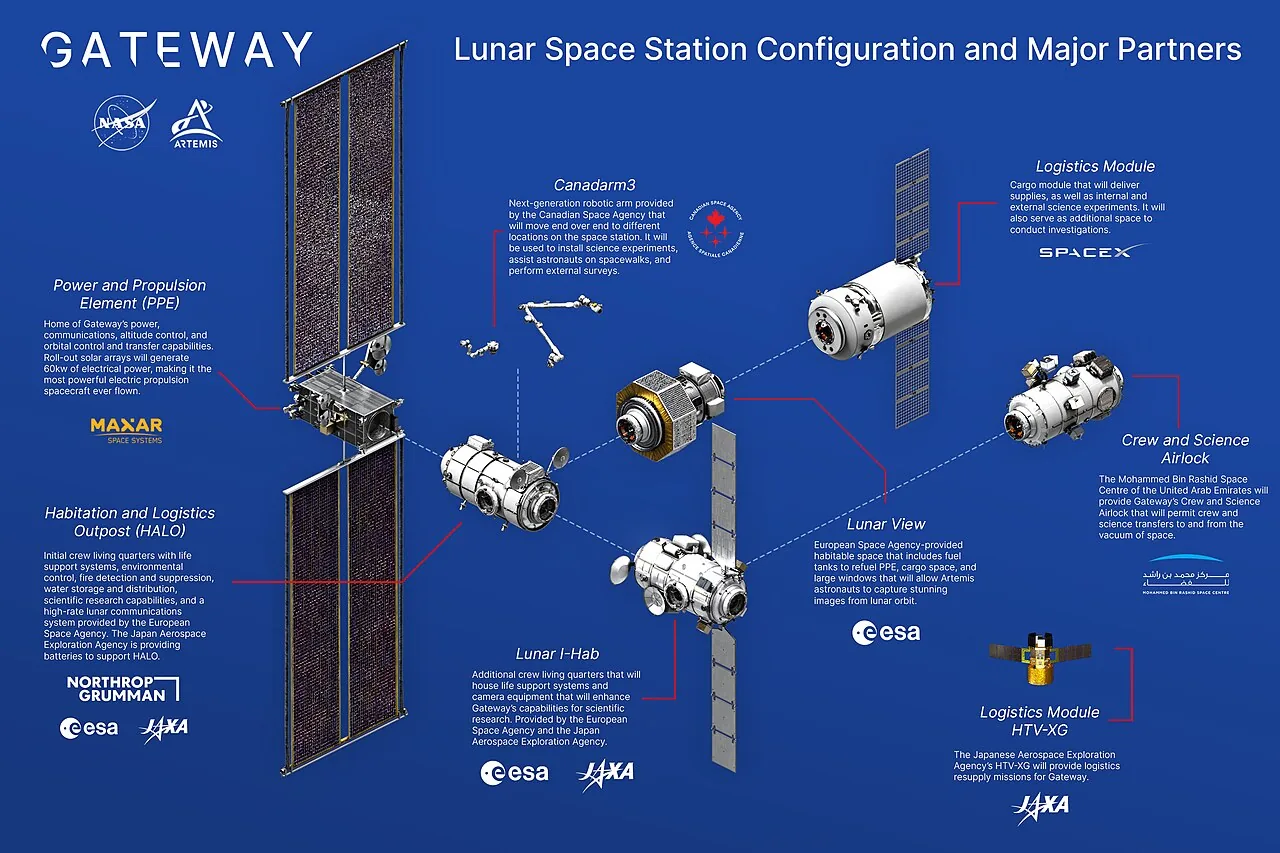
Power and Propulsion Element (PPE)
The PPE is Gateway's engine room — it makes electricity and gently pushes the whole station around the Moon.
Why it exists: A station out at the Moon needs its own power and its own engines to reach and hold the right orbit, and the PPE provides both.
Without it: With no engine block, there is nothing to power the station or keep it in its orbit around the Moon.
For engineers: Solar-electric propulsion delivers the high specific impulse needed to spiral out to, and maintain, the roughly 6.5-day NRHO with minimal propellant mass.
PPE is designed to be the most powerful solar-electric spacecraft ever flown — its thrusters ionise xenon and use roughly a tenth of the propellant a chemical engine would need.
Source: NASA — A Powerhouse in Deep Space: Gateway's Power and Propulsion ElementSTEP 2 · power
Roll-Out Solar Arrays (ROSA)
Two giant solar wings roll out like yoga mats to catch sunlight and make the station's electricity.
Why it exists: Everything on Gateway runs on electricity, and out by the Moon the Sun is the only place to get it.
Without it: With the wings rolled up, Gateway has almost no power and its systems go dark.
For engineers: Roll-out composite booms give high specific power at low stowed volume, essential for a 60 kW-class SEP spacecraft on a single launch.
Each wing is about the size of a football field's end zone, yet launches rolled up like a yoga mat.
Source: NASA — A Powerhouse in Deep Space: Gateway's Power and Propulsion ElementSTEP 3 · habitation
Habitation and Logistics Outpost (HALO)
HALO is the first little home at the Moon, with doors for spaceships to dock and room for astronauts to live and work.
Why it exists: Astronauts need somewhere pressurised to live, and their ride — the Orion spacecraft — needs a place to park.
Without it: With no first cabin, crews have nowhere to live and Orion has nothing to dock to.
For engineers: It is Gateway's core: the crewed volume and berthing tree that PPE powers and that I-Hab, Lunar View, the airlock and visiting vehicles all connect to.
HALO is built on the same production line as Northrop Grumman's Cygnus cargo ships — inside, it's roughly the size of a small studio apartment.
Source: NASA — Welcomes Gateway's HALO Module to USSTEP 4 · comms
Lunar Link (ESA communications)
Lunar Link is Gateway's big radio, carrying messages between the station, the Moon's surface and Earth.
Why it exists: Astronauts, rovers and mission control all need to talk to each other, and radio is the only way across that distance.
Without it: Without the radio, Gateway can't relay calls between the Moon and Earth.
For engineers: Gateway's near-rectilinear halo orbit is never blocked from Earth by the Moon and dwells over the south pole for most of each ~6.5-day lap, so the relay can forward surface traffic almost continuously.
Lunar Link is Europe's contribution bolted onto an American module — Gateway is international right down to its radio.
Source: NASA — Welcomes Gateway's HALO Module to US (Lunar Link provided by ESA)STEP 5 · robotics
Canadarm3 (CSA robotics)
Canadarm3 is a smart robot arm that can move things and tend the station by itself, even when no astronauts are aboard.
Why it exists: Gateway is empty most of the time, so it needs a robot that can work on its own.
Without it: With no robot arm, there's no way to service the station or move cargo when the crew is away.
For engineers: Autonomy is essential because Gateway spends most of the time uncrewed; the arm berths logistics, relocates payloads and services the exterior.
Unlike its predecessors, Canadarm3 is designed to work on its own around the Moon — it can carry out some tasks with no astronaut and no ground controller in the loop.
Source: CSA — About Canadarm3STEP 6 · habitation
Lunar I-Hab (ESA / JAXA habitat)
Lunar I-Hab is the main living-and-lab room where astronauts really settle in when they visit Gateway.
Why it exists: The first cabin is tight, so a bigger habitat lets crews stay longer and do more science.
Without it: Without it, astronauts can only stay a short time in cramped quarters.
For engineers: Its closed-loop environmental control provides the life support needed for longer expeditions beyond the HALO-only baseline.
For all its bulk, its usable living space is only about 10 cubic metres — roughly the interior of a medium campervan.
Source: ESA — Gateway (Lunar I-Hab; JAXA life support)STEP 7 · structure
Lunar View (ESA refuelling & storage, formerly ESPRIT)
Lunar View is the station's fuel-and-storage room, and it holds the only windows where astronauts can look out at the Moon.
Why it exists: Gateway's engines need topping up, the crew needs storage, and everyone wants a window.
Without it: Without it, Gateway can't be refuelled and has no window on the Moon.
For engineers: On-orbit refuelling replenishes the propellant the solar-electric system consumes for station-keeping, extending Gateway's lifetime well beyond a single fill.
Lunar View holds the only windows on the entire station — the single spot where a crew can float up and watch the Moon roll by.
Source: ESA — Gateway (Lunar View: refuelling, storage, windows)STEP 8 · structure
Crew and Science Airlock (MBRSC)
The airlock is Gateway's front door to space, where astronauts suit up and step outside.
Why it exists: To work outside or fix the station, astronauts need an airtight doorway between the cabin and empty space.
Without it: Without the airlock, there's no easy way for crews to go outside.
For engineers: A dedicated airlock decouples EVA and external-payload operations from the habitable volume, protecting cabin atmosphere and enabling deep-space spacewalks.
It is the UAE's ticket to the Moon: in return for building the airlock, the UAE is set to send an Emirati astronaut to Gateway on a future Artemis mission.
Source: NASA — NASA, United Arab Emirates Announce Artemis Lunar Gateway Airlock