Full mission transcript
Every chapter of Artemis I, in sequence.
L−79 days
Two Scrubs and Two Hurricanes
August 29, 2022 · 12:34 UTC
The rocket was ready before the world would let it fly. On August 29, 2022, with a two-hour launch window open and the 322-foot Space Launch System fueled on Pad 39B, a sensor reported that the hydrogen bleed meant to chill RS-25 engine number 3 was not bringing it into the proper temperature range. The launch director halted the count at approximately 8:34 a.m. EDT — the culprit, engineers later concluded, was a faulty temperature sensor, not the engine itself. Five days later, on September 3, a liquid hydrogen leak opened up in the quick-disconnect cavity between the ground and flight plates of the tail service mast umbilical. Three attempts to reseat the seal failed. Scrub two.
Then the Atlantic hurricane season took its turn. With Hurricane Ian bearing down on Florida, the rocket retreated — rolling off Pad 39B at 11:21 p.m. EDT on September 26 atop Crawler-Transporter 2 and reaching shelter inside the Vehicle Assembly Building the next morning. Weeks later, with the stack back on the pad, Hurricane Nicole arrived too fast to run from. NASA rode it out. Winds at the 60-foot level peaked at 82 mph against an 85-mph design limit — a sensor at the top of a 467-foot tower gusted near 100 mph, but that was never a structural reference — and the storm's toll amounted to loose caulk and torn weather coverings.
Through it all stood the machine itself: SLS Block 1, weighing 5.75 million pounds fueled and built to deliver 8.8 million pounds of thrust — roughly 15 percent more than the Saturn V, making it the most powerful rocket ever to fly successfully, a title it would hold until Starship's first flight five months later. On the night of November 15, the countdown resumed one more time. In Firing Room 1, launch director Charlie Blackwell-Thompson polled her team, then keyed the countdown net with a message for everyone who had waited out the scrubs and the storms.
T+00:00:00
We Rise Together
November 16, 2022 · 06:47 UTC
At 1:47:44 a.m. EST on November 16, 2022 — 06:47:44 UTC — the four RS-25 engines and twin solid rocket boosters lit, and the first Space Launch System left Earth, turning night into day over the Kennedy Space Center. It was the first flight of SLS and the first Orion ever bound for the Moon, flying with no one aboard. In mission manager Mike Sarafin's words that morning, the team had watched the world's most powerful rocket "take the Earth by its edges and shake the wicked out of it."
The ascent ran like a metronome. The boosters separated at T+2 minutes 12 seconds. The service module fairing and launch abort system jettisoned just past three minutes. The core stage's engines cut off at T+8:03 and the stage fell away twelve seconds later. Orion's four solar array wings began unfolding eighteen minutes into the flight, and at T+52:56 the Interim Cryogenic Propulsion Stage nudged the orbit's low point higher.
Then came the burn that made it a Moon mission. At T+1:29:27, the ICPS ignited for trans-lunar injection — eighteen minutes of thrust that flung Orion out of Earth orbit. The spacecraft separated from the spent stage at T+1:57:36 and flew on alone, while behind it the Orion Stage Adapter released ten shoebox-sized CubeSat science missions into deep space.
Control room · NASA broadcast - T+00:00:08 Nail (NASA commentary): Boosters, ignition, and liftoff of Artemis I! We rise together, back to the Moon and beyond!
- T+00:14:20 Blackwell-Thompson (Launch Director): Well, for once I might be speechless.
- T+00:15:00 Blackwell-Thompson (Launch Director): It is not by chance that you are here today. So I want you to look around — look around at this team — and know that you have earned it. You have earned your place in the room. You have earned this moment. You have earned your place in history. You were part of a first.
- T+00:15:57 Blackwell-Thompson (Launch Director): The harder the climb, the better the view. We showed the Space Coast tonight what a beautiful view it is. So congratulations.
T+1d 17:12
Outbound
November 18, 2022 · 00:00 UTC
For five days Orion coasted outward, and the pictures came home first: cameras mounted on the tips of the solar array wings turned back toward a shrinking blue Earth, framing the spacecraft against the planet it was leaving behind. No astronauts looked out the windows — but the commander's seat was not empty.
Strapped into it was Commander Moonikin Campos, a manikin in an orange Orion Crew Survival System suit, wired with sensors to record the acceleration, vibration, and radiation a human commander would feel. The name, chosen by more than 300,000 votes in a 2021 public bracket contest, honors Arturo Campos (1934–2001), the Mexican-American NASA electrical engineer who managed the lunar module's electrical power subsystem — and helped bring Apollo 13 home. Fifty-two years after Campos worked the problem that saved three astronauts, his namesake was flying the route back to the Moon.
Riding with him were Helga and Zohar — two instrumented phantom torsos mapping radiation dose, one wearing a protective AstroRad vest, one without — while a Snoopy doll drifted through the cabin as the flight's zero-gravity indicator. The ten CubeSats released on launch day fared unevenly: some thrived, while others, like NEA Scout, were never heard from again. On Flight Day 6, Orion's optical navigation camera opened its shutter on a wall of grey craters — the Moon, filling the frame.
T+5d 06:09
Lunar Flyby
November 21, 2022 · 12:57 UTC
On the morning of November 21, Orion flew behind the Moon and went silent. Loss of signal came at 12:25 UTC, beginning a blackout of roughly 34 minutes in which the spacecraft was entirely on its own. At 12:44, with no one watching and no ground station in reach, Orion's orbital maneuvering system engine lit for 2 minutes 30 seconds — the outbound powered flyby burn, executed autonomously on the far side of the Moon.
At 12:57 UTC the spacecraft skimmed just 81 miles — 130 kilometers — above the lunar surface, its closest outbound approach, and two minutes later it emerged from behind the Moon and called home. The burn had accelerated Orion from 2,128 to 5,102 mph and bent its path toward the vast orbit ahead. On the way past, it crossed about 1,400 miles above Tranquility Base, where Apollo 11 had landed 53 years earlier.
The machine was running better than its designers had promised. Propellant use was tracking about 75 pounds better than prelaunch expectations, and the black-and-white frames streaming from the optical navigation camera — raw, unglamorous engineering images — turned out to be some of the most haunting lunar portraits since the Apollo era.
T+12d 14:17
Farther Than Any Before
November 28, 2022 · 21:05 UTC
On November 25 at 21:52 UTC, Orion's orbital maneuvering system engine burned for 1 minute 28 seconds, changing its velocity by 363 feet per second and easing the spacecraft into a distant retrograde orbit — a vast, exceptionally stable loop reaching some 40,000 miles beyond the Moon, so large that half a revolution takes about a week. On the way in, Orion had already climbed more than 57,000 miles above the lunar surface.
The next morning, a record fell — and it fell to family. Orion passed 248,655 miles from Earth, the mark set in April 1970 by Apollo 13, the crippled mission that Arturo Campos — the engineer honored by the manikin in Orion's commander's seat — had helped bring home. NASA framed the new record precisely: the farthest distance for a mission with a spacecraft designed to carry humans to deep space and back. Artemis I's mark stands for an uncrewed, human-rated craft; the crewed record now belongs to Artemis II.
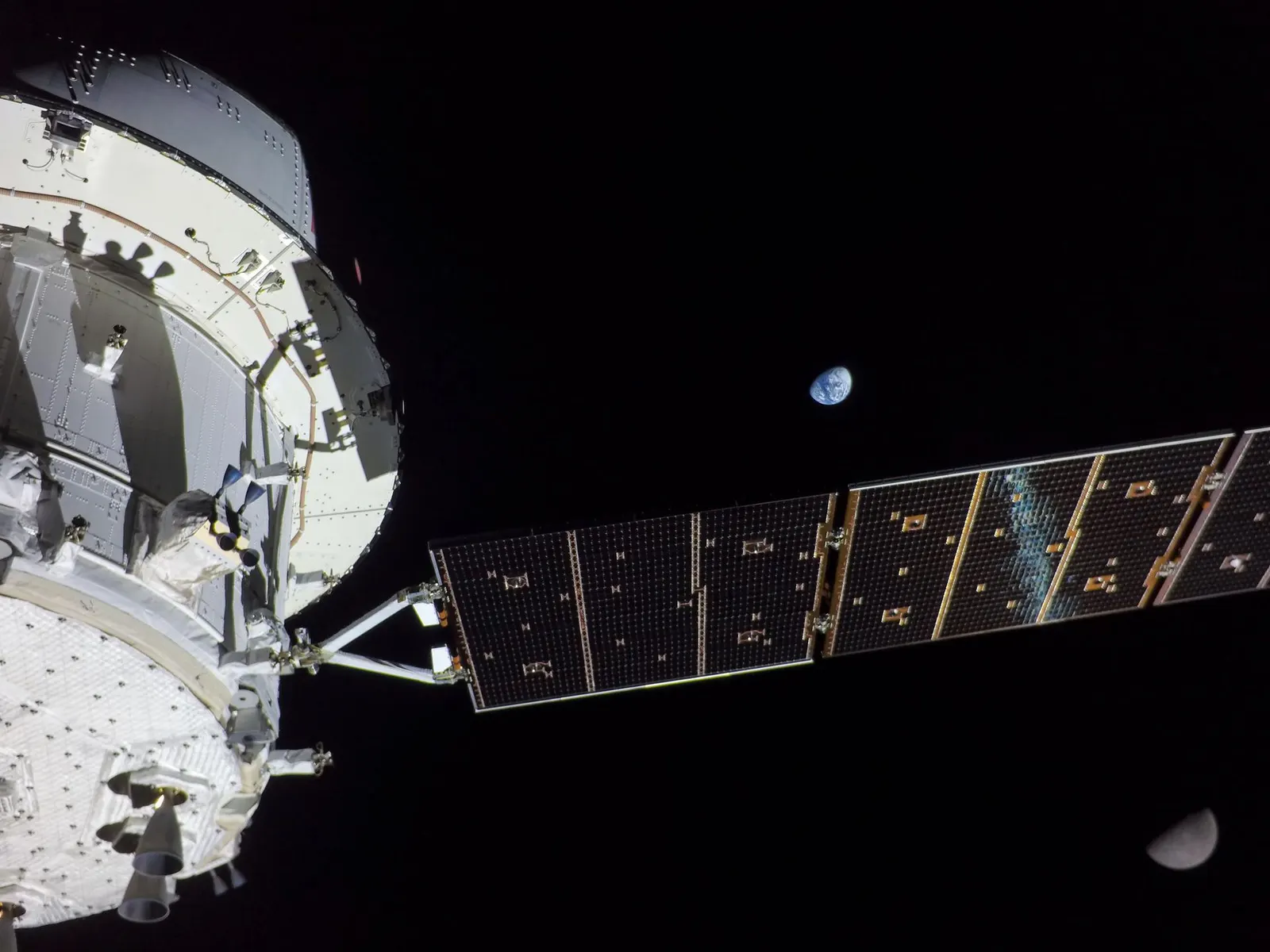
On November 28 at about 21:05 UTC, Orion reached the far edge of its orbit: 268,563 miles — 432,210 kilometers — from Earth, while floating 43,138 miles from the Moon. A camera on a solar array tip captured the moment that became the mission's signature image — the spacecraft in the foreground, and beyond it the Moon and the Earth hanging together in the same black frame, every human being who has ever lived inside one photograph.
T+19d 09:55
The Journey Home
December 5, 2022 · 16:43 UTC
Leaving the distant retrograde orbit took another precise push. On December 1 at 21:53 UTC, the European Service Module's main engine fired for 1 minute 45 seconds — about 454 feet per second of velocity change — breaking Orion out of its week-long loop and dropping it back toward the Moon. A 20.1-second trajectory correction at 10:43 UTC on December 5 trimmed the aim.
Hours later, Orion made its second and final pass behind the Moon. At 16:43 UTC it swept to within 80.6 miles of the surface — the return powered flyby — and the main engine lit for 3 minutes 27 seconds, adding roughly 655 mph and using the Moon's gravity as a slingshot. When the burn ended, the spacecraft was committed: a trajectory pointed at a patch of the Pacific Ocean, six days away.
As Orion came around the limb, its cameras caught Earth rising beyond the Moon's grey horizon — a crescent of blue emerging from blackness, the destination revealing itself behind the waypoint. The outbound mission was over. Everything now led home.
T+25d 10:32
Thirty-Two Times the Speed of Sound
December 11, 2022 · 17:20 UTC
On December 11, the crew module said goodbye to the European Service Module that had powered it for 25 days, separating at 17:00 UTC. Twenty minutes later, Orion hit the top of the atmosphere — entry interface, 400,000 feet — traveling 24,581 mph. Mach 32. Nearly 25,000 miles per hour.
Then it did something no human-rated spacecraft had done before: a skip entry. Orion dipped into the upper atmosphere, used aerodynamic lift to skip back out like a stone off a pond, then re-entered for good — splitting the punishing deceleration into two gentler pulses of about 4 g each and extending its control over the landing point. Behind the 16.5-foot AVCOAT heat shield, the largest of its kind ever flown, temperatures reached about 5,000 degrees Fahrenheit — roughly half as hot as the surface of the Sun. In about twenty minutes, the spacecraft shed nearly 24,500 mph: the forward bay cover came off and drogue chutes deployed around 22,000 feet at 17:36, and the three main parachutes blossomed near 5,000 feet, slowing Orion to about 20 mph.
The flight was a test, and the test taught. Post-flight inspection found the heat shield's AVCOAT had charred and cracked in ways engineers had not predicted, shedding fragments and leaving more than 100 divots — a finding that would drive a revised entry profile for the crewed Artemis II mission that followed.
T+25d 10:52
Fifty Years to the Day
December 11, 2022 · 17:40 UTC
At 17:40 UTC on December 11, 2022, Orion settled onto the Pacific Ocean west of Baja California, near Guadalupe Island — a landing zone moved some 300 nautical miles south days earlier to dodge bad weather. The capsule came down within eyesight of the recovery ship USS Portland, about five nautical miles out, where Recovery Director Melissa Jones's joint NASA-Navy team was waiting. The mission had lasted 25 days, 10 hours, and 53 minutes.
The date was no accident of scheduling — it was history rhyming. Fifty years to the day earlier, on December 11, 1972, Apollo 17 had landed in the Taurus-Littrow valley for humanity's last visit to the Moon. Half a century separated the two spacecraft, and Orion closed the distance with numbers of its own: more than 1.4 million miles traveled, a maximum distance of 268,563 miles, two lunar flybys at roughly 80 miles, and more time in space than any human-rated spacecraft had ever logged without docking to another vehicle.
Aboard USS Portland, the recovery team raised an Artemis flag as the capsule was secured. The following spring, on April 3, 2023, NASA named the four astronauts of Artemis II — the crew who would ride the path Orion had just proven. The test flight was over. The return had begun.
Sources: NASA — Artemis I Mission Special · NASA Blog — Artemis I Liftoff · NASA Blog — Flight Day 6: Orion Performs Lunar Flyby · NASA Blog — Flight Day 13: Orion Goes the (Max) Distance · NASA Blog — Flight Day 20: Orion Conducts Return Powered Flyby · NASA Release — Splashdown! Orion Returns to Earth After Historic Moon Mission
Answers come only from the Artemis I mission record above.
Continue your journey

The moment in history
Moment
Artemis I — uncrewed Moon-orbit test flight
The moment in history
The mission file
Mission
Artemis I
The mission file
Build it yourself
Build it
Gateway Assembly Complex — build the Lunar Gateway
Build it yourself
From the same era
Experience
Artemis II
From the same era
From the same era
Experience
Chandrayaan-3
From the same era