STEP 1 · structure
Rover Chassis & Warm Electronics Box
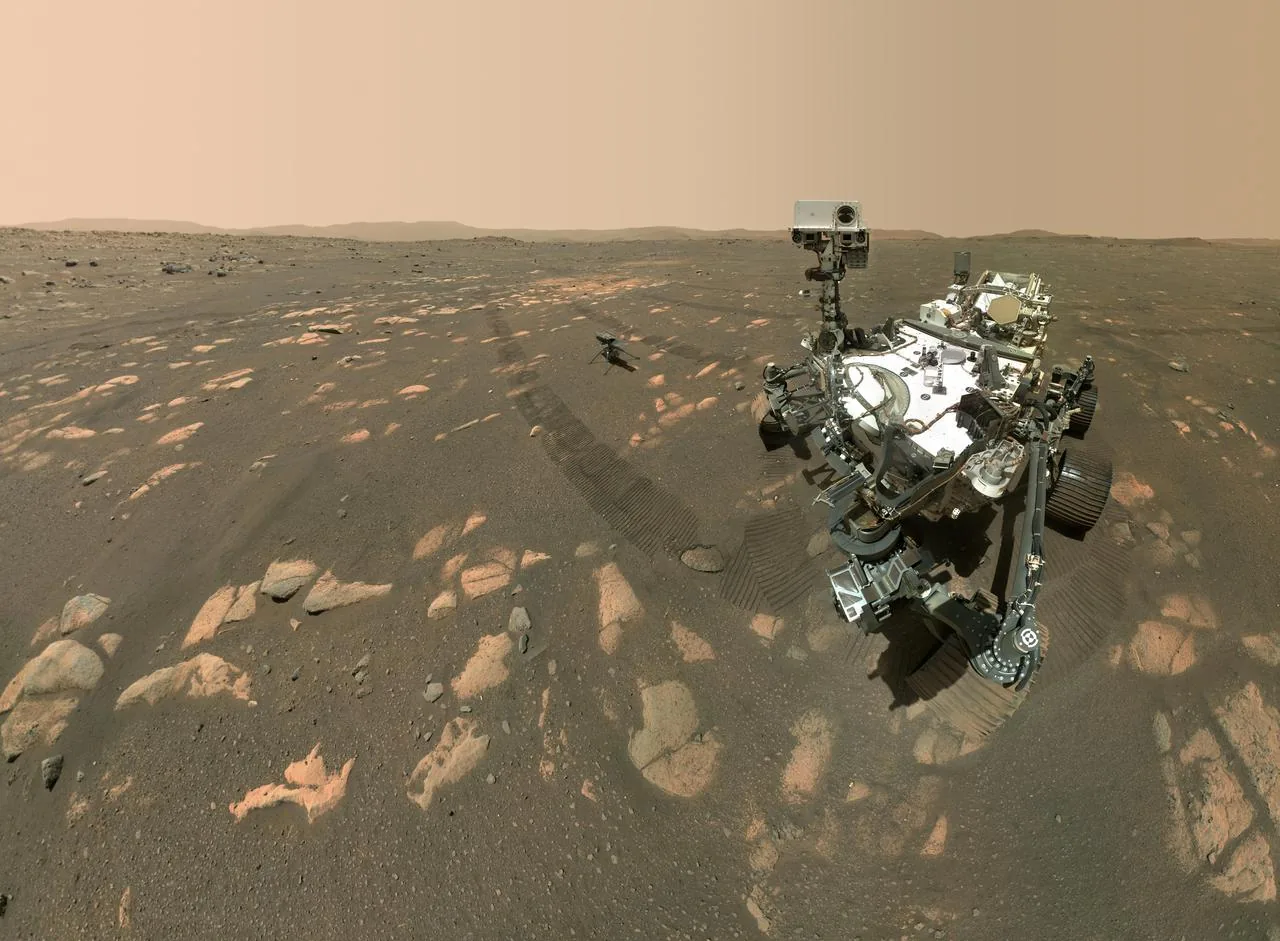
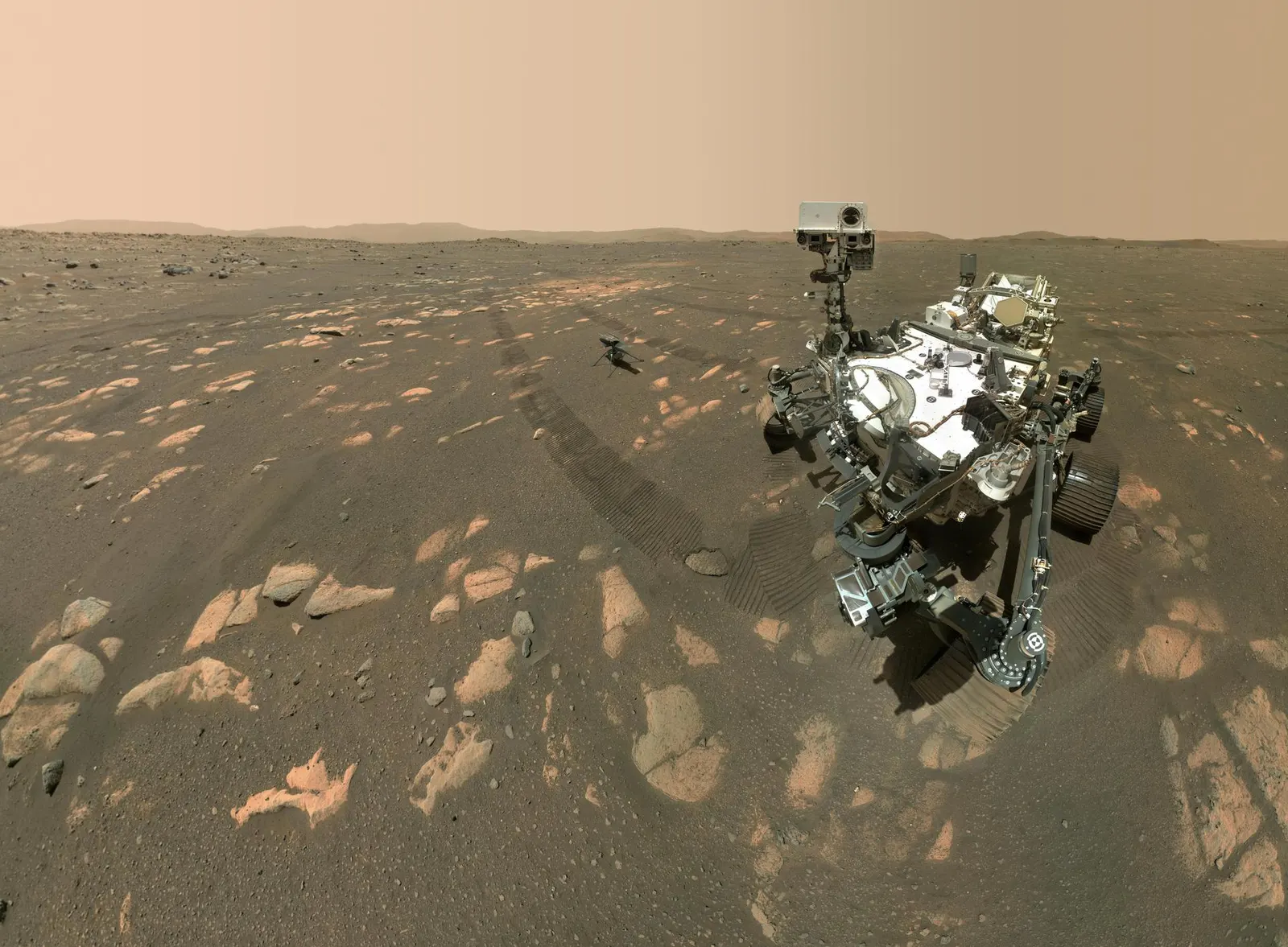
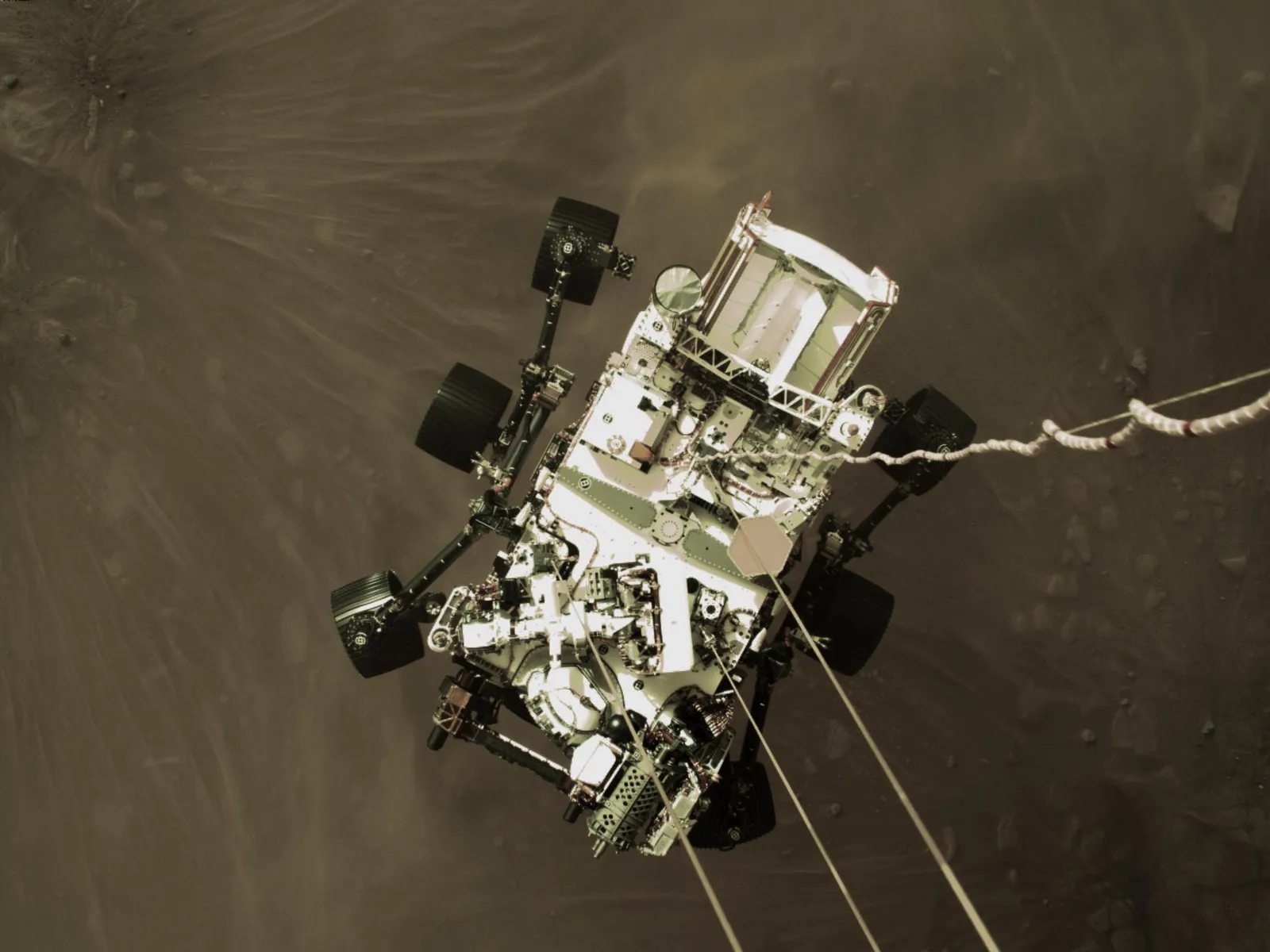
The rover's body — a strong box on legs that holds everything together and keeps the computer cozy.
Why it exists: Mars nights get brutally cold, so the body is really a warm, padded box that protects the brain and battery.
Without it: There would be nothing to attach the wheels, arm, or cameras to — and the electronics would freeze.
For engineers: It is simultaneously the mechanical backbone (mounting the mobility, mast, arm, RTG, and antennas) and the thermal enclosure that, with RTG waste heat and heater loops, keeps the RAD750 avionics and Li-ion battery survivable through the diurnal cycle.
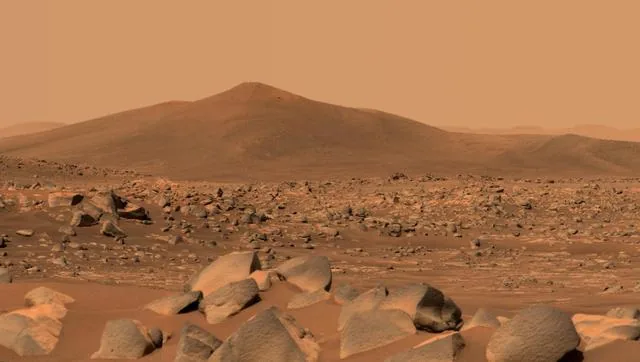
The body doubles as an insulated 'thermos' — it keeps the electronics near room temperature even when Jezero's night air falls to roughly -90 C.
Source: NASA Science — Perseverance Rover ComponentsSTEP 2 · power
Radioisotope Power System (MMRTG)
A nuclear battery that turns the heat from decaying plutonium into electricity — day, night, and dust storm.
Why it exists: Dust and long winters starve solar panels on Mars, but a nuclear battery just keeps making power on its own.
Without it: The rover would have no reliable power and would shut down when the dust rolled in.
For engineers: Radioisotope power decouples the energy budget from insolation and dust opacity, and its waste heat is harvested to warm the vehicle — a combined power-and-thermal solution no solar array can match at Jezero's latitude.
Its 4.8 kg of plutonium dioxide will keep generating power for at least 14 years — far longer than the rover's original prime mission.
Source: NASA JPL — Mars 2020 Launch Press Kit: PowerSTEP 3 · thermal
Heat Rejection & Heater System
The rover's plumbing that moves heat around — carrying warmth from the nuclear battery to the cold parts.
Why it exists: Some parts run too hot and others get too cold, so a fluid loop shares the heat where it's needed.
Without it: Parts of the rover would overheat while others froze.
For engineers: It turns the RTG's ~2 kW of thermal output into a managed asset — warming the WEB and actuators at night and rejecting surplus by day — so the thermal budget stays closed without solar dependence.
The rover recycles the heat from its own nuclear battery — a fluid loop pipes that warmth around the body to keep parts from freezing at night.
Source: NASA JPL — Mars 2020 Launch Press Kit: PowerSTEP 4 · mobility
Mobility System — Rocker-Bogie & Six Wheels
Six aluminum wheels on a clever suspension that lets the rover climb over rocks without tipping.
Why it exists: The rocker-bogie lets all six wheels stay on the ground over bumpy terrain, so the rover can go where the science is.
Without it: The rover couldn't move — it would be stuck wherever it landed.
For engineers: The differential-averaging rocker-bogie geometry maintains ground contact and limits chassis pitch on obstacles without springs, trading speed (~4.4 cm/s) for reliability over unknown regolith and rock.
Each wheel carries 48 grousers (cleats) for grip, and the rover's top speed is only about 4.4 cm per second — a careful, deliberate crawl.
Source: NASA Science — Perseverance Rover ComponentsSTEP 5 · avionics
Rover Compute & AutoNav
The rover's brain — a rugged computer that lets it drive and make decisions by itself.
Why it exists: Earth is so far away that messages take many minutes, so the rover has to think for itself while it drives.
Without it: The rover couldn't decide anything or drive safely on its own.
For engineers: Radiation tolerance and onboard autonomy are mandatory given the deep-space environment and light-time delay; AutoNav's onboard terrain assessment decoupled traverse rate from ground-in-the-loop cadence, evaluating most of the first Mars year's driving.
The rover's self-driving 'AutoNav' handled most of its first-Mars-year distance, mapping hazards and choosing its own path between Earth commands.
Source: NASA Science — Perseverance Rover ComponentsSTEP 6 · comms
Telecommunications Antennas
The rover's antennas — how it sends pictures and data back toward Earth.
Why it exists: Most data hops up to spacecraft orbiting Mars, which then beam it the rest of the way home.
Without it: Everything the rover discovers would be stuck on Mars with no way to reach us.
For engineers: UHF relay via orbiters carries the overwhelming majority of downlink volume, while the X-band HGA provides low-rate direct command/telemetry — a two-tier architecture that maximizes return within the rover's mass and power limits.
About 99.9% of Perseverance's science data never goes straight to Earth — it hops up to Mars orbiters first, which relay it home.
Source: NASA JPL — Mars 2020 Landing Press Kit: TelecommunicationsSTEP 7 · optics
Remote Sensing Mast (Mastcam-Z, Navcams, SuperCam)
The rover's head on a neck — cameras that look around and a laser that zaps rocks to learn what they're made of.
Why it exists: From up high the rover can survey the landscape, pick where to drive, and study rocks from a distance.
Without it: The rover would be nearly blind and couldn't plan where to go.
For engineers: Elevated, articulated remote sensing enables traverse planning and standoff geochemistry, filtering targets so contact-science and sampling time is spent only on the highest-value rocks.
Perseverance carries 19 cameras on the rover itself — and 23 across the whole spacecraft counting the landing cameras, more than any earlier Mars mission.
Source: NASA Science — Perseverance Science InstrumentsSTEP 8 · robotics
Robotic Arm & Coring Turret (PIXL, SHERLOC, Drill)
A long arm with a spinning 'hand' of tools that touches rocks and drills out little cores.
Why it exists: To really study a rock you have to reach out and touch it — and to save a sample you have to drill it.
Without it: The rover could photograph rocks but never touch, study up close, or collect them.
For engineers: Turret-mounted fine-scale instruments plus coring integrate proximity science and sample acquisition in one placement, minimizing arm cycles and preserving sample integrity.
The 2.1 m arm has five joints — like a shoulder, elbow, and wrist — and its turret ends in a rotary-percussive drill that cuts finger-sized rock cores.
Source: NASA Science — Perseverance Rover ComponentsSTEP 9 · payload
Sample Caching System
The rover's belly factory that seals rock cores into clean metal tubes to save for a trip back to Earth.
Why it exists: The best way to study Mars rocks is in labs on Earth, so the rover carefully seals samples to send home someday.
Without it: The rover could study rocks on Mars but never save any to bring back.
For engineers: Ultra-clean acquisition, hermetic sealing, and cataloged storage preserve sample integrity and provenance for potential Mars Sample Return, the highest-value science the architecture can enable.
Perseverance is the first rover ever to carry a sample-caching system — 43 tubes in all (38 for samples, 5 'witness' tubes), some already banked in a backup depot at Three Forks.
Source: NASA Science — Perseverance Mars Rock SamplesSTEP 10 · instrument
Body-Mounted Science — MOXIE, MEDA, RIMFAX
Three built-in experiments: one makes oxygen, one is a weather station, one is ground radar that peers underground.
Why it exists: They test what future explorers will need — breathable oxygen, weather forecasts, and a look beneath the surface.
Without it: The rover would lose its 'prepare for humans' science and its underground view.
For engineers: They validate ISRU for propellant/life-support, provide environmental context and dust dynamics, and add stratigraphic subsurface imaging — data classes complementary to remote and contact science.
MOXIE made oxygen from the Martian atmosphere 16 times — 122 grams total, at up to 12 grams per hour and 98% purity — the first oxygen ever produced on another planet.
Source: NASA — MOXIE Completes Mars MissionSTEP 11 · payload
Ingenuity Mars Helicopter
A tiny helicopter that rode down under the rover and flew — the first flying machine on another planet.
Why it exists: Flying scouts can peek over hills and ahead of the rover, something wheels can never do.
Without it: There would be no aerial scout and no first-flight milestone.
For engineers: It demonstrated controlled atmospheric flight at ~1% Earth sea-level density via high-RPM rotors and onboard autonomy, validating aerial mobility as a future Mars architecture element.
Ingenuity weighed just 1.8 kg but flew 72 times over nearly three years — the mission expected only five flights — before its final flight in January 2024.
Source: NASA Science — Ingenuity Mars Helicopter