STEP 1 · structure
Pressurized Habitat Module
The place people actually live — a sealed room full of Earth-like air on a planet that has almost none.
Why it exists: Mars air is so thin and so full of carbon dioxide that stepping outside unprotected would kill you in moments, so home has to be a sealed bubble of breathable air.
Without it: There is nowhere to take your helmet off — no warm, breathable, pressurized place to live.
For engineers: It must hold a large pressure differential across a wide surface through nights that fall below -100°C and through dust loading, which is why reference designs favor mass-efficient inflatable/expandable shells or buried rigid modules. Volumes vary by study; the ~100 m³ shown is representative of a four-person long-stay crew, not a fixed spec.
NASA's ground stand-in — the 3D-printed Mars Dune Alpha habitat at Johnson Space Center — is 1,700 square feet, and a four-person crew lived sealed inside it for over a year (June 2023 to July 2024) to rehearse the isolation of a Mars stay.
Source: NASA — CHAPEA (Crew Health and Performance Exploration Analog)STEP 2 · power
Fission Surface Power Reactor
A small nuclear reactor that makes electricity day and night — even in a dust storm that blots out the Sun.
Why it exists: Dust storms on Mars can dim the sky for weeks, so counting on solar panels alone is a gamble; a reactor just keeps making power.
Without it: When a dust storm hides the Sun, the base could run out of power and freeze.
For engineers: Radioisotope units (a rover's MMRTG makes only ~110 W) can't scale to habitat loads, and solar is hostage to dust opacity; a fission plant decouples the entire energy budget from sunlight. NASA is developing the 40-kWe class to demonstrate on the Moon first, then adapt for Mars.
NASA's target is a reactor that runs for a decade with no human intervention — a one-year demonstration followed by nine operational years — and it will be proven on the Moon before it is adapted for Mars.
Source: NASA Glenn — Fission Surface Power ProjectSTEP 3 · power
Energy Storage & Power Distribution
Big batteries and wiring that store power and hand it out to everything in the base.
Why it exists: Even a nuclear reactor needs a buffer for sudden demands and for switching, so batteries smooth it all out and share the power around.
Without it: A single power spike or glitch could knock systems offline with nothing to catch them.
For engineers: PMAD converts, conditions, and protects; storage provides ride-through and peak-shaving so the fission source can be sized to average rather than peak demand. NASA's Fission Surface Power scope explicitly includes power conversion, heat rejection, and distribution — not just the reactor.
The reactor is only half the system — NASA's Fission Surface Power contracts required each design to include power conversion, heat rejection, and distribution, because raw reactor heat isn't usable until it's converted and routed.
Source: NASA Glenn — Fission Surface Power ProjectSTEP 4 · thermal
Thermal Control System & Radiators
The base's heating and cooling — it keeps people and machines from freezing at night or overheating during the day.
Why it exists: Mars swings from mild afternoons to brutally cold nights, and all the equipment inside makes heat that has to go somewhere.
Without it: The base would freeze in the dark and cook its own electronics in the light.
For engineers: The thin CO2 atmosphere gives almost no convective cooling, so heat rejection is largely radiative; the huge diurnal swing (roughly +20°C to below -125°C) plus reactor and ISRU waste heat make thermal balance a continuous control problem, not a fixed setpoint.
Because Mars' air is far too thin to carry heat away the way a fan does on Earth, the base has to dump its excess heat as infrared glow from radiator panels — the same way spacecraft cool themselves in vacuum.
Source: NASA Science — Mars Facts (temperature range)STEP 5 · life-support
Air Revitalization (ECLSS)
The machine that keeps the air breathable — it takes out the carbon dioxide people breathe out and puts oxygen back in.
Why it exists: In a sealed room the air you breathe out would slowly poison you, so a machine has to constantly clean it and refresh the oxygen.
Without it: The air would fill with carbon dioxide and run out of oxygen — the crew would suffocate.
For engineers: For a multi-hundred-day stay with no resupply, air must be regenerated, not stored; the ISS ECLSS proves the architecture (molecular-sieve CO2 scrubbing, electrolysis-based oxygen generation) that a Mars habitat scales up, ideally topped off by ISRU oxygen.
The technology is already flying: on the space station, the Air Revitalization System strips out carbon dioxide with molecular sieves and the Oxygen Generation System makes oxygen by splitting water — the proof-of-concept for a base that can't be resupplied.
Source: NASA — Environmental Control and Life Support Systems (ECLSS)STEP 6 · life-support
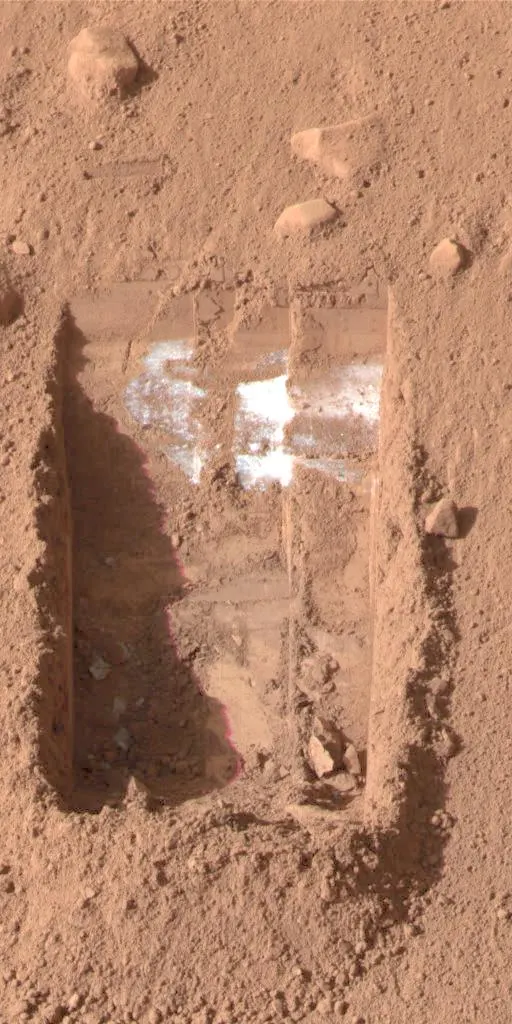
Water Recovery & Subsurface Ice Extraction
It recycles nearly all the crew's water and digs frozen water out of the ground to top up the supply.
Why it exists: Hauling water from Earth is impossibly heavy, so the base reuses almost every drop and mines ice buried under the Martian dirt.
Without it: The crew would run out of water — you can't carry enough from Earth, and you can't fly more in.
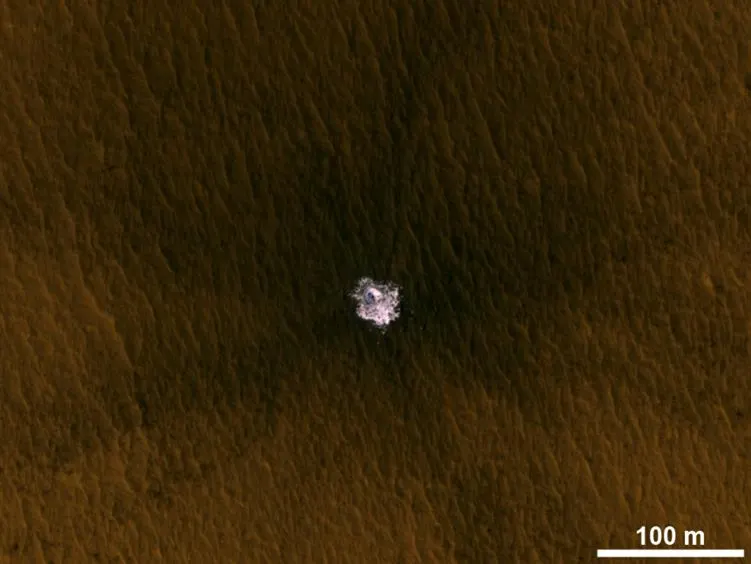
For engineers: Surface ice is stable only at latitudes too cold for a crew, so water comes from recycling plus mined subsurface ice; the ISS ECLSS reached ~98% water recovery (up from 93-94% before its brine processor), and SWIM identifies accessible mid-latitude deposits for landing-site selection.
The space station already recycles about 98% of its water — including sweat and urine — and the final few percent came from a 'brine processor' that squeezes water out of the leftover concentrate.
Source: NASA — ISS Water Recovery Milestone (98%)STEP 7 · payload
ISRU Oxygen & Propellant Plant
A machine that makes oxygen — and rocket-fuel ingredients — out of the Martian air.
Why it exists: You can't carry enough oxygen and fuel for the trip home, so the base makes them from the carbon dioxide right outside.
Without it: There'd be no locally made oxygen to breathe and no oxidizer to fuel the ride back to orbit.
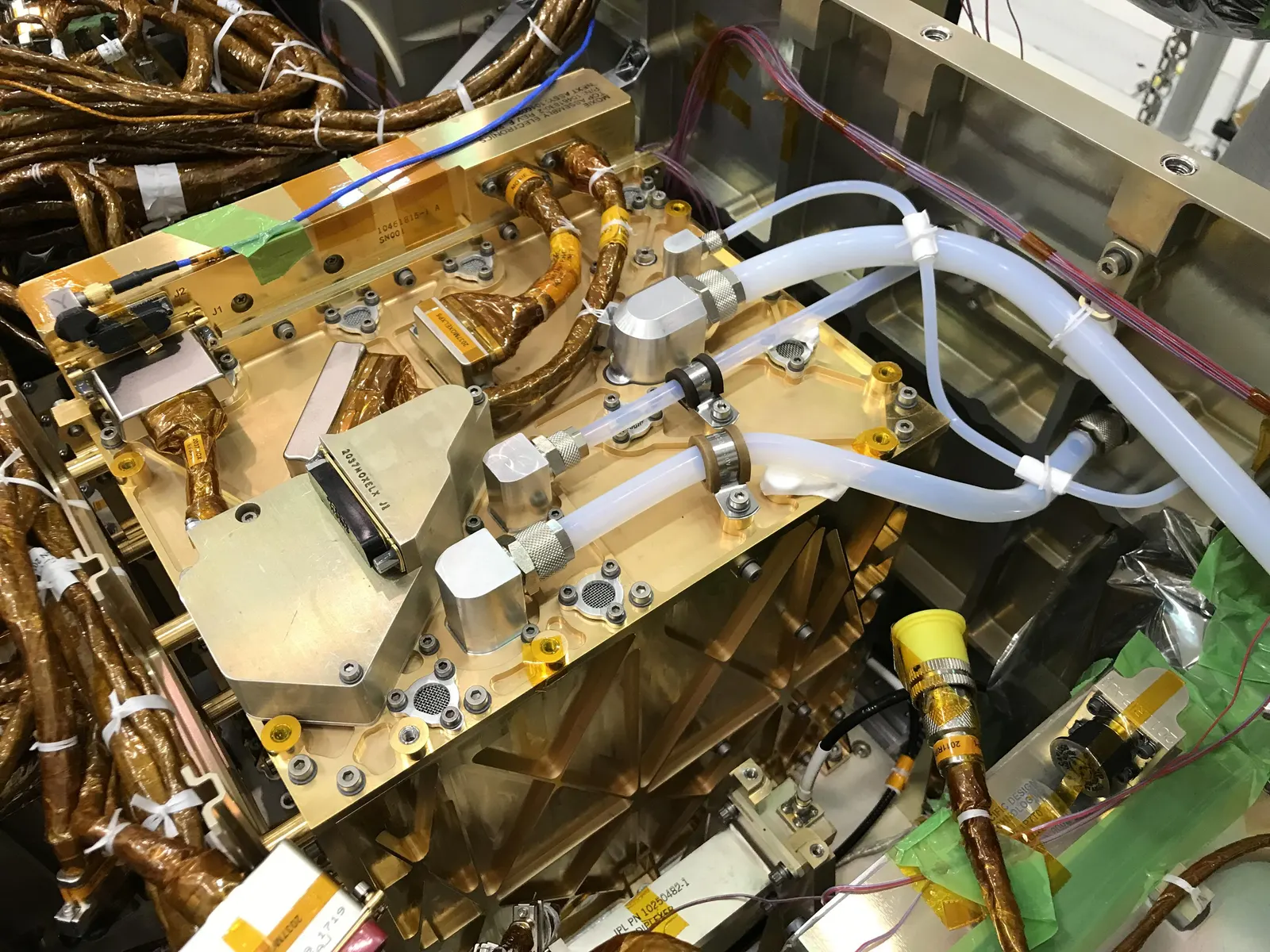
For engineers: Making oxidizer on Mars slashes the mass launched from Earth — NASA notes locally made liquid oxygen could supply more than 75% of the propellant a crew needs to leave. MOXIE validated the chemistry, running 16 times and producing 122 grams of oxygen total, peaking at 12 grams per hour at 98% purity.
MOXIE, a toaster-sized experiment on Perseverance, first made oxygen on Mars on April 20, 2021, ran 16 times, and produced 122 grams total — and NASA estimates locally made liquid oxygen could supply more than 75% of the propellant a crew needs to launch home.
Source: NASA JPL — MOXIE Completes Its Mars Mission (122 g, 16 runs, 12 g/hr)STEP 8 · structure
Regolith / Ice Radiation Shielding
A thick blanket of Martian dirt or water ice piled over the habitat to block space radiation.
Why it exists: Mars has no protective magnetic shield like Earth's, so harmful radiation rains down — piling dirt or ice on top soaks it up.
Without it: The crew would take a dangerous radiation dose over their long stay.
For engineers: Galactic-cosmic-ray dose can't be fully stopped, only attenuated by mass, and hydrogen-rich materials (water ice, polyethylene) are most effective per kilogram. Curiosity's RAD data put a full Mars round trip at roughly 1 sievert — near career limits — with a large share accrued on the surface, and RAD even measured lower dose rates beneath natural rock cover.
One NASA concept, the Langley 'Mars Ice Home,' wraps the crew in a shell of water ice — because ice is packed with hydrogen it's one of the best radiation shields you can make from Martian resources, and robots can fill it before anyone arrives.
Source: NASA JPL — How Curiosity Is Making Mars Safer (natural-material shielding)STEP 9 · habitation
Airlock & EVA Suitport
The door to the outside — you seal yourself in, the air comes out, and then you can step onto Mars.
Why it exists: You can't just open a door to Mars or all the air rushes out, so an airlock lets people leave and return without emptying the base.
Without it: Every trip outside would dump the base's air — and dusty suits would foul everything inside.
For engineers: Repeated EVAs demand a small, evacuable volume to conserve air; NASA suitport studies replace the airlock cycle with suits docked to the cabin wall, enabling egress in about 10 minutes while keeping abrasive regolith dust outside the vehicle.
In NASA's 'suitport' concept the spacesuit hangs on the outside of the hab and you climb in through its back — crews can be outside in about ten minutes, and the dust that coats everything on Mars never gets inside.
Source: NASA NTRS — Small Pressurized Rover with Suit PortsSTEP 10 · comms
Communications Terminal
The base's antennas — how the crew talks to Earth, even though messages take many minutes to arrive.
Why it exists: Earth is so far away that a message takes several minutes each way, so the base needs strong antennas and has to work without instant help.
Without it: The crew would be cut off from Earth — no data, no guidance, no word home.
For engineers: Light-time of 3 to 22.4 minutes one way rules out joysticking, so comms are about throughput and coverage: the orbiter fleet relays at higher data rates during passes, and the DSN's three globally spaced complexes keep Earth in view as it rotates.
Even at the speed of light a hello from Mars takes 3 to 22 minutes to reach Earth — so a real conversation is impossible, and the base leans on a fleet of orbiters and NASA's Deep Space Network to move its data.
Source: NASA Science — The Mars Relay Network (light time & orbiters)STEP 11 · mobility
Pressurized Rover
A little RV for Mars — a driveable, pressurized cabin so the crew can explore far from the base in shirtsleeves.
Why it exists: On foot in a suit you can't go far, so a pressurized rover lets the crew travel for days and only suit up to step outside.
Without it: Exploration would be limited to short walks near the base.
For engineers: Meaningful surface science requires traverses far beyond suited walking range, so the rover is effectively a small mobile habitat — NASA's SEV concept mounts a cabin on a chassis whose wheels pivot 360° and drive about 10 km/h, sustaining two crew for up to 14 days.
NASA's Space Exploration Vehicle is essentially a Mars 'RV' — a pressurized cabin for two that can range for up to 14 days at a time on wheels that pivot a full 360 degrees and drive about 10 km/h in any direction.
Source: NASA Science — Space Exploration Vehicle (pressurized rover)