All Astronauts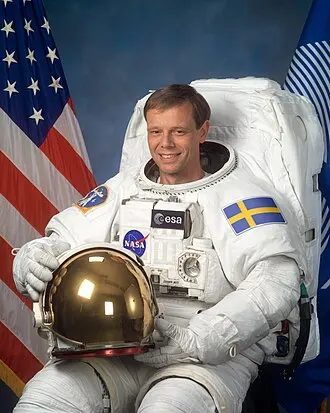 VETERANRetiredESA
VETERANRetiredESAESA·🇸🇪 Sweden·Born 1957
Christer Fuglesang
'Why haven't we been back to the Moon?' Who are we, I wonder?
Hours in Space
2
Missions
5
EVAs
32h
EVA Time
What they aspire to
He hopes humanity will return to the Moon and continue inspiring young people through science.
Biography
First Swedish astronaut. Particle physicist who performed five spacewalks — the first person outside the US/Russian programs to do more than three EVAs.
Before NASAParticle physicist who worked at CERN on proton-antiproton collision experiments and on CP-violation in kaons before teaching mathematics at the Royal Institute of Technology in Stockholm.
Life & career
Arne Christer Fuglesang was born in Stockholm in 1957 to a Swedish mother and a Norwegian-born father who had become a Swedish citizen. He came to spaceflight through pure science rather than the cockpit. After a master's degree in engineering physics from the Royal Institute of Technology (KTH), he earned a doctorate in experimental particle physics in 1987 and later became an associate professor at Stockholm University. As a researcher he worked at CERN in Geneva, first on the UA5 experiment studying proton-antiproton collisions and later, as a CERN Fellow, on the CPLEAR experiment probing the subtle CP-violation of kaons, while also contributing to detector research and teaching mathematics at KTH. In May 1992 ESA selected him for its astronaut corps, and he trained at the European Astronaut Centre in Cologne, later qualifying at NASA and even certifying as a Soyuz flight engineer during a long wait for a Shuttle seat.
Fuglesang finally flew on 10 December 2006 aboard Space Shuttle Discovery on STS-116, becoming the first Swedish citizen in space on the mission he named Celsius. It was a demanding assembly flight to the ISS: he conducted three spacewalks to attach new truss hardware and rewire the station's electrical power system, including an unplanned excursion to help coax in a stubbornly jammed solar array. He returned to orbit on 28 August 2009 on STS-128, a mission he called Alissé, performing two more spacewalks to swap an ammonia tank and route cabling to prepare the station for the European-built Node 3 module. Across his two flights he logged around 627 hours in space and, crucially, five spacewalks totaling roughly 32 hours — making him the first person from outside the American or Russian programs to perform more than three EVAs, then a record for any ESA astronaut.
His achievements earned him the NASA Space Flight Medal and the gold Wargentin Medal from the Royal Swedish Society of Sciences, and cemented his standing as the pioneer of Swedish human spaceflight. Now retired from active flight status, Fuglesang has devoted himself to education and public engagement, becoming a professor at KTH and a prominent voice in Sweden's science community. He is candid about his wish, captured in the question 'Why haven't we been back to the Moon?', that humanity press further outward, and he continues to write and speak — his book '13 Days in Space after 14 Years on Earth' recounting the long road from selection to launch — while championing science education and Sweden's continued role in space exploration.
Notable Missions
STS-116STS-128
Beyond the Mission
Hobbies & Interests
skiingrunningfrisbeereading
Causes They Champion
Science educationPromoting Swedish participation in spaceflight
Languages
SwedishEnglishRussian
Awards & Honors
- Wargentin Medal in gold (Royal Swedish Society of Sciences)
- NASA Space Flight Medal
Authored
- 13 Days in Space after 14 Years on Earth(2007)
Fun fact
He performed five spacewalks across STS-116 and STS-128, more than any other ESA astronaut at the time.
More Astronauts
Other space travelers from ESA