USSR · Energiamission
February 20, 1986
Mir core module launched
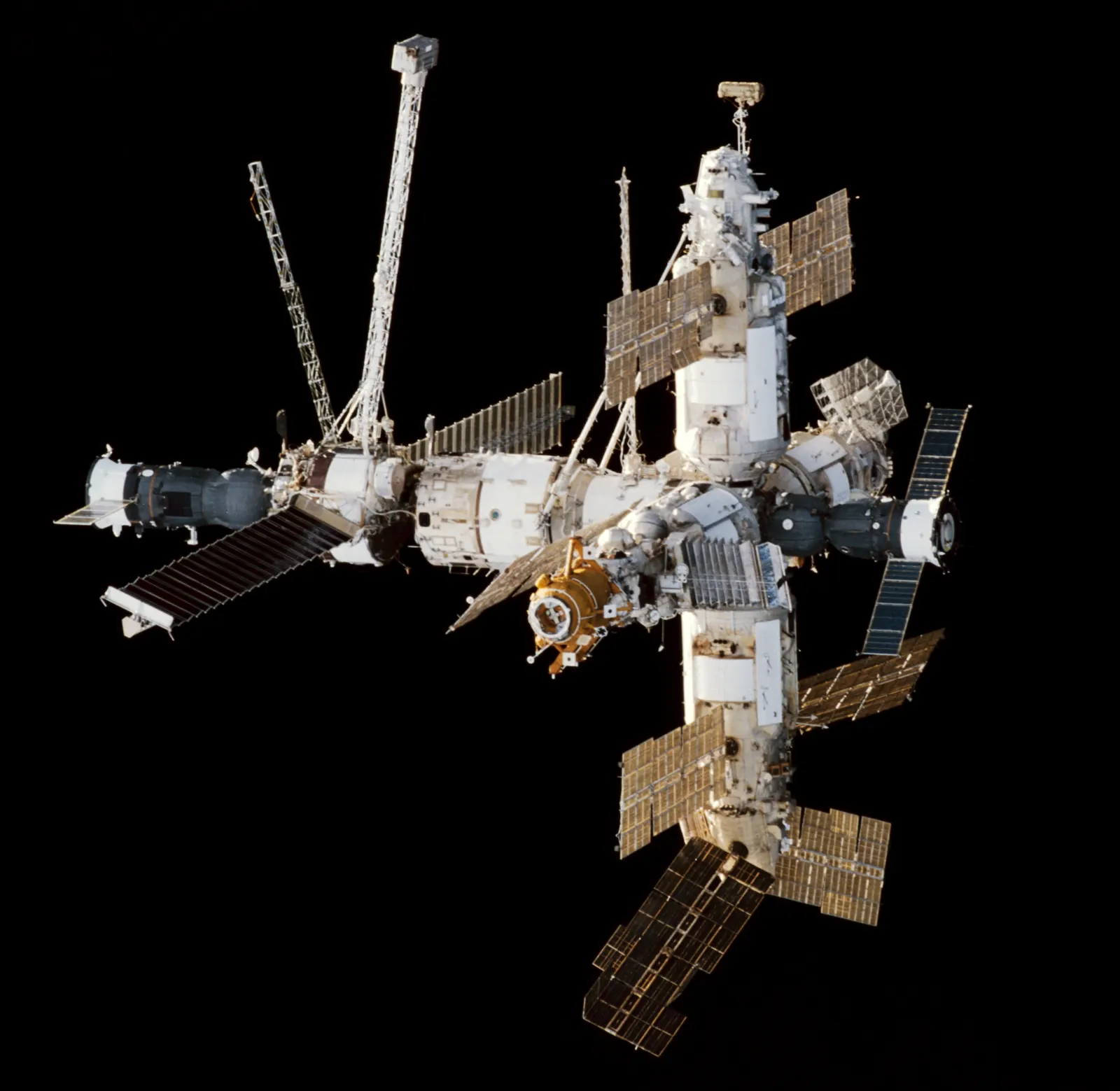
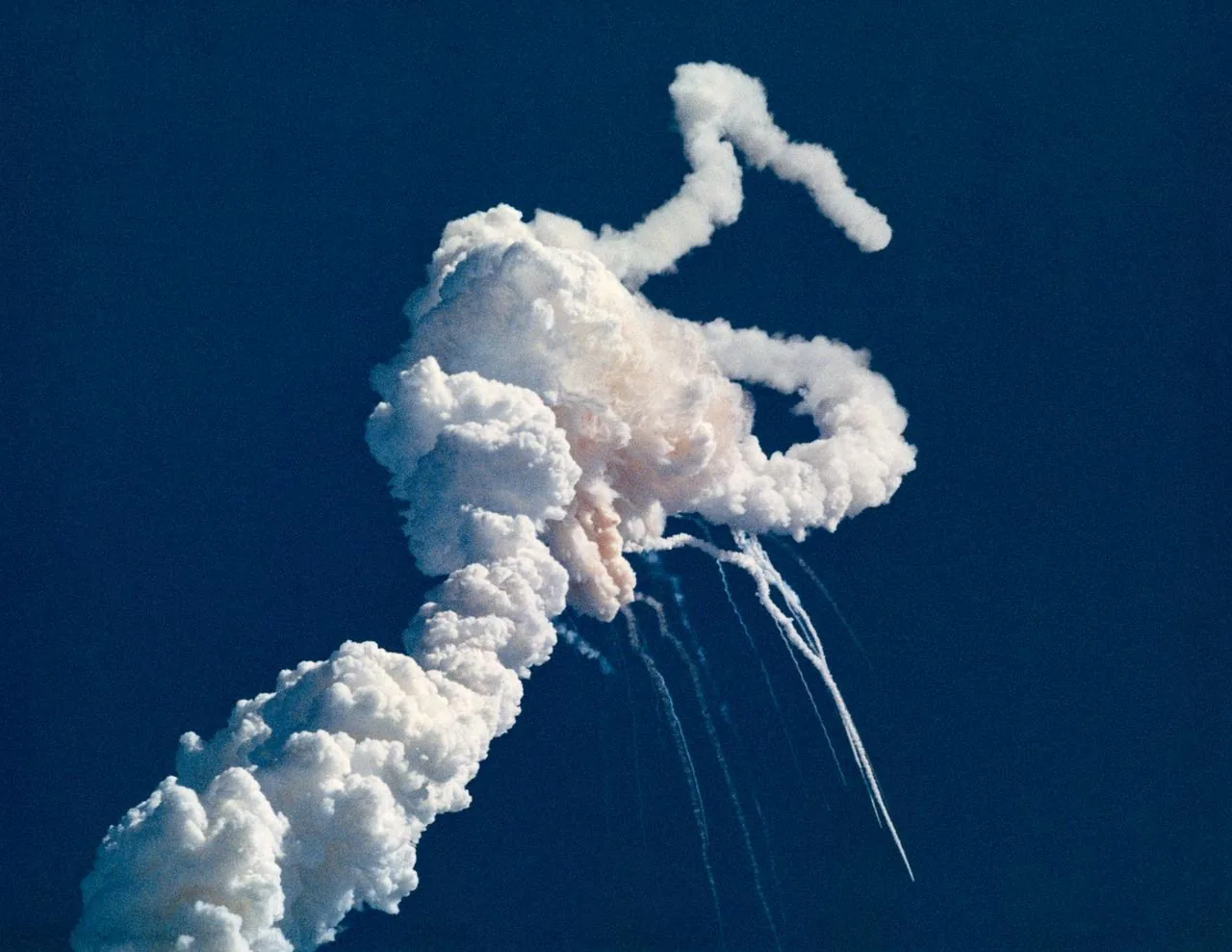
Three weeks after Challenger fell from the Florida sky, the Soviet Union answered with an audacious bet on permanence. In the small hours of 20 February 1986, Moscow time, a Proton rocket rose from Baikonur carrying a 20-tonne cylinder called Mir, a word that means peace, world, and community all at once. The launch had been hurried so success could be announced at the 27th Communist Party Congress days later. Nine minutes after liftoff the base block reached orbit and unfurled its antennas and twin solar wings, and a new kind of space station existed.
What made Mir different was the node at its bow: a spherical docking hub with four radial ports and an axial one, plus another port at the stern. Stations before it were single cans, launched whole and abandoned when their consumables ran out. Mir was a chassis. Specialized laboratories could arrive years later and bolt on, while Soyuz ferries and Progress freighters cycled through the remaining ports. The first residents, Leonid Kizim and Vladimir Solovyov, arrived that March, then flew their Soyuz over to the aging Salyut 7 and back, history's only crew transfer between two space stations.
Over the following decade the research modules joined the core, growing Mir into a roughly 130-tonne complex that hosted 125 people from a dozen countries. It endured nearly everything: an onboard fire in February 1997, a Progress freighter collision that punctured the Spektr module that June, power failures, and the collapse of the country that built it. Crews kept coming. From September 1989 to August 1999 the station was never once empty, a 3,644-day streak unmatched until the ISS overtook it in 2010. Aboard Mir, Valeri Polyakov logged the 437-day flight that remains the single-mission record.
By the late 1990s Russia could not afford two stations, and its money and engineers shifted to the International Space Station, whose Russian segment is Mir's direct descendant. On 23 March 2001, controllers commanded a final burn from a docked Progress freighter, and the fifteen-year-old complex broke apart over the South Pacific, its surviving fragments splashing down near Fiji. Every modular outpost since, from the ISS to China's Tiangong, is built on the architecture Mir proved.
Mission Data
Launch
19/20 Feb 1986, 21:28 UTC (Proton-K, Baikonur)
Core module mass
~20.4 t (45,000 lb)
Docking ports on core
6
Assembled station mass
~130 t after expansion
Longest continuous occupation
3,644 days (1989–1999)
Deorbit
23 Mar 2001, South Pacific
Key Facts
Launched barely three weeks after the Challenger accident, with the flight timed so success could be announced at the 27th Communist Party Congress.
Its first crew flew their Soyuz from Mir to the aging Salyut 7 station and back, the only station-to-station crew transfer ever performed.
Hosted 125 cosmonauts and astronauts from 12 countries, including seven NASA astronauts on long-duration Shuttle-Mir stays.
Survived both an onboard fire and a cargo-ship collision in 1997 and still kept crews aboard until 1999.
Its 3,644-day streak of continuous habitation stood as the record until the ISS finally surpassed it in October 2010.
Why It Mattered
Mir turned spaceflight from visits into residence. It proved a station could be assembled in orbit piece by piece, repaired in place, and inhabited for years at a stretch, and it generated much of what medicine knows about long-duration weightlessness. The Shuttle-Mir program of the 1990s taught NASA and Russia to operate together, making the International Space Station politically and technically possible. The ISS, Tiangong, and every future modular outpost trace their lineage to the 20-tonne base block of February 1986.
NASA, STS089-340-035
Official source