Image: NASA
Mir
Mission Profile
| Launch date | 1986-02-20 |
|---|---|
| Launch site | Baikonur Cosmodrome, Site 200/39 |
| Launch vehicle | Proton-K |
| Spacecraft | Mir orbital complex (DOS-7 core + Kvant-1, Kvant-2, Kristall, Spektr, Priroda, Docking Module) |
| Target | Low Earth Orbit |
| Type | Crewed |
| End date | 2001-03-23 |
| Recovery | Destructive reentry over the South Pacific Ocean on 23 March 2001, with debris falling near Fiji |
| Cost | ≈ US$4.2 billion over its lifetime (2001 estimate by RKA General Director Yuri Koptev) |
| Mass | 129,700 kg (assembled complex) |
| Duration | 15 years in orbit (5,511 days), occupied for about 12.5 years — including 3,644 consecutive days from 1989 to 1999 |
| Partners | NPO Energia / KB Salyut, NASA (Shuttle–Mir), ESA (Euromir), Interkosmos partner states |
Overview
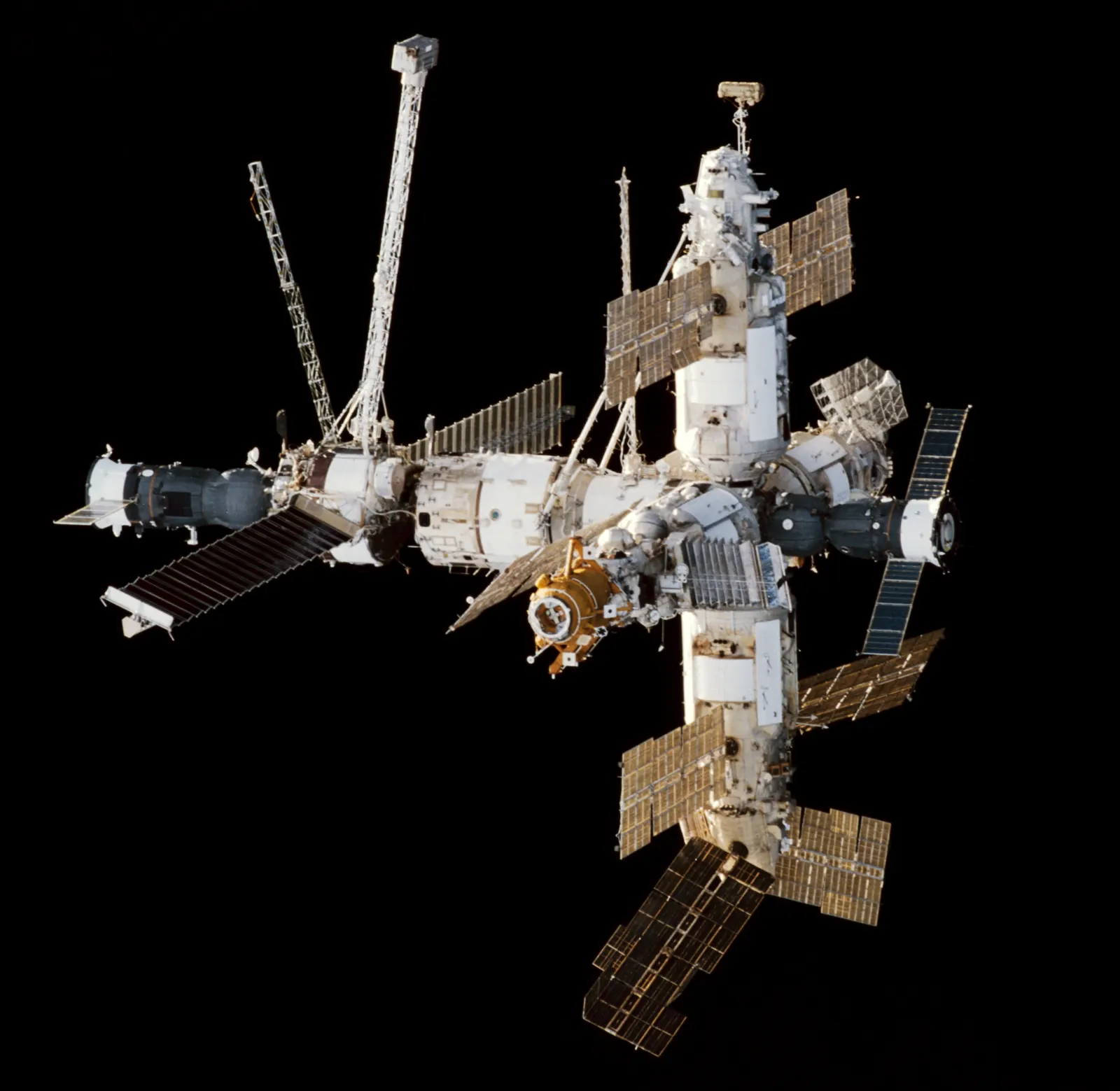
Mir was the first modular space station and the place where humanity learned to live in orbit. Its core module (DOS-7) launched on a Proton-K from Baikonur on 20 February 1986; over the following decade six more elements — Kvant-1, Kvant-2, Kristall, Spektr, Priroda and a Shuttle-delivered Docking Module — grew it into a 129,700-kilogram complex orbiting at 51.6 degrees. Mir was continuously inhabited for 3,644 days between 1989 and 1999, a record unbroken until the ISS surpassed it in 2010, and hosted some 105 spacefarers from 12 nations across roughly twelve and a half years of occupation. It staged the longest single spaceflight in history — physician Valery Polyakov's 437 days in 1994–95 — and the first year-long flight, by Vladimir Titov and Musa Manarov in 1987–88. After the Soviet collapse the station became the centrepiece of the Shuttle–Mir programme: nine Shuttle dockings beginning with STS-71 in June 1995, with NASA astronauts such as Shannon Lucid (188 days in 1996) serving aboard. Mir survived a 1997 onboard fire and a collision with the Progress M-34 freighter that punctured the Spektr module, before funding ran out and it was deorbited into the South Pacific near Fiji on 23 March 2001 — a programme its final director costed at roughly $4.2 billion over its lifetime.
Crew
Yuri Romanenko
Commander, Mir EO-2 (1987)
326 days aboard Mir in 1987, a world record at the time; previously commanded the first Salyut 6 resident crew
Vladimir Titov
Commander, Mir EO-3 (1987–88)
Shared the first year-long spaceflight — 365 days — with Musa Manarov
Musa Manarov
Flight Engineer, Mir EO-3 and EO-8
Co-holder of the first year-in-space record; 541 cumulative days across two Mir expeditions
Sergei Krikalev
Flight Engineer, Mir EO-4 and EO-9/10
His 311-day 1991–92 flight spanned the Soviet collapse, earning him the epithet 'the last citizen of the USSR'
Valery Polyakov
Physician-cosmonaut, Mir EO-3/4 and EO-15–17
Holds the all-time single-flight record: 437 days aboard Mir, 1994–95
Sergei Avdeyev
Flight Engineer, Mir EO-12, EO-20 and EO-26/27
747 cumulative days across three Mir expeditions, a career record at the time
Shannon Lucid
NASA Board Engineer, Shuttle–Mir (1996)
188 days aboard Mir — then the US single-flight record and the women's world record
Gennady Padalka
Commander, Mir EO-26 (1998–99)
198 days aboard Mir before going on to set the career time-in-space record on the ISS
Key Milestones
1986-02-20
Mir core module (DOS-7) launched on a Proton-K from Baikonur
1986-03-15
Soyuz T-15 cosmonauts Leonid Kizim and Vladimir Solovyov become Mir's first occupants
1995-03-22
Valery Polyakov lands after 437 days aboard — still the longest single human spaceflight
1995-06-29
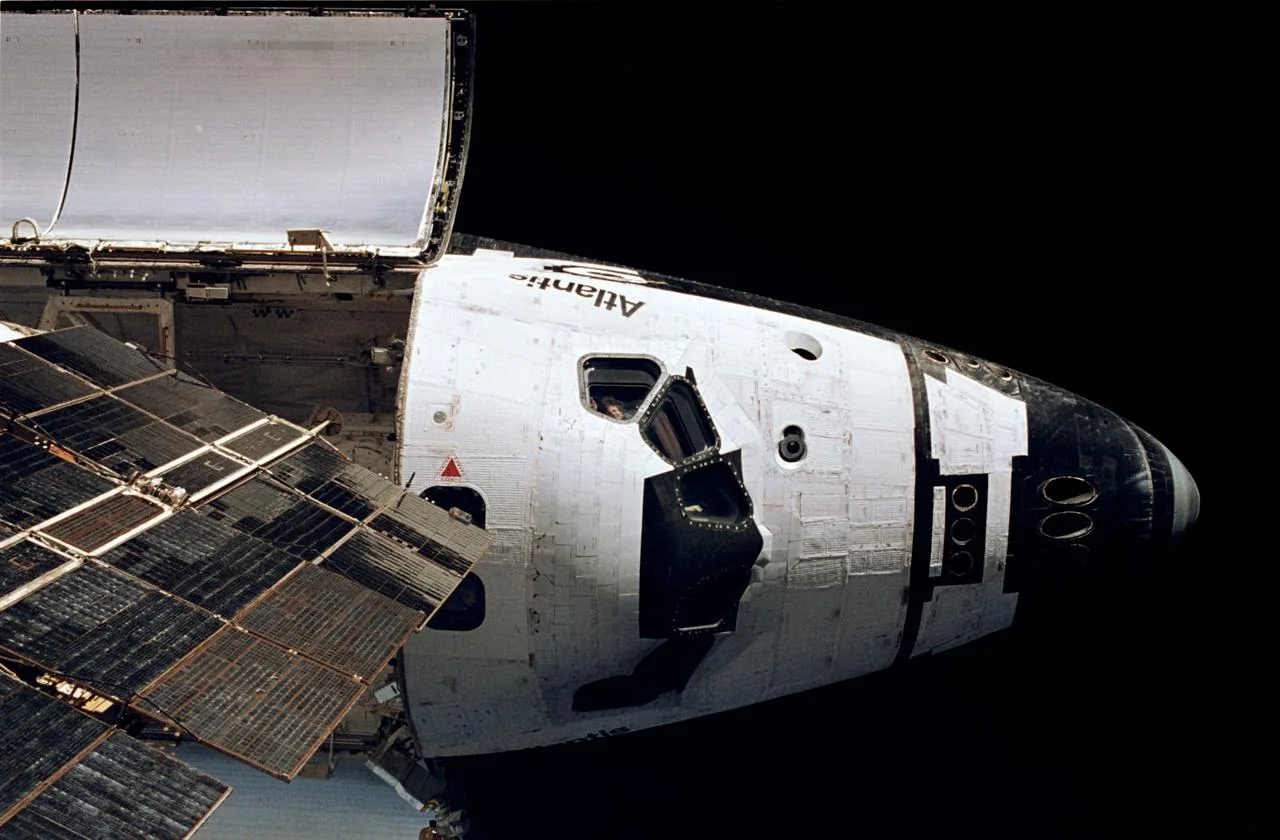
Space Shuttle Atlantis docks on STS-71, the first of nine Shuttle–Mir dockings
1996-04-26
The Priroda module docks, completing the station's assembly after a decade
2001-03-23
Mir is deorbited; surviving debris falls into the South Pacific near Fiji
Key Achievements
First modular space station, assembled in orbit from seven pressurized modules over ten years
Hosted the longest single human spaceflight ever — Valery Polyakov's 437 days (1994–95)
Continuously inhabited for a record 3,644 days (1989–1999), unbroken until the ISS in 2010
Welcomed some 105 spacefarers from 12 nations and supported around 80 spacewalks
Anchored the Shuttle–Mir programme — nine Shuttle dockings that rehearsed the ISS partnership
Legacy & Significance
Mir is the bridge between the pioneer stations of the 1970s and the permanent human presence of today: it proved modular assembly, taught the medicine of year-plus spaceflight, and — through fire, collision and improvised repair — generated an unmatched body of knowledge about keeping an ageing outpost alive. Politically it did something grander still, transforming Cold War rivals into station partners through Shuttle–Mir; the operational playbook, docking hardware lineage and even many of the people who built the International Space Station came directly from Mir. Five of the ten longest human spaceflights in history were flown aboard it.