India · ISROfirstrobotic
September 2, 2023
Aditya-L1 — India's first dedicated solar observatory
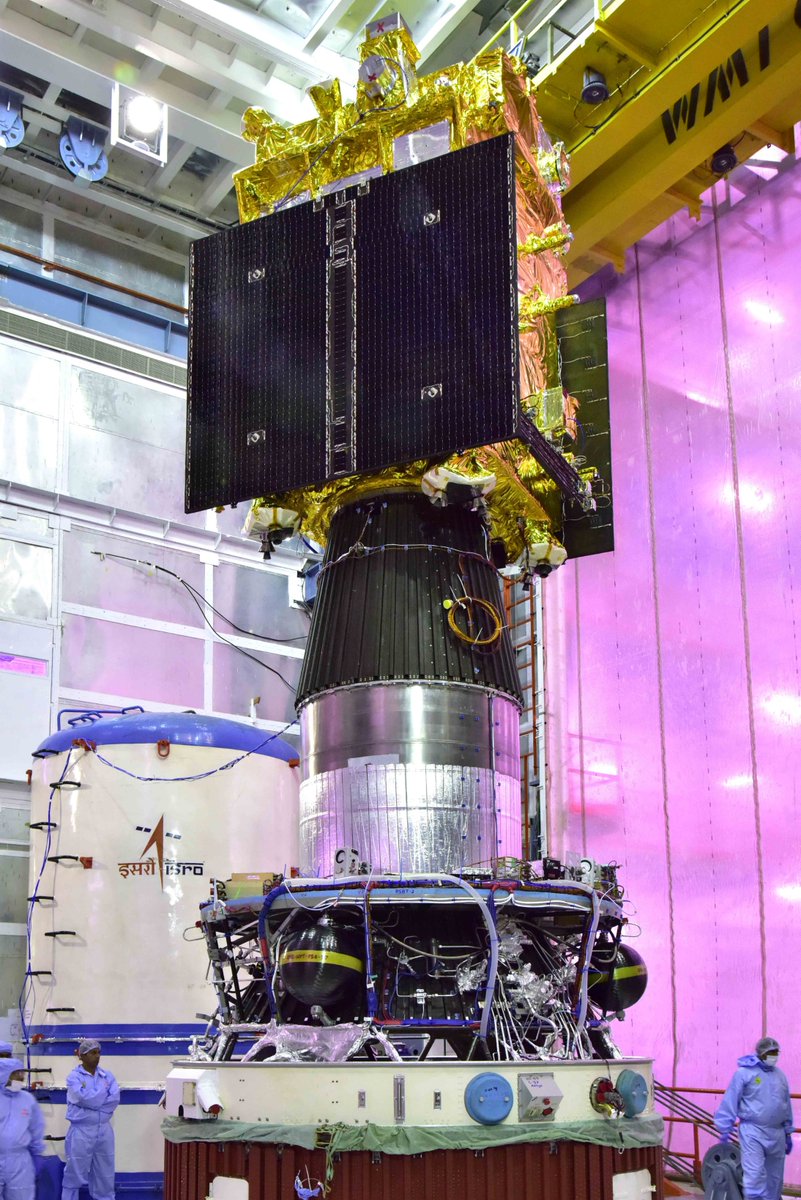
Ten days after India landed on the Moon, the launch pads at Sriharikota were busy again. At 11:50 a.m. on 2 September 2023, a PSLV rocket climbed away from the Satish Dhawan Space Centre carrying Aditya-L1, named for Surya, the Sun god of Hindu tradition, on the country's first mission to study a star. The crowds in the viewing galleries were still riding the euphoria of Chandrayaan-3; now they watched ISRO turn, in less than a fortnight, from the Moon to the Sun.
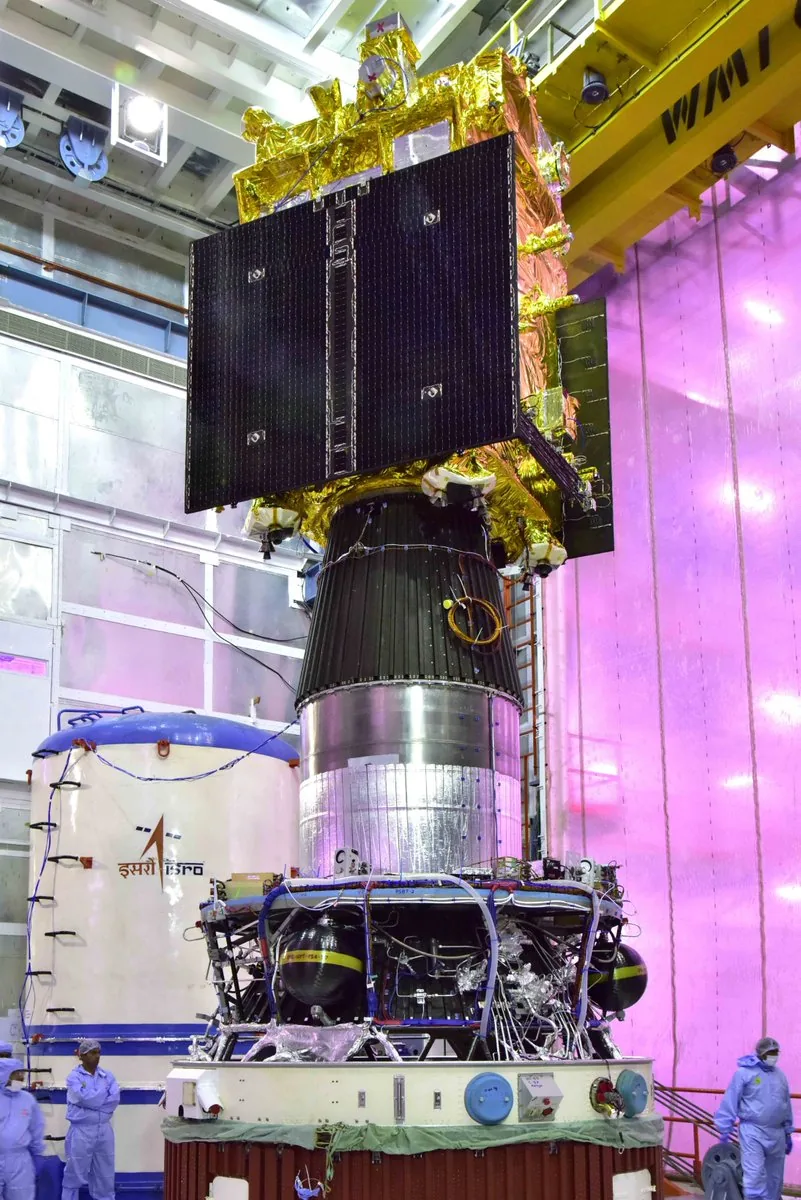
The destination was a place rather than a world: Lagrange point 1, a gravitational balance point 1.5 million kilometres sunward of Earth where a spacecraft can hold position indefinitely with an uninterrupted view of the Sun, no eclipses and no nights. The 1,480-kilogram observatory carries seven instruments, four that stare at the Sun and three that taste the solar wind streaming past. Its crown jewel, the Visible Emission Line Coronagraph, blocks the solar disc with an internal occulter to manufacture a continuous artificial eclipse, revealing the corona that ground astronomers glimpse only during rare minutes of totality.
After a 126-day cruise, Aditya-L1 slipped into its halo orbit around L1 on 6 January 2024, a wide loop it traces roughly once every 178 days. From that vantage it works on the Sun's deepest puzzles, why the corona blazes at millions of degrees above a far cooler surface and how coronal mass ejections erupt, while serving a practical role as a sentinel: solar wind that washes over the spacecraft reaches Earth about an hour later, giving satellite operators and power grids advance warning of geomagnetic storms. India had joined the small club of nations keeping a permanent watch on our star.
“India creates yet another landmark. India's first solar observatory Aditya-L1 reaches its destination.”
Mission Data
Launch
2 Sep 2023, 11:50 IST (PSLV-C57, Sriharikota)
Launch mass
1,480 kg
Science payloads
7
Distance from Earth
1.5 million km (Sun–Earth L1)
Halo orbit insertion
6 Jan 2024
Halo orbit period
~178 days
Key Facts
Aditya-L1 launched just ten days after the Chandrayaan-3 Moon landing, capping the most consequential fortnight in ISRO's history.
From L1 the observatory never experiences an eclipse or a night; it watches the Sun continuously, around the clock, year after year.
Its coronagraph creates a continuous artificial total eclipse, observing the corona down to 1.05 solar radii, a view ground astronomers get only fleetingly during real eclipses.
Solar wind sampled at the spacecraft reaches Earth roughly an hour later, making Aditya-L1 an early-warning buoy for geomagnetic storms.
It holds station 1.5 million kilometres out, about four times farther than the Moon, yet only one percent of the way to the Sun.
Why It Mattered
Aditya-L1 announced that ISRO's ambitions extend beyond destinations to entire disciplines. Heliophysics from L1 had been the preserve of NASA and ESA observatories like SOHO; with one launch India placed its own permanent solar observatory at the Sun-Earth L1 point and gained an independent space-weather early-warning capability, increasingly vital for a country operating large satellite fleets and power infrastructure. Coming ten days after Chandrayaan-3's landing, it cemented 2023 as the year India became a full-spectrum space science power on a famously lean budget.
ISRO (GODL-India)
Official sourceContinue your journey
Mission
Aditya-L1
The mission behind this moment

Moment
JUICE launches to Jupiter's icy moons
From the same era

Moment
Chandrayaan-3 — first soft landing near lunar south pole
From the same era

Moment
OSIRIS-REx returns asteroid sample to Earth
From the same era

Moment
SLIM — Japan becomes the fifth nation to soft-land on the Moon
From the same era