All Astronauts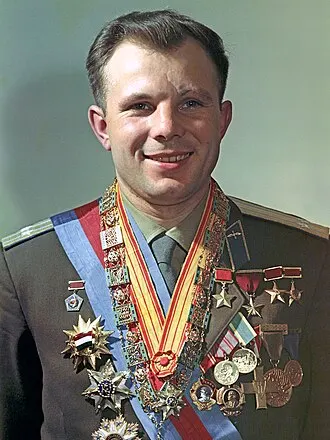 LEGENDIn MemoriamROS
LEGENDIn MemoriamROSRoscosmos·🇷🇺 Russia·Born 1934
Yuri Gagarin
First human in space (April 12, 1961)
2h
Hours in Space
1
Missions
0
EVAs
—
EVA Time
Poyekhali! (Let's go!)
I see Earth! It is so beautiful!
Orbiting Earth in the spaceship, I saw how beautiful our planet is. People, let us preserve and increase this beauty, not destroy it!
I could have gone on flying through space forever.
Inspirations
Konstantin TsiolkovskySergei KorolevYuri Nagibin
What they aspire to
He hoped humanity would safeguard the beauty of Earth he had witnessed from orbit and continue exploring space peacefully.
Biography
First human in space. Completed one orbit of Earth aboard Vostok 1, forever changing human history.
Before NASASoviet Air Forces fighter pilot who flew MiG-15s with the Northern Fleet before being selected for the cosmonaut corps in 1960.
Life & career
Yuri Alekseyevich Gagarin was born on 9 March 1934 in the village of Klushino in Smolensk Oblast, the son of a carpenter and a dairy farmer on a collective farm. His childhood was shadowed by the German occupation during the Second World War, and he came of age in a Soviet Union rebuilding itself. He first trained in the metal trades, qualifying as a foundryman at a vocational school, and then continued his studies at the Saratov Industrial Technical School. But it was flying that captured him: he joined a local aeroclub in Saratov, then entered the First Chkalov Air Force Pilot's School in Orenburg, graduating as a fighter pilot. He flew MiG-15s with the Northern Fleet before being selected in 1960 as one of the first twenty Soviet cosmonauts. Standing only 1.57 metres (5 ft 2 in), Gagarin fit easily inside the cramped Vostok capsule, and his calm temperament, quick mind, and everyman appeal helped Sergei Korolev's team choose him for the first attempt at human spaceflight.
On 12 April 1961, Gagarin launched from the Baikonur Cosmodrome aboard Vostok 1, a Vostok 3KA spacecraft, becoming the first human being to leave Earth. With his signature cry of "Poyekhali!" ("Let's go!"), he rode the rocket into orbit and circled the planet once, the entire flight from launch to landing lasting 108 minutes. The mission was almost entirely automated — a deliberate design choice, since no one knew how a human would function in weightlessness — and Gagarin reported that he felt fine and marvelled at the beauty of Earth below. As the Vostok descent module fell back through the atmosphere, he ejected at roughly 7 kilometres altitude and parachuted to the ground separately from the capsule, coming down in the Saratov region near the Volga River. It was his only spaceflight, but it was enough to change history: in a single orbit he proved that humans could survive the journey into space and return.
Gagarin's flight made him an instant global icon and a symbol of Soviet technological achievement at the height of the Cold War. Named a Hero of the Soviet Union and decorated with the Order of Lenin, he toured the world as an ambassador of the space age and rose to prominence within the cosmonaut corps, eventually training others and pressing to fly again. His life was cut short on 27 March 1968, when the MiG-15UTI training jet he was flying with instructor Vladimir Seryogin crashed near the town of Novoselovo; he was 34. The exact cause remained officially murky for decades, though a leading account — advanced by his friend and fellow cosmonaut Alexei Leonov — attributes the crash to turbulence from another aircraft passing dangerously close. Gagarin's ashes were interred in the Kremlin Wall Necropolis in Moscow. More than half a century later he remains the definitive first, honoured worldwide each 12 April on "Yuri's Night," his name synonymous with the moment humanity first slipped the bonds of Earth.
Records & Firsts
Notable accomplishments by Yuri Gagarin
- First human in space (April 12, 1961)
- First human to orbit Earth
Mission Timeline
- Pilot-Cosmonaut
Vostok 3KA
Vostok 1
Launch: Apr 12, 1961Landing: Apr 12, 1961Duration: 1 day- First human spaceflight
- Single orbit of Earth in 108 minutes
Beyond the Mission
Hobbies & Interests
ice hockeybasketballfishingwater skiing
Causes They Champion
Promoting peaceful uses of outer spaceSoviet youth aviation programs
Languages
Russian
Awards & Honors
- Hero of the Soviet Union
- Order of Lenin
- Order of Karl Marx (East Germany)
- Hero of Socialist Labour (Czechoslovakia)
Fun fact
He was only 1.57 m (5 ft 2 in) tall, an advantage in fitting inside the cramped Vostok capsule.
From the cockpit
“When they saw me in my space suit and the parachute dragging alongside as I walked, they started to back away in fear. I told them, don't be afraid, I am a Soviet like you, who has descended from space and I must find a telephone to call Moscow!”
Learn More
More Astronauts
Other space travelers from Roscosmos