
USA · NASA / APLfirstrobotic
December 24, 2024
Parker Solar Probe makes closest-ever approach to the Sun
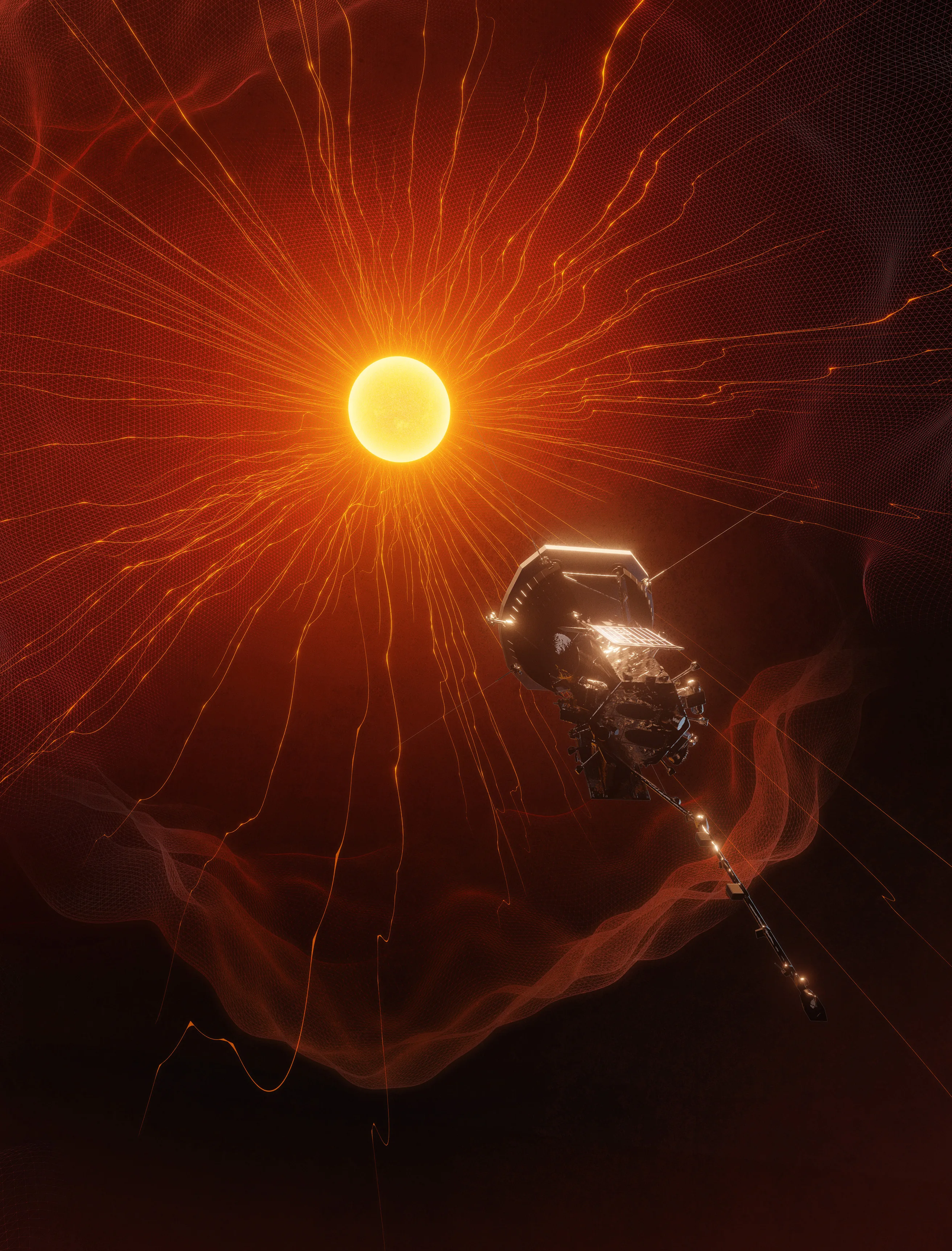
On Christmas Eve 2024, the fastest object humanity has ever built was completely alone. At 6:53 a.m. Eastern time, Parker Solar Probe swept through perihelion just 6.1 million kilometers above the Sun's visible surface, deep inside the corona, moving at roughly 692,000 kilometers per hour. No signal could reach it; no telemetry could leave. At the Johns Hopkins Applied Physics Laboratory in Maryland, the mission operations team could only wait through the holiday while their spacecraft flew closer to a star than anything in history, trusting six years of engineering to a few hours of fire.
Getting there took seven slingshots past Venus, the last on 6 November 2024, each one tightening the orbit like a hand winding a spring. Survival rested on a 11.4-centimeter-thick carbon composite heat shield that faces temperatures near 980 degrees Celsius on these closest passes while the instruments a couple of meters behind it sit near room temperature. The spacecraft keeps the shield pointed sunward autonomously; at these distances, by the time a warning reached Earth and a command returned, it would already be too late.
Two days later, late on 26 December, a simple beacon tone arrived at APL: alive and healthy. Detailed telemetry followed on New Year's Day, confirming the spacecraft had sailed through the corona collecting data from territory no instrument had ever touched. Parker repeated the record-matching pass in March and June 2025, completing its primary mission of 24 solar orbits and giving physicists their first sustained measurements from inside the Sun's atmosphere, where the solar wind is born and the corona is somehow heated to millions of degrees.
There was poetry in the achievement. The probe is the first NASA mission named for a living person: Eugene Parker, the University of Chicago physicist who predicted the solar wind in 1958 and was ridiculed for it. He watched the launch in 2018 at age 91 and died in 2022, before his namesake completed the journey. The spacecraft carries his photograph and a copy of that 1958 paper, now the closest human artifacts to a star.
“No human-made object has ever passed this close to a star, so Parker will truly be returning data from uncharted territory.”
Mission Data
Record perihelion
24 Dec 2024, 11:53 UTC
Distance from solar surface
6.1 million km
Speed
≈692,000 km/h, fastest human-made object
Heat shield
11.4 cm carbon composite
Launched
12 Aug 2018, Delta IV Heavy
Venus gravity assists
7
Key Facts
At closest approach Parker was moving fast enough to fly from Washington, D.C. to Tokyo in under a minute.
The spacecraft was out of contact during the pass; the team spent Christmas waiting for a beacon tone, which finally arrived on 26 December, with full telemetry following on New Year's Day.
Parker is the first NASA mission named after a living person: Eugene Parker, mocked in 1958 for predicting the solar wind, watched the launch at 91; the probe carries his photo and his 1958 paper.
During the pass the shield's sunward face endured temperatures near 980 °C while the instruments behind it stayed close to room temperature.
The record was no one-off: Parker matched the 6.1-million-kilometer distance again in March and June 2025, flying through the corona three times at its design limit.
Why It Mattered
The Christmas Eve perihelion completed a quest astrophysicists had dreamed about since the dawn of the space age: a probe flying inside a star's atmosphere. Data from Parker's deepest passes feed directly into the two great unsolved problems of solar physics, why the corona is hundreds of times hotter than the surface below it and how the solar wind is accelerated, and into the space weather forecasting that protects power grids, aviation and the growing satellite economy. As an engineering feat, the mission proved that thermal protection, autonomy and trajectory design could take a spacecraft to 692,000 km/h within reach of the Sun and bring its data home, setting records for speed and proximity that may stand for decades.
NASA/Johns Hopkins APL/Steve Gribben
Official sourceContinue your journey
Mission
Parker Solar Probe
The mission behind this moment

Moment
Europa Clipper launches to Jupiter's icy moon
From the same era

Moment
Starship Flight 6 — propulsive soft splashdown
From the same era

Moment
Blue Ghost Mission 1 and IM-2 launch together
From the same era

Moment
New Glenn — Blue Origin's first orbital launch
From the same era