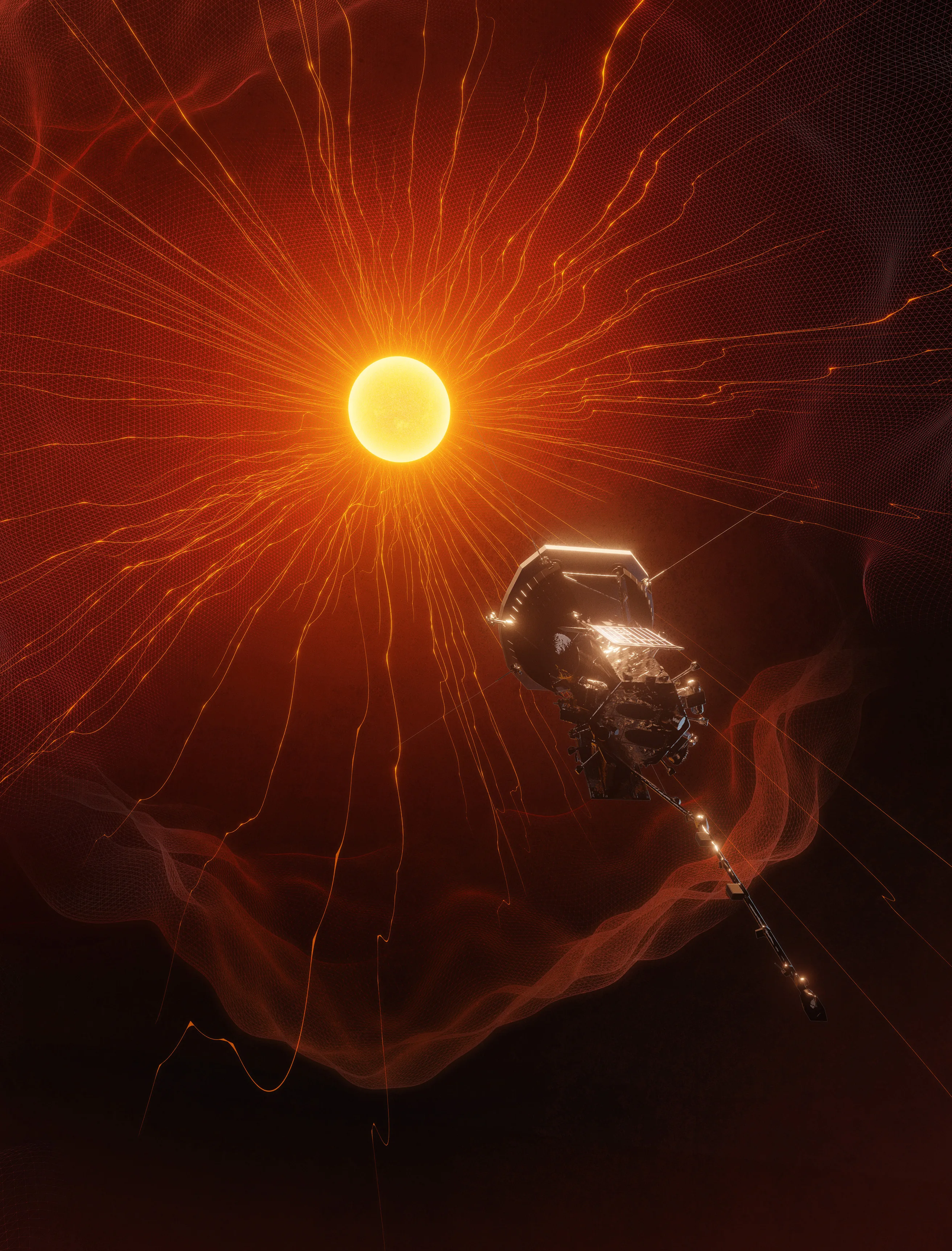
Image: NASA / Johns Hopkins APL
Parker Solar Probe
Mission Profile
| Launch date | 2018-08-12 |
|---|---|
| Launch vehicle | Delta IV Heavy |
| Spacecraft | Parker Solar Probe |
| Target | Sun |
| Type | Robotic |
| Cost | $1.5B life-cycle |
| Mass | 685 kg |
| Duration | 7-year primary mission with 24 perihelia (completed June 2025); mission extension under review |
| Partners | Johns Hopkins APL (lead), Naval Research Laboratory, Smithsonian Astrophysical Observatory, Princeton |
| Instruments | FIELDS (electromagnetic), SWEAP (solar wind), ISʘIS (energetic particles), WISPR (imager) |
Prime Contractors
Companies that built, launched, or operate this mission. Tickers link to their investor profile.
- Johns Hopkins APL
- United Launch Alliance
- Northrop Grumman
Overview
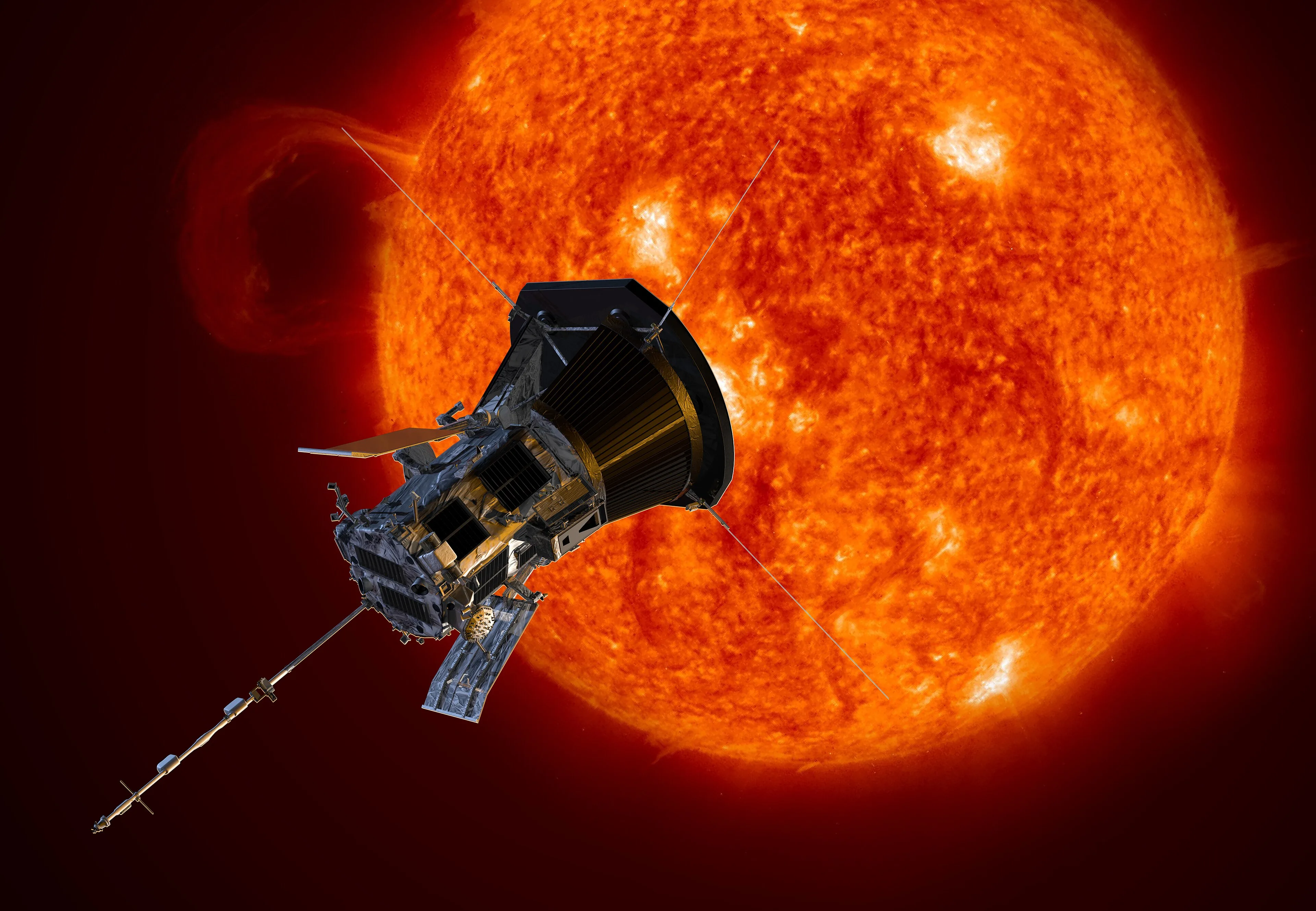
Parker Solar Probe is NASA's flagship heliophysics mission — the first spacecraft ever designed to fly through the Sun's outer atmosphere, the corona, and the closest any human-made object has ever come to a star. Launched in August 2018 on a Delta IV Heavy with a Star-48 upper stage, the spacecraft uses seven Venus gravity assists to progressively shrink its perihelion. On 24 December 2024 Parker reached its first ultra-close perihelion of 6.1 million km from the Sun's surface, traveling at approximately 692,000 km/h — the fastest velocity any human-made object has ever achieved. At those distances Parker is inside the Alfvén critical surface, sampling solar wind plasma before it has fully escaped the Sun's magnetic grip. The 685-kg spacecraft is protected by a 11.4-cm-thick carbon-composite heat shield that keeps the science instruments at room temperature even as the shield's front face exceeds 1,400°C. Parker carries four instrument suites — FIELDS (electric and magnetic fields), SWEAP (plasma and particles), ISʘIS (energetic particles), and WISPR (white-light imager). The mission has already revealed the previously theoretical 'switchbacks' in the solar magnetic field, the origin of the slow solar wind, and the structure of the Sun's dust environment near perihelion. The probe is named after solar physicist Eugene Parker, the first living scientist to have a NASA mission named in his honor.
Key Milestones
2018-08-12
Launch on Delta IV Heavy from Cape Canaveral
2018-09-28
First Venus gravity-assist flyby
2018-11-05
First perihelion (24 million km)
2021-04-28
Becomes first spacecraft to enter the solar corona
2024-12-24
Reaches 6.1 million km perihelion at 692,000 km/h
2025-06
24th and final primary-mission perihelion completed
2025-12-18
26th close approach to the Sun