
China · CNSA / CMSAhuman
April 24, 2025
Shenzhou 20 launches crew to Tiangong
At 5:17 p.m. Beijing time on 24 April 2025, a Long March 2F rose from the Gobi Desert at Jiuquan, the same steppe where China's human spaceflight story began. The date was no accident: it was the tenth national Space Day, marking 55 years to the day since Dongfanghong-1, China's first satellite, reached orbit in 1970. Aboard sat commander Chen Dong, making his third flight, alongside rookies Chen Zhongrui, a former fighter pilot, and Wang Jie, an engineer, both from the astronaut class selected in 2020.
About six and a half hours after liftoff, Shenzhou 20 docked at the radial port of Tiangong's Tianhe core module, and the crew floated in to relieve Shenzhou 19. By 2025 this rhythm, two crewed launches a year, handovers in orbit, a permanently staffed Chinese station, had become so reliable it barely made headlines. The crew settled in for six months of spacewalks to install debris shielding and a science program that included China's first space experiment on planarian flatworms, studying regeneration alongside zebrafish and streptomyces cultures.
The drama came at the end. On 5 November 2025, hours before the scheduled return, inspections found a small crack in a window of Shenzhou 20's reentry capsule, most likely from a space debris strike. China judged the spacecraft unsafe for crew. In an unprecedented swap, Chen Dong's crew came home on 14 November aboard the newer Shenzhou 21 spacecraft, landing safely at Dongfeng, while their successors were left temporarily without a lifeboat until the uncrewed Shenzhou 22 launched on 25 November.
What began as a routine rotation ended as a 204-day flight, the longest Chinese crewed mission to date, and made Chen Dong the first Chinese astronaut to pass 400 cumulative days in space. The wounded Shenzhou 20 capsule was eventually brought back uncrewed in January 2026 for engineers to study. The mission became a case study in both the maturity of China's station operations and the growing menace of orbital debris to every crew in orbit.
Mission Data
Launch
24 Apr 2025, 5:17 p.m. Beijing time
Rocket / site
Long March 2F, Jiuquan Satellite Launch Center
Docking
Tianhe radial port, ≈6.5 hours after liftoff
Crew
3 taikonauts (1 veteran, 2 first-time flyers)
Mission length
204 days, longest Chinese crewed flight to date
Return
14 Nov 2025, aboard the Shenzhou 21 spacecraft
Key Facts
The launch fell on China's Space Day, exactly 55 years after Dongfanghong-1, the country's first satellite, flew from the same Jiuquan spaceport in 1970.
The crew ran China's first space regeneration experiment on planarian flatworms, creatures that can regrow a severed head, alongside zebrafish and streptomyces studies.
A suspected debris strike cracked their return capsule's window hours before the planned November undocking, forcing the first crew swap of return spacecraft in Chinese spaceflight history.
The extended 204-day flight made Chen Dong the first Chinese astronaut to exceed 400 cumulative days in space.
The improvised rescue left the incoming Shenzhou 21 crew briefly without an escape craft, until China launched the uncrewed Shenzhou 22 on 25 November 2025 as a replacement lifeboat.
Why It Mattered
Shenzhou 20 demonstrated both faces of China's human spaceflight program in a single mission. The launch itself showed a system running with quiet, industrial regularity: two crews a year, in-orbit handovers, a station never left empty. The ending showed something rarer and more important, that China could improvise safely under pressure, reassigning return spacecraft, accepting a gap in lifeboat coverage, and launching an uncrewed replacement within weeks. The window crack also gave the world one of its clearest warnings yet about orbital debris as an operational threat to crewed stations, a problem every spacefaring nation now shares.
Mission Crew
Chen DongChen ZhongruiWang Jie
China News Service (中国新闻社), CC BY 4.0, via Wikimedia Commons
Official sourceContinue your journey
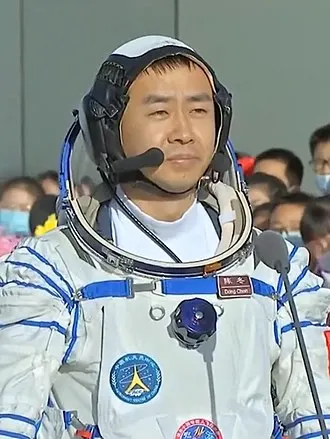
Astronaut
Chen Dong
Flew on this mission

Moment
IM-2 Athena reaches the lunar south pole — partial success
From the same era

Moment
Wilmore and Williams return after unplanned nine-month ISS stay
From the same era

Moment
Tianwen-2 launches — China's first asteroid sample-return mission
From the same era

Moment
SpaceX Crew-11 launches to the ISS
From the same era