
USA · NASA/JPLmissionrobotic
July 4, 2016
Juno enters Jupiter orbit
While America watched fireworks on the Fourth of July 2016, the people who most needed the night to go right were sealed in a windowless room at NASA's Jet Propulsion Laboratory. Juno, launched on 5 August 2011 and nearly five years and 2.8 billion kilometres into its journey, was diving toward Jupiter at one of the highest speeds any human-made object had reached, threading a gap between the planet and its lethal radiation belts. At 8:18 p.m. Pacific time, right on schedule, its main engine lit.
The 35-minute burn had to happen entirely on the spacecraft's own initiative. Juno spun itself up to five revolutions per minute for stability, turned its antenna away from Earth, and slowed by 542 metres per second while its makers listened to faint telemetry tones arriving 48 minutes after the fact. At 8:53 p.m. Pacific time the tone confirming capture arrived, and the room at JPL erupted. A spacecraft running on sunlight 25 times weaker than Earth's had put itself into polar orbit around the largest planet in the Solar System.
Everything about Juno was an engineering dare. It was the first solar-powered spacecraft sent to Jupiter, flying three nine-metre solar wings to harvest a few hundred watts. Its computers ride inside a titanium vault because Jupiter's radiation would otherwise destroy them, and bolted to its deck are three aluminum LEGO figurines: the god Jupiter, his wife Juno, and Galileo, who discovered the planet's large moons in 1610.
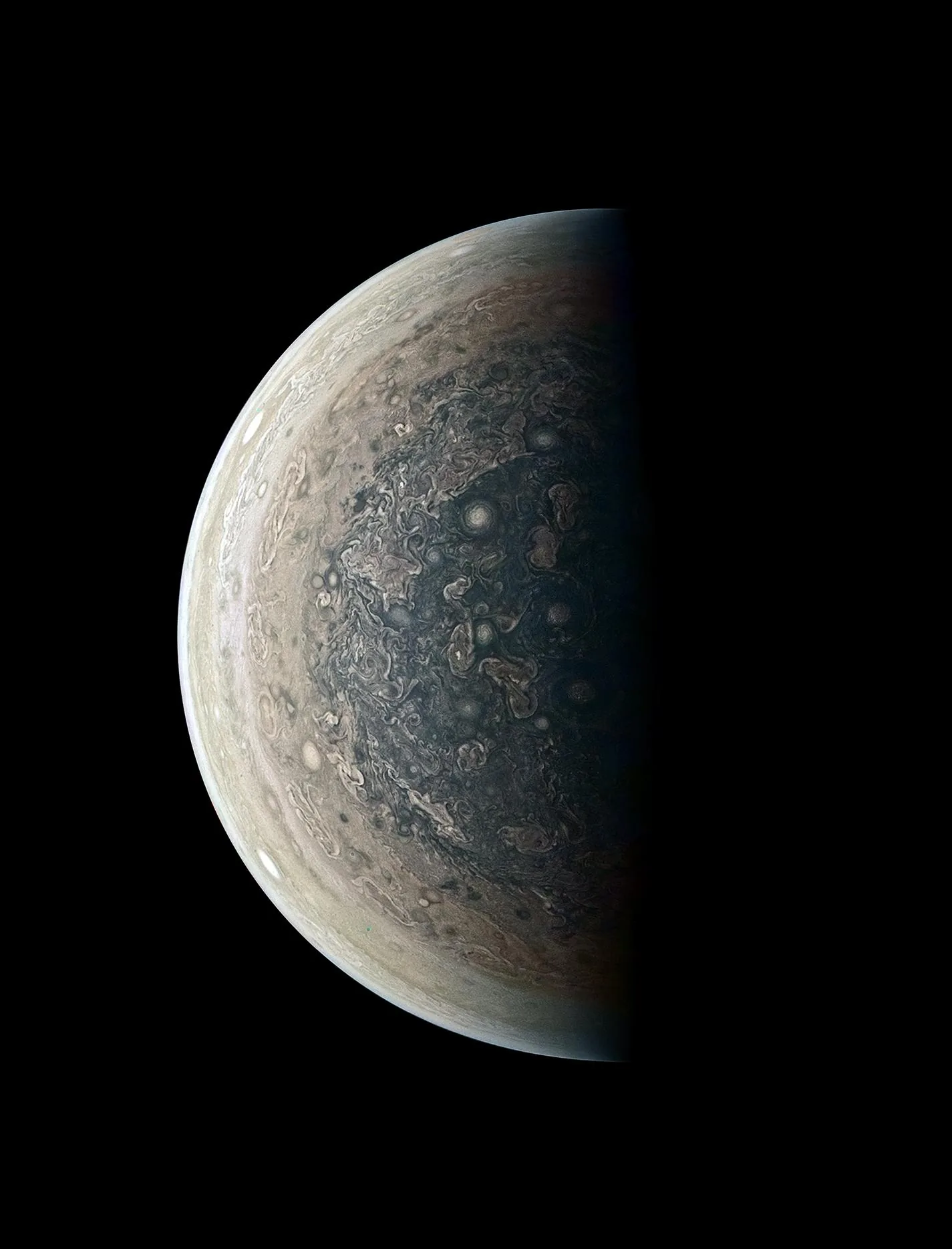
Settled into long 53-day polar orbits, Juno proceeded to rewrite the textbook. Its instruments revealed geometric clusters of cyclones at both poles, a surprisingly deep Great Red Spot, a lumpy magnetic field, and gravity data pointing to a strange, dilute core, while JunoCam's images, processed by volunteers around the world, became some of the most recognizable planetary photographs ever made. Extended well beyond its planned end, the mission went on to fly past Ganymede, Europa and Io, operating through September 2025 and beyond its original imagination.
“The mission team did great. The spacecraft did great. We are looking great. It's a great day.”
Mission Data
Launch
5 Aug 2011, Atlas V 551
Orbit insertion
4 Jul 2016
Insertion burn
35 min, slowing 542 m/s
Cruise distance
2.8 billion km (1.7 billion mi)
Power
Three 9 m solar wings, ~500 W at Jupiter
Orbit
53-day polar orbits
Key Facts
Juno carries three LEGO minifigures machined from spacecraft-grade aluminum: the god Jupiter, the goddess Juno, and Galileo Galilei, complete with his telescope.
The make-or-break engine burn happened with the spacecraft spun up to five revolutions per minute and effectively out of contact; confirmation tones took 48 minutes to crawl back to Earth at light speed.
Its electronics fly inside a titanium radiation vault, because over the mission Juno absorbs a radiation dose NASA compared to more than 100 million dental X-rays.
At Jupiter, sunlight is 25 times weaker than at Earth, and no solar-powered spacecraft had ever operated so far from the Sun before Juno.
JunoCam was included largely for public engagement, and its raw images, processed by volunteers worldwide, produced some of the most famous planetary photographs in history.
Why It Mattered
Juno proved that solar power could work in the outer Solar System, a decision that reshaped how missions to deep space are designed, and its radiation-vault architecture became a template for surviving the harshest environments around Jupiter. Scientifically it transformed the gas giant from a banded postcard into a three-dimensional world: polygonal polar cyclone clusters, a dilute 'fuzzy' core that challenged planet-formation models, and the deepest map yet of a giant planet's gravity and magnetism. Its citizen-science imaging model changed how agencies share missions with the public, and its extended tour of Ganymede, Europa and Io bridged directly into the Europa Clipper era.
NASA / JPL-Caltech
Official sourceContinue your journey
Mission
Juno
The mission behind this moment

Moment
New Horizons flies past Pluto
From the same era

Moment
Falcon 9 first stage lands vertically after orbital launch
From the same era

Moment
SES-10 — first reflight of an orbital-class rocket booster
From the same era

Moment
BepiColombo launches toward Mercury
From the same era