USA · NASA/JPLfirstrobotic
January 31, 1958
Explorer 1 — first US satellite, discovers Van Allen belts
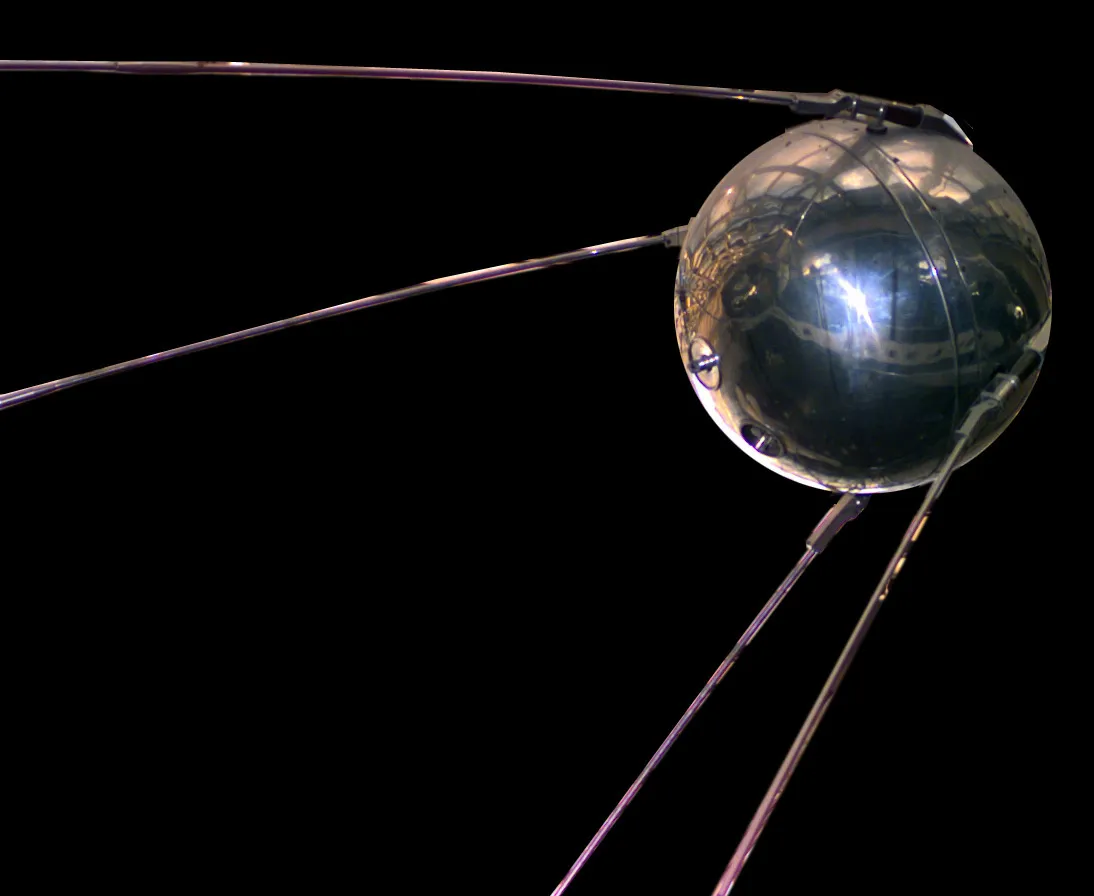
Late on the night of 31 January 1958, a slender white rocket stood floodlit at Cape Canaveral's Launch Complex 26. America had watched Sputnik cross its skies for four months and had watched its own Vanguard rocket explode on the pad in December on live television. At 10:48 p.m. Eastern time the Juno I booster lit and climbed into the dark, and after ninety anxious minutes a tracking station in California confirmed a signal coming back around the world. The United States was in orbit.
The satellite itself was a two-meter pencil of instruments weighing just 13.9 kilograms, designed and built by the Jet Propulsion Laboratory in 84 days. NASA did not yet exist; this was the Army Ballistic Missile Agency's rocket, Wernher von Braun's modified Jupiter-C, mated to a payload carrying James Van Allen's cosmic ray experiment, a single Geiger-Müller tube from the University of Iowa. At about 1:30 a.m., Pickering, Van Allen, and von Braun hoisted a full-scale model overhead at a Washington press conference, creating one of the Space Race's defining photographs.
Then the instrument started behaving strangely. At low altitudes the counter clicked along as expected, but at the high points of the orbit it sometimes fell silent. Van Allen's team realized the tube was not failing, it was saturating, overwhelmed by radiation far more intense than anyone had predicted. Earth, they concluded, is wrapped in belts of charged particles trapped by its magnetic field. Explorer 3 confirmed the theory two months later, and the Van Allen radiation belts became the first scientific discovery of the Space Age.
Explorer 1 transmitted until 23 May 1958, then circled silently for twelve more years before burning up on 31 March 1970 after roughly 58,000 orbits. Even its flaws taught lessons: the satellite's flexible whip antennas drained rotational energy and flipped it into an end-over-end tumble, an accident that rewrote the rules of spacecraft spin stability and is still cited in aerospace textbooks today.
Mission Data
Launch
31 Jan 1958, 10:48 p.m. EST, Cape Canaveral LC-26A
Launch vehicle
Juno I (modified Jupiter-C)
Mass
13.9 kg (30.66 lb)
Orbit
354 × 2,515 km, 114.8 min period
Last transmission
23 May 1958
Reentry
31 Mar 1970, after ~58,000 orbits
Key Facts
JPL designed and built America's first satellite in just 84 days after getting the go-ahead in the wake of Sputnik.
NASA did not exist yet: Explorer 1 was launched by the US Army, and the agency that would inherit it was not created until October 1958.
The famous photo of Pickering, Van Allen, and von Braun hoisting a model satellite overhead was taken at a triumphant 1:30 a.m. press conference in Washington.
The Geiger counter's mysterious silences at high altitude were the discovery: the tube was saturated by radiation thousands of counts beyond its design, revealing the radiation belts.
Its flexible whip antennas accidentally caused the satellite to tumble end over end, an unplanned experiment that established a foundational rule of spacecraft spin stability.
Why It Mattered
Explorer 1 put the United States into the Space Race and, more importantly, set the template for how the country would run it: every launch should return science. The discovery of the Van Allen radiation belts, made by an instrument weighing a few kilograms, founded the field of magnetospheric physics and proved that space itself was an environment to be measured, not just crossed. Within months Congress created NASA, and the Explorer program it began is still launching scientific satellites today, making it the longest-running spacecraft series in American history.
NASA/JPL (public domain)
Official source