
USA · NASA/JPLfirstrobotic
August 25, 2012
Voyager 1 enters interstellar space
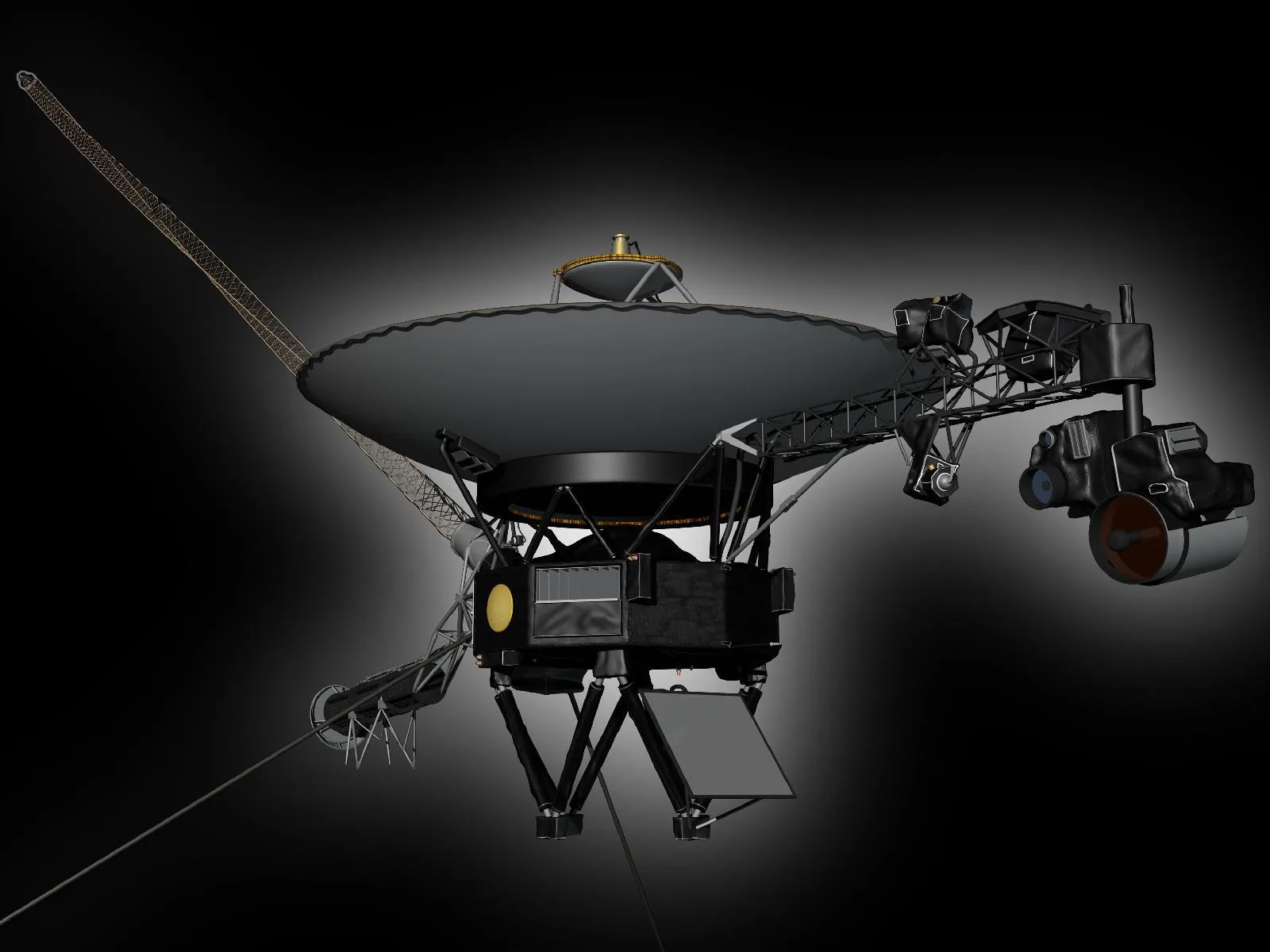
Nothing happened on 25 August 2012, at least nothing anyone could see. More than 18 billion kilometres from Earth, a spacecraft built in the disco era sailed on in silence. But aboard Voyager 1, the particle counters told a sudden story: charged particles from the Sun all but vanished, while galactic cosmic rays from dying stars elsewhere in the Milky Way surged. After a 35-year journey, the probe had slipped across the heliopause, the boundary where the Sun's wind yields to the matter between the stars. No one on Earth would be sure of it for more than a year.
The problem was cruel: the one instrument designed to measure the surrounding plasma directly had been dead since 1980. Proof required knowing the density of the gas Voyager was flying through, and there was no way to read it. The Sun itself provided the answer. A massive solar eruption in March 2012 finally washed over Voyager 1 in April 2013 and set the local plasma ringing like a struck bell. The plasma wave instrument heard the oscillation, and the pitch revealed a density forty times higher than the outer heliosphere. Only interstellar space could be that dense.
Working backwards through the data, Don Gurnett's team dated the crossing to around 25 August 2012, at 121.7 astronomical units from the Sun. NASA made it official on 12 September 2013, with the results published in the journal Science. Thirty-six years after leaving Florida in September 1977 on a mission to Jupiter and Saturn, Voyager 1 had become the first human-made object to enter the space between the stars.
It is still out there, still transmitting through NASA's Deep Space Network, its signal taking the better part of a day to arrive. Bolted to its side rides the Golden Record, a gold-plated copper disc carrying greetings in 55 languages, the sounds of Earth, and Chuck Berry. Long after its power fades, the spacecraft will drift on, our first envoy to the galaxy.
“Now that we have new, key data, we believe this is mankind's historic leap into interstellar space.”
Mission Data
Launch
5 Sep 1977
Heliopause crossing
25 Aug 2012
Distance at crossing
121.7 AU (~18.2 billion km)
Confirmation announced
12 Sep 2013
Speed
~17 km/s relative to the Sun
Plasma density jump
~40× the outer heliosphere
Key Facts
Voyager 1 crossed into interstellar space on the very day Neil Armstrong died, 25 August 2012; one era of exploration ended as another quietly began.
The crossing also fell exactly 23 years to the day after sister ship Voyager 2's closest approach to Neptune on 25 August 1989.
The instrument meant to detect the crossing had been dead for 32 years; confirmation required the Sun's own eruption to make the interstellar plasma 'ring' so the plasma wave antennas could hear its density.
Scientists debated the data for over a year, and NASA only confirmed the historic crossing thirteen months after it actually happened.
The Golden Record aboard carries greetings in 55 languages, whale song, a heartbeat, and Chuck Berry's Johnny B. Goode, humanity's mixtape for whoever finds it.
Why It Mattered
Voyager 1's crossing turned the heliopause from a theoretical construct into a measured place and gave humanity its first direct samples of the interstellar medium, data no other spacecraft will replicate for decades. It redrew the textbook picture of the Sun's protective bubble, revealing a boundary stranger and more porous than models predicted. Beyond the science, the moment carried rare symbolic weight: a 1977 spacecraft with less memory than a key fob became our species' first interstellar object, proof that patient engineering can outlive the generation that built it.
NASA / JPL
Official sourceContinue your journey
Mission
Voyager 1
The mission behind this moment

Moment
STS-135 Atlantis — final Space Shuttle mission
From the same era

Moment
Curiosity rover lands on Mars
From the same era

Moment
Mangalyaan launches — Mars Orbiter Mission
From the same era

Moment
Chang'e 3 / Yutu — first Chinese soft Moon landing
From the same era