Full mission transcript
Every chapter of Artemis II, in sequence.
T+00:00:00
We Go for All Humanity
April 1, 2026 · 22:35 UTC
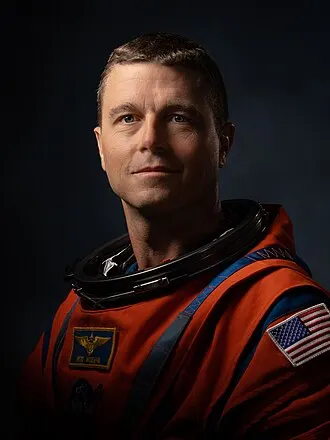
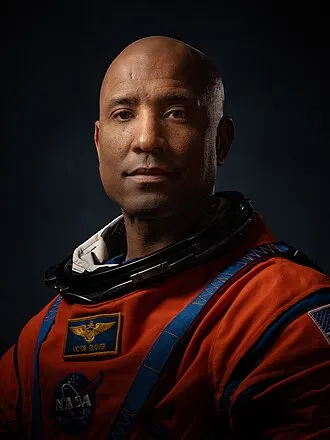
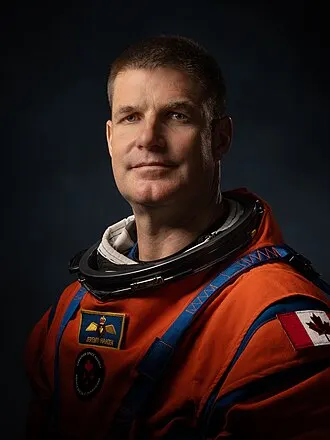
The date read April 1, and NASA spent the morning assuring the world it was no joke. Seventeen months of delay — a heat-shield investigation, life-support and battery work, a hydrogen leak in February, a helium-flow problem in March — had pushed Artemis II from late 2024 to this evening. Now the 322-foot Space Launch System stood fueled on Launch Complex 39B with four people at the top: commander Reid Wiseman, pilot Victor Glover, and mission specialists Christina Koch and Jeremy Hansen of the Canadian Space Agency. Their Orion spacecraft carried a callsign the crew had chosen themselves: Integrity.
During the final poll, launch director Charlie Blackwell-Thompson called up to the spacecraft, and the crew answered in relay. Glover: 'We are going for our families.' Koch: 'We are going for our teammates.' Hansen finished the crew's answer with the words that became the mission's promise. Wiseman closed it out — 'All right, Charlie, your Artemis II crew is go for launch. Full send' — and Blackwell-Thompson sent back a benediction: on this historic mission, they carried the heart of the Artemis team, the daring spirit of the American people and partners across the globe, and the hopes and dreams of a new generation. 'Good luck. Godspeed, Artemis II. Let's go.'
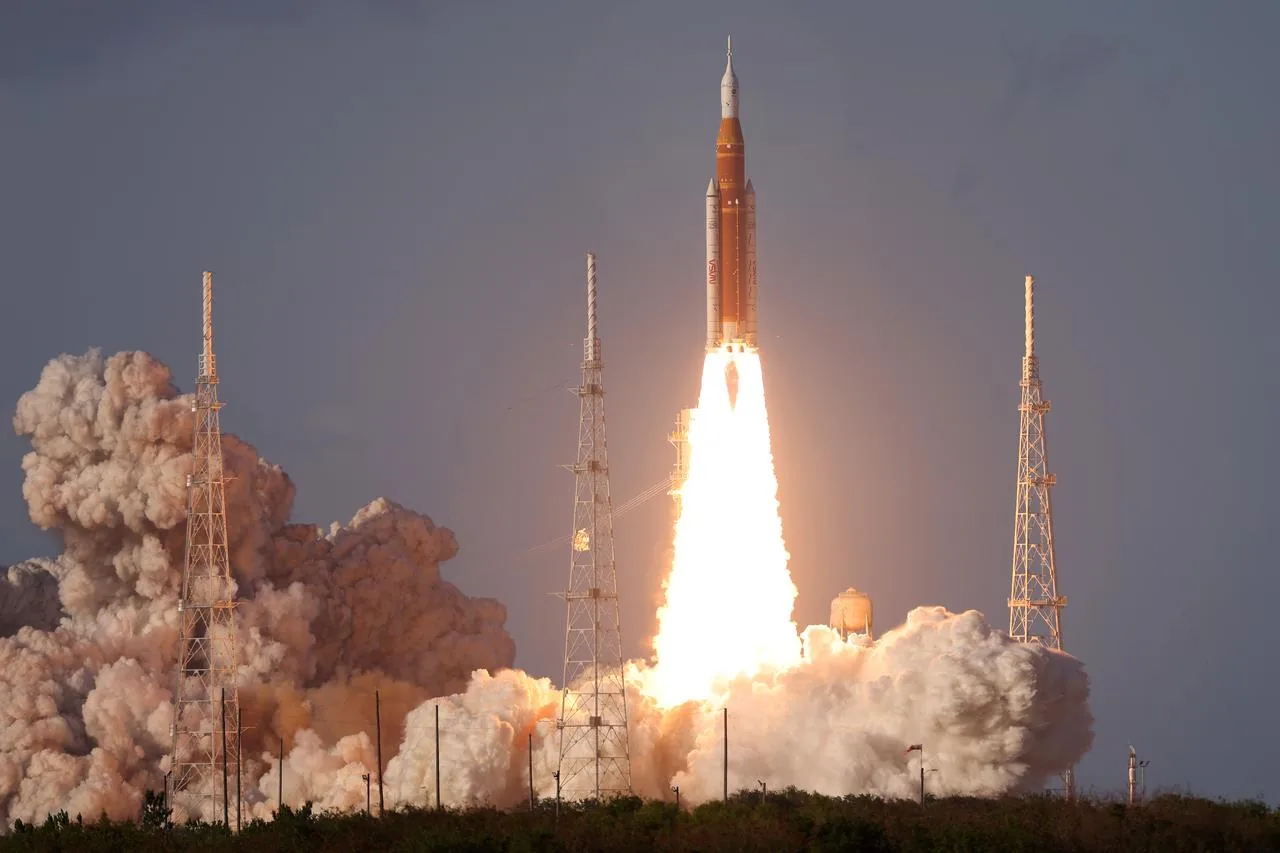
At 22:35 UTC — 6:35 p.m. local — the boosters lit and 8.8 million pounds of thrust pushed the stack off the pad, NASA commentator Derrol Nail calling the moment: 'And liftoff. The crew of Artemis II, now bound for the Moon. Humanity's next great voyage begins.' The vehicle cleared the tower in seven seconds, went supersonic in under a minute, shed its boosters at two minutes nine seconds and its launch abort system at three thirteen. Main engine cutoff came at T+8:02, and about eighteen minutes in, Orion's four solar array wings unfolded. No human had flown beyond low Earth orbit since Apollo 17 in December 1972 — 53 years. Aboard Integrity were the first woman, the first person of color, and the first non-American ever to fly on a lunar mission, a crew announced under one NASA administrator in 2023 and flown under another in 2026.
Air-to-ground · NASA broadcast - T−16:01 Blackwell-Thompson (LD): Attention on the net: this is the launch director performing the final poll for launch. Verify no constraints and go for launch.
- T−15:15 Glover: Thank you, Charlie. This is Victor. We are going for our families.
- T−15:09 Koch: This is Christina. We are going for our teammates.
- T−15:03 Hansen: This is Jeremy. We are going for all humanity.
- T−14:59 Wiseman: All right, Charlie, your Artemis II crew is go for launch. Full send.
- T−14:52 Blackwell-Thompson (LD): Reid, Victor, Christina, and Jeremy — on this historic mission you take with you the heart of this Artemis team, the daring spirit of the American people and our partners across the globe, and the hopes and dreams of a new generation. Good luck, Godspeed, Artemis II. Let's go.
- T+00:00:00 Nail (NASA commentary): Booster ignition, and liftoff. The crew of Artemis II, now bound for the Moon. Humanity's next great voyage begins.
- T+00:00:21 Jordan (Houston PAO): Houston now controlling the flight of Integrity on the Artemis II mission around the Moon.
- T+00:08:26 CAPCOM: Integrity — nominal MECO, core stage separated.
- T+00:08:30 Integrity (crew): We see the same onboard, Stan.
T+05:02:00
Shakedown in High Orbit
April 2, 2026 · 03:37 UTC
Artemis II did not sprint to the Moon. First came a deliberate shakedown cruise: the Interim Cryogenic Propulsion Stage raised Orion's orbit into a vast ellipse reaching roughly 46,000 miles above Earth, a loop that takes about 23 and a half hours to complete. Up there, far above the International Space Station's neighborhood, the crew became the first people ever to live on Orion's full life-support system — every scrubber, valve, and fan getting its first exam with human lives attached.
Then Orion separated from the spent upper stage and turned around to face it. With Wiseman alongside, Glover took manual control and flew a roughly 70-minute proximity-operations demonstration — approaching the free-floating stage, station-keeping, backing away — wringing out the handling qualities astronauts will need for dockings on later Artemis flights. The crew reported the real spacecraft flew crisper than the simulator. The demo was complete by 03:37 UTC, five hours into the mission.
The discarded stage had one more job: its adapter released four 12U CubeSats built by Artemis Accords partners — South Korea, Germany, Argentina, and Saudi Arabia — before the stage itself was disposed over the Pacific. On flight day two, a 43-second burn of Orion's service module raised the orbit's low point, setting the table for the maneuver everything else depended on.
T+1d 01:14
Goodbye, Earth Orbit
April 2, 2026 · 23:49 UTC
On the evening of April 2, the mission management team polled go, and at 23:49 UTC Orion performed the burn that ended five decades of waiting: trans-lunar injection. On Artemis I, the uncrewed test flight, the ICPS upper stage had done this job. This time the stage was long gone — it was Orion's own European Service Module main engine, a single 6,700-pound-thrust engine built around shuttle-heritage hardware, that lit and held for five minutes and fifty seconds, adding 1,274 feet per second and pushing the spacecraft to roughly 24,527 miles per hour.
When the engine shut down, the crew of Integrity were no longer in Earth orbit. For the first time since December 1972, human beings were on their way to the Moon — and on a trajectory chosen for its elegance as much as its ambition. Artemis II flew a free return: a path shaped so that the Moon's own gravity would swing the spacecraft around the far side and sling it home, no lunar orbit insertion required, no second big burn standing between the crew and Earth if anything failed.
As Orion receded, communications shifted from the ground stations that serve Earth orbit to the Deep Space Network — the giant dishes in California, Spain, and Australia that talk to spacecraft at planetary distances. The numbers on the flight controllers' displays began climbing into territory no crewed mission had touched in 53 years.
T+2d 01:25
The Long Coast
April 4, 2026 · 00:00 UTC
For three days Orion coasted outward, and the mission settled into the strange domesticity of deep space. Four people shared 316 cubic feet of habitable volume — roughly the interior of a large van — for a quarter-million-mile road trip. On April 3, Wiseman photographed a shrinking Earth through the windows. The crew worked exercise sessions on a resistance device, collected saliva samples for an immune-system study, and at night clipped T-shirts over the windows, because in translunar space the Sun never sets.
The flight's honest texture showed early. Shortly after launch, the toilet's pump refused to prime until the crew worked the fix. Then, on flight days three and four, urine froze inside the toilet's external vent line. Mission control's solution was elegantly simple: rotate the spacecraft so sunlight fell on the frozen plumbing, run the heaters, and let the Sun do the thawing. It worked. Crews who go to the Moon to stay will inherit a hundred small lessons like this one — none of them glamorous, all of them necessary.
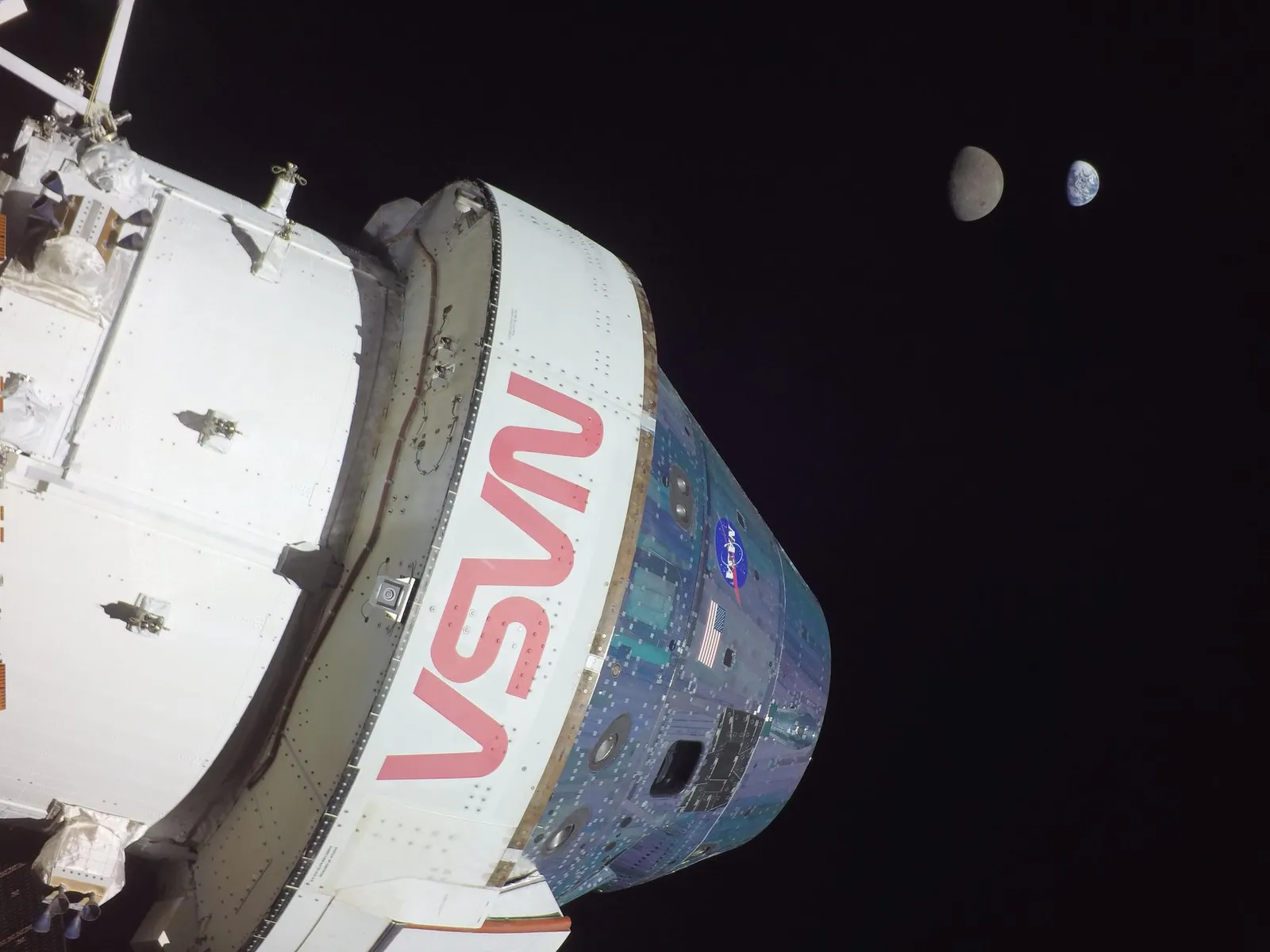
Out the windows, the destination grew. The crew's long-lens photographs from these days show the Moon swelling from a distant ornament into a place — and behind them, Earth contracting to a blue circle a thumb could cover.
T+4d 19:21
Welcome to the Neighborhood
April 6, 2026 · 17:56 UTC
Flight day six began with a voice from 1968. The crew's wake-up call was a message from Jim Lovell — who had flown to the Moon on Apollo 8 and fought his way back from it on Apollo 13 — recorded in 2025, in the months before his death that August, and uplinked now to the crew retracing his path. 'Hello, Artemis II! This is Apollo astronaut Jim Lovell. Welcome to my old neighborhood!' He told them he was proud to pass the torch as they swung around the Moon, and signed off with a flight plan for the soul: 'It's a historic day, and I know how busy you'll be. But don't forget to enjoy the view.' Wiseman, audibly moved, called it an awesome message and promised a great day.
Hours later, the crew made the old neighborhood's most storied address their own. At 17:56 UTC, Orion passed 248,655 miles from Earth — the record distance any human had ever reached, set by Lovell, Swigert, and Haise aboard the crippled Apollo 13 in April 1970. This was not 'the farthest since Apollo': it was the farthest ever. Every mile beyond this point was new territory for the species, and the mark would keep moving until it froze at 252,756 miles. Hansen, the first non-American on a lunar mission, marked the record and then challenged this generation and the next to make sure it would not stand for long.
Koch put the physics of the day in a sentence: 'We are now falling to the Moon rather than rising away from Earth.' Ahead, growing in the windows, the far side waited.
T+5d 00:26
Far Side
April 6, 2026 · 23:01 UTC
At 22:44 UTC the Moon slid between Orion and home, and the radios went quiet. For the first time in 53 years, human beings were behind the Moon — out of sight of Earth, out of reach of any signal, four people and a spacecraft alone over terrain no eyes had seen directly since Apollo. Around 23:00 UTC, Integrity reached its closest approach: 4,067 miles — 6,545 kilometers — above the far side, close enough for the crew to study the battered highlands that face permanently away from Earth.
Minutes later, between 23:02 and 23:07, the spacecraft crested the far edge of its free-return loop: 252,756 miles from Earth, the farthest human beings have ever been from the planet — farther than Apollo 13, farther than anyone. There was no engine burn to make, no orbit to enter. The trajectory chosen four days earlier was doing exactly what it was designed to do, trading the Moon's gravity for a ride home.
At 23:22, a camera on one of Orion's solar arrays caught Earth rising past the Moon's darkened limb — and for the first time since 1972, there were human eyes at the window to watch an Earthrise in person rather than in a photograph. Three minutes later the Deep Space Network reacquired Orion's signal, and Koch's voice came through with the relief of the species in it. The crew of Artemis II had not orbited the Moon — they had done something in its way more graceful: borrowed its gravity, rounded its hidden side, and started falling home.
T+6d 01:25
Falling Home
April 8, 2026 · 00:00 UTC
The flyby had one last spectacle in it. From 00:35 to 01:32 UTC on April 7, shortly after rounding the Moon, the crew watched the Moon slide across the Sun — a solar eclipse visible only from Orion's vantage point in space, the Sun's corona flaring around the black lunar disk while zodiacal light glowed along the horizon of the sky. 'It just looks unreal,' Glover said. During the dark passage, observers documented four lunar impact flashes — meteoroids striking the surface below. Then the Moon shrank astern, and the long fall began.
The return coast was the free-return trajectory keeping its promise: for three days, Earth's gravity did essentially all of the work, pulling Integrity home along the path drawn at trans-lunar injection. On flight day eight, engineers reported a small helium leak in the service module's oxidizer pressurization system — watched closely, characterized carefully, and judged zero risk to the crew or the return. After the toilet and the vent line, it barely rated a headline.
What did rate one was waiting at the bottom of the fall. Orion's heat shield was built to the same design that had returned from Artemis I with charred Avcoat cracked and shed in ways no model predicted — more than a hundred divots. Rather than rebuild the shield, NASA's answer, endorsed by Administrator Jared Isaacman in January 2026, was to fly it unmodified on a modified entry profile: a steeper, shorter descent shaped to let the Avcoat outgas without trapping the heat that had broken it before. The analysis said it would work. In three days, four lives would test the analysis.
T+9d 01:32
Integrity, Arriving
April 11, 2026 · 00:07 UTC
On the last evening — April 10 in California, already April 11 by Universal Time — the sequence ran like a countdown in reverse. A final trajectory correction at 18:53 UTC. Crew module separation from the faithful European Service Module at 23:33. An eighteen-second raise burn at 23:37. And at 23:53, entry interface: 400,000 feet, nearly 35 times the speed of sound, the modified entry profile beginning the test the whole descent had been redesigned around. NASA's flight-day blog put the expected peak at about 3,000 degrees Fahrenheit on the heat shield. Inside, the crew pulled up to 3.9 g through roughly six minutes of plasma blackout.
The shield held. Drogue chutes punched out around 22,000 feet at 00:03 UTC, the three main parachutes blossomed a minute later, and at 00:07 Integrity settled onto the Pacific southwest of San Diego at about 20 miles per hour. Wiseman keyed the radio with four words that closed a 53-year gap. At the hatch, a Navy diver counted four green lights and welcomed the crew home; within about two hours, helicopters had delivered the crew to the amphibious ship USS John P. Murtha, where they were piped aboard in Navy tradition: 'Integrity, arriving.'
The ledger read 695,081 miles in 9 days, 1 hour, and 32 minutes, every primary test objective met — entry, descent, and landing, in the words of NASA associate administrator Amit Kshatriya, performed as designed. Isaacman met the crew at Ellington Field on April 11, and at their first press conference five days later the four astronauts kept returning to the same line: they had left as a crew and come back as best friends. The road ahead was now concrete rather than conditional — Artemis III, targeting the first crewed lunar landing since 1972, set its sights on 2028 with a spacecraft that had finally carried people to the Moon's far side and brought them gently home.
Sources: NASA Release — Liftoff! NASA Launches Astronauts on Historic Artemis Moon Mission · NASA Blog — Flight Day 2: Orion Completes TLI Burn, Crew Begins Journey to the Moon · NASA Blog — Flight Day 6: Crew Ready for Lunar Flyby · NASA Release — NASA Welcomes Record-Setting Artemis II Moonfarers Back to Earth
The people who flew it
Meet the Artemis II crew
The people who lived these seconds. Open a profile to read who they were.

Answers come only from the Artemis II mission record above.