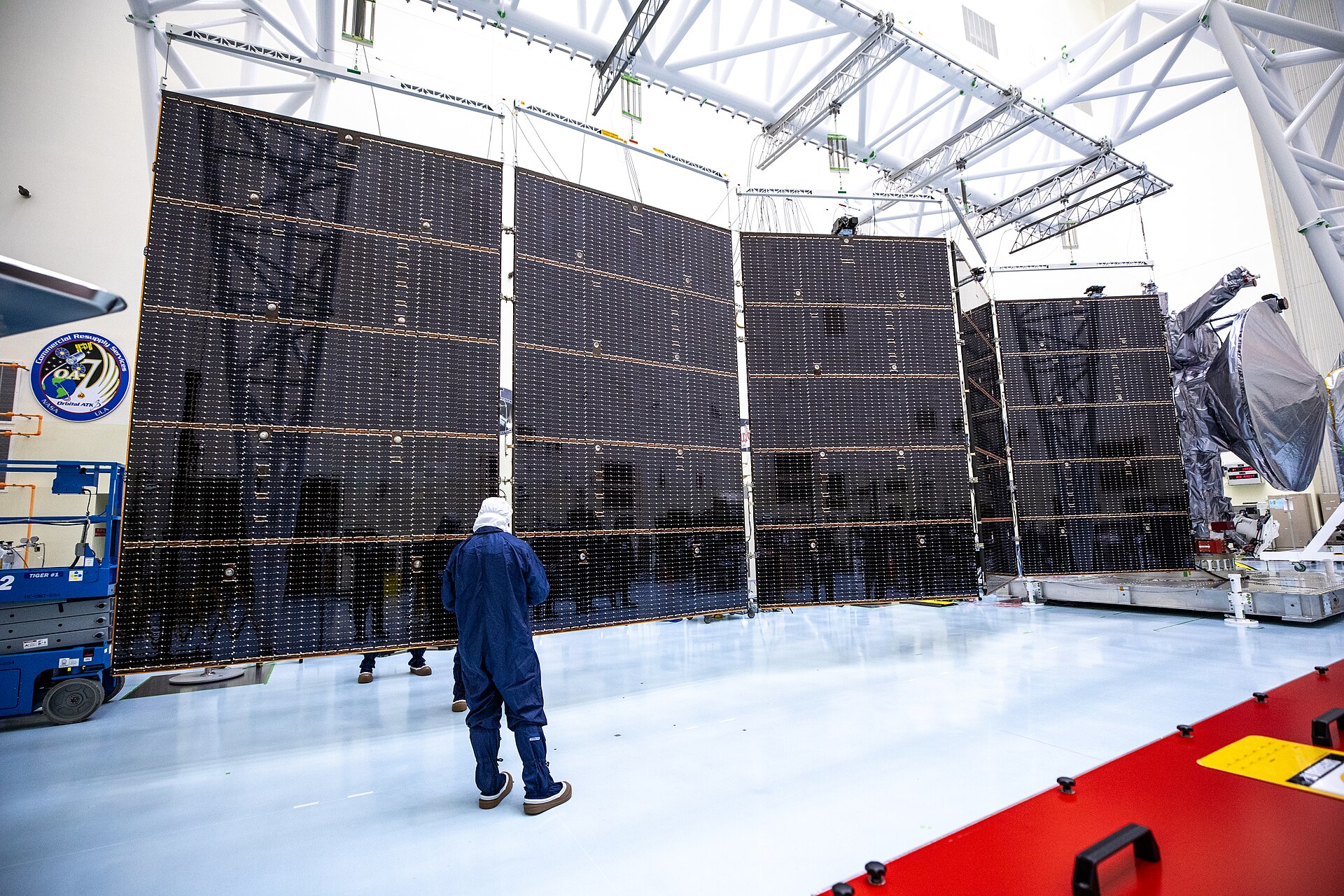
Europa Clipper
Europa Clipper is NASA's $5.2B flagship mission to Jupiter's moon Europa, launched on Falcon Heavy on October 14, 2024 and en route for a 2030 Jupiter orbit insertion followed by 49 low-altitude flybys of Europa to characterize the moon's icy shell and subsurface ocean's habitability potential [1][2]. As the heaviest planetary mission ever assembled by NASA at 6,065 kg fully fueled and the first NASA flagship to fly on a commercial Falcon Heavy launcher, Clipper anchors a multi-decade contract base across APL (Johns Hopkins), JPL (Caltech), Maxar Technologies (avionics box), L3Harris (magnetometer boom), and SpaceX (launch + $178M contract) [3][4][5].
Funding & Contract Structure
Total committed: $5.2B lifecycle cost (development + launch + Phase E operations through 2034) per NASA OIG IG-22-014, including the $178M SpaceX Falcon Heavy launch contract awarded July 2021 [7][5]
Annual run-rate: FY2025 enacted operations cost: ~$120M/year through cruise phase; ramps to ~$210M/year during 2030-2034 Jupiter prime mission [10]
Per launch: Single-launch mission; SpaceX Falcon Heavy launch contract: $178M (fully-expendable configuration, no booster recovery) [5]
Procurement vehicle: COST-PLUS — Government pays incurred costs plus a fee — contractor bears low risk; cost overruns common.
Congressional status: Bipartisan congressional support; congressional language mandated SLS launch in early appropriations but was rescinded in 2021 enabling SpaceX selection; FY2027 budget request funds operations [10]
GAO / CRS findings
| Date | Finding |
|---|---|
| NASA OIG IG-22-014 confirmed $5.2B lifecycle cost ceiling and found Europa Clipper on track for October 2024 launch; flagged radiation-hardness analysis of mixed-lot transistors as open risk requiring resolution before launch[7] | |
| NASA conducted formal review of mixed-lot transistor radiation hardness; concluded August 2024 that flight transistors were qualified for planned mission radiation dose, clearing path for October 2024 launch[9] |
Beneficiary Breakdown
| Contractor | Role | Share | Ticker |
|---|---|---|---|
| Applied Physics Laboratory (Johns Hopkins) | prime | Spacecraft integration prime; built Europa Imaging System (EIS), ECM magnetometer (with L3Harris boom heritage), and PIMS plasma instrument[2] | private |
| Maxar Technologies | sub | Built the propulsion module and contributed avionics subsystems; awarded ~$132M subcontract via JPL prime[11] | MAXR |
| L3Harris Technologies | sub | Magnetometer boom heritage (formerly Honeywell heritage acquired via L3Harris) and ground-segment radio frequency assembly[12] | LHX |
| SpaceX | supplier | Falcon Heavy launch services contract awarded July 2021 at $178M for the October 2024 launch; fully-expendable configuration[5] | private |
| Southwest Research Institute | sub | MASPEX mass spectrometer and Europa-UVS ultraviolet spectrograph instruments; ~$120M cumulative instrument subcontracts[13] | private |
| Lockheed Martin | supplier | Radioisotope-equivalent power-management subsystem and high-gain antenna components via subcontract; modest content vs. flagship outer-planet missions[14] | LMT |
Key Milestones
Europa Clipper formulation phase begins after Congress directs NASA to develop Europa mission
NASA awards SpaceX $178M launch contract for Falcon Heavy after congressional SLS-mandate language is removed
NASA completes formal review of mixed-lot transistor radiation hardness; concludes spacecraft cleared for October 2024 launch
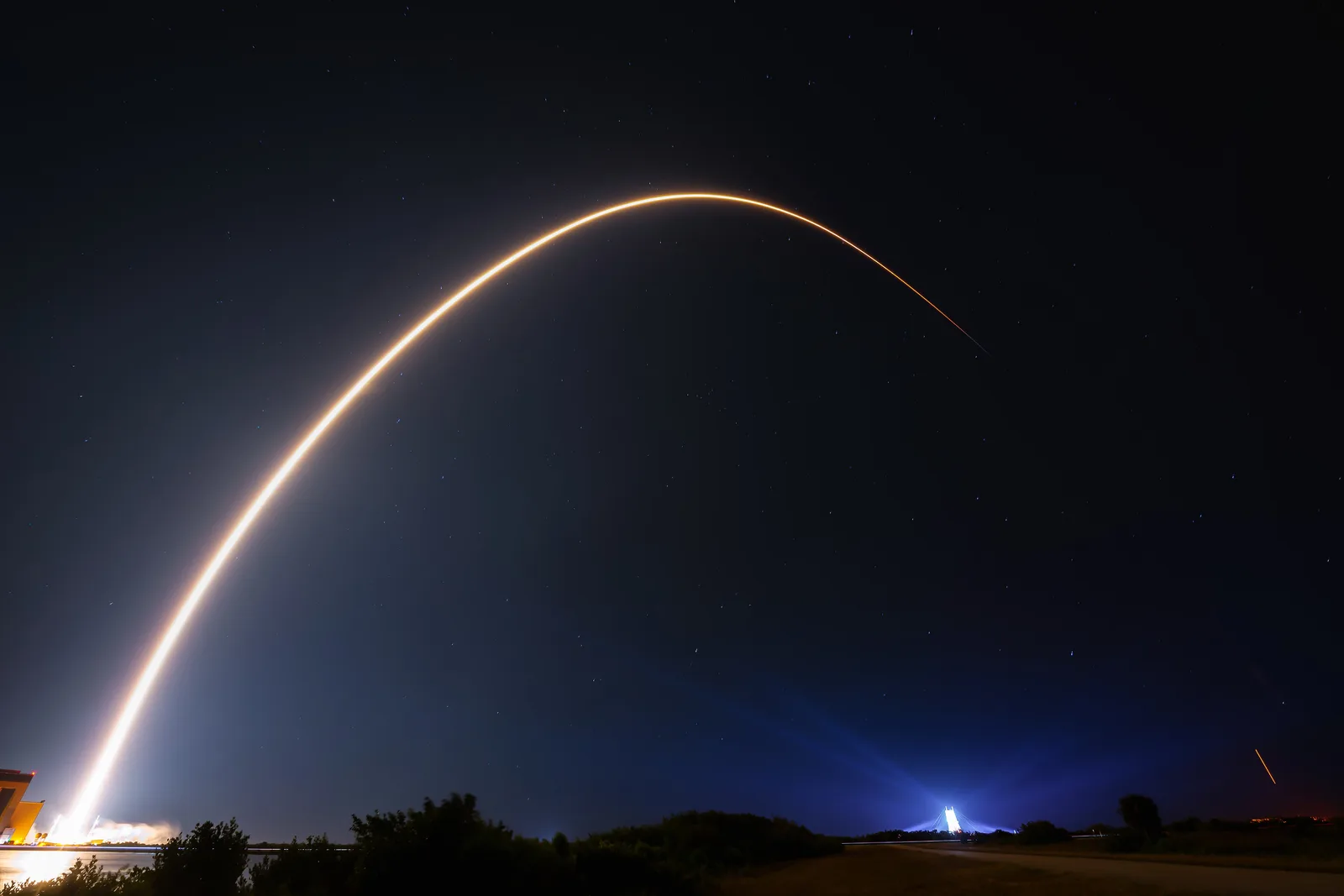
Europa Clipper launches on Falcon Heavy from KSC LC-39A on October 14, 2024 at 16:06 UTC
Mars gravity assist flyby on March 1, 2025 at ~890 km altitude; first MEGA trajectory leg complete
Earth gravity assist flyby on December 3, 2026; final cruise-phase trajectory adjustment
Jupiter Orbit Insertion on April 11, 2030 — single mission-critical propulsive burn
First Europa flyby; instrument commissioning at full Jovian environment
Nominal four-year prime mission concludes after 49 Europa flybys; extended-mission decision pending Senior Review
Catalysts
| Date | Event | Sentiment |
|---|---|---|
| Europa Clipper Earth flyby on December 3, 2026 — gravity assist; opportunity for instrument calibration against Earth-Moon system[6] | neutral | |
| Deep-cruise spacecraft commissioning of all nine science instruments at full mission radiation-shielded configuration[1] | neutral | |
| Jupiter Orbit Insertion (JOI) on April 11, 2030 — single largest mission-critical event; spacecraft survival defines mission success[6] | bullish | |
| First Europa flyby — closest approach as low as 25 km altitude; first dedicated Europa imaging since Galileo mission ended in 2003[1] | bullish | |
| Nominal four-year prime mission concludes after 49 Europa flybys; extended mission decision pending Senior Review[1] | neutral |
Risk Register
Competitive Landscape
Investability Map
| Ticker | Exposure | Note |
|---|---|---|
| MAXR | medium | Maxar Technologies built the Europa Clipper propulsion module (~$132M subcontract); deep-space planetary work is a credibility credential for future MSR alternative-architecture and Uranus Orbiter bids. Mars / outer planets represent <10% of Maxar revenue. |
| LHX | low | L3Harris supplies the magnetometer boom and ground-segment RF; modest closed-loop revenue but franchise value for future flagship instruments. |
| LMT | low | Lockheed Martin's Clipper content is below-the-line vs. its Mars, Orion and military space franchise; minimal incremental exposure. |
| NOC | low | Northrop Grumman supplies discrete spacecraft components on Clipper; far smaller exposure than Roman, JWST or Artemis. |
Not investment advice. Figures as-quoted from cited sources.
Sources
- [1] NASA — Europa Clipper mission page (Agency budget doc, accessed )
- [2] Johns Hopkins APL — Europa Clipper spacecraft integration page (Agency budget doc, accessed )
- [3] NASA — Europa Clipper spacecraft facts (6,065 kg fully fueled, 30.5m solar array span) (Agency budget doc, accessed )
- [4] NASA — Europa Clipper begins its journey to Jupiter's icy moon (launch announcement, Oct 14, 2024) (Agency budget doc, accessed )
- [5] NASA — SpaceX awarded Europa Clipper launch services contract ($178M, July 2021) (Agency budget doc, accessed )
- [6] NASA JPL — Europa Clipper Mars-Earth Gravity Assist (MEGA) trajectory (Agency budget doc, accessed )
- [7] NASA OIG IG-22-014 — NASA's Europa Clipper Mission audit (Sept 2022); $5.2B lifecycle cost (GAO / CRS report, accessed )
- [8] NASA — Europa Clipper science instruments overview (EIS, MASPEX, SUDA, REASON, Europa-UVS, E-THEMIS, ECM, PIMS) (Agency budget doc, accessed )
- [9] NASA — Europa Clipper transistor radiation review concludes spacecraft cleared for launch (Aug 2024) (Agency budget doc, accessed )
- [10] NASA — Fiscal Year 2027 Budget Request (Apr 3, 2026); Planetary Science line items (Agency budget doc, accessed )
- [11] Maxar Technologies — Europa Clipper propulsion module program page (Official company site, accessed )
- [12] L3Harris Technologies — Space and Mission Systems instrument heritage (Official company site, accessed )
- [13] Southwest Research Institute — Europa Clipper instruments MASPEX and Europa-UVS (Official company site, accessed )
- [14] Lockheed Martin — Deep-space mission subsystems program page (Official company site, accessed )
- [15] National Academies — Decadal Survey for Planetary Science 2023-2032: Uranus Orbiter and Probe priority (GAO / CRS report, accessed )
- [16] SpaceNews — Europa Clipper launch and post-launch trajectory analysis (Industry trade press, accessed )