Full mission transcript
Every chapter of DART, in sequence.
—
A Question No One Had Answered
November 24, 2021 · 05:00 UTC
The dinosaurs had no space program. For 4.5 billion years, every world in the solar system has been at the mercy of whatever crosses its path — and Earth is no exception. The question is not whether a dangerous asteroid will one day be found on a collision course, but whether, when it is, we will be able to do anything about it.
DART — the Double Asteroid Redirection Test — was built to answer one piece of that question: if we saw one coming, could we hit a small asteroid hard enough, and early enough, to change where it goes? No one had ever tried.
T+00:00:00
Launch
November 24, 2021 · 06:21 UTC
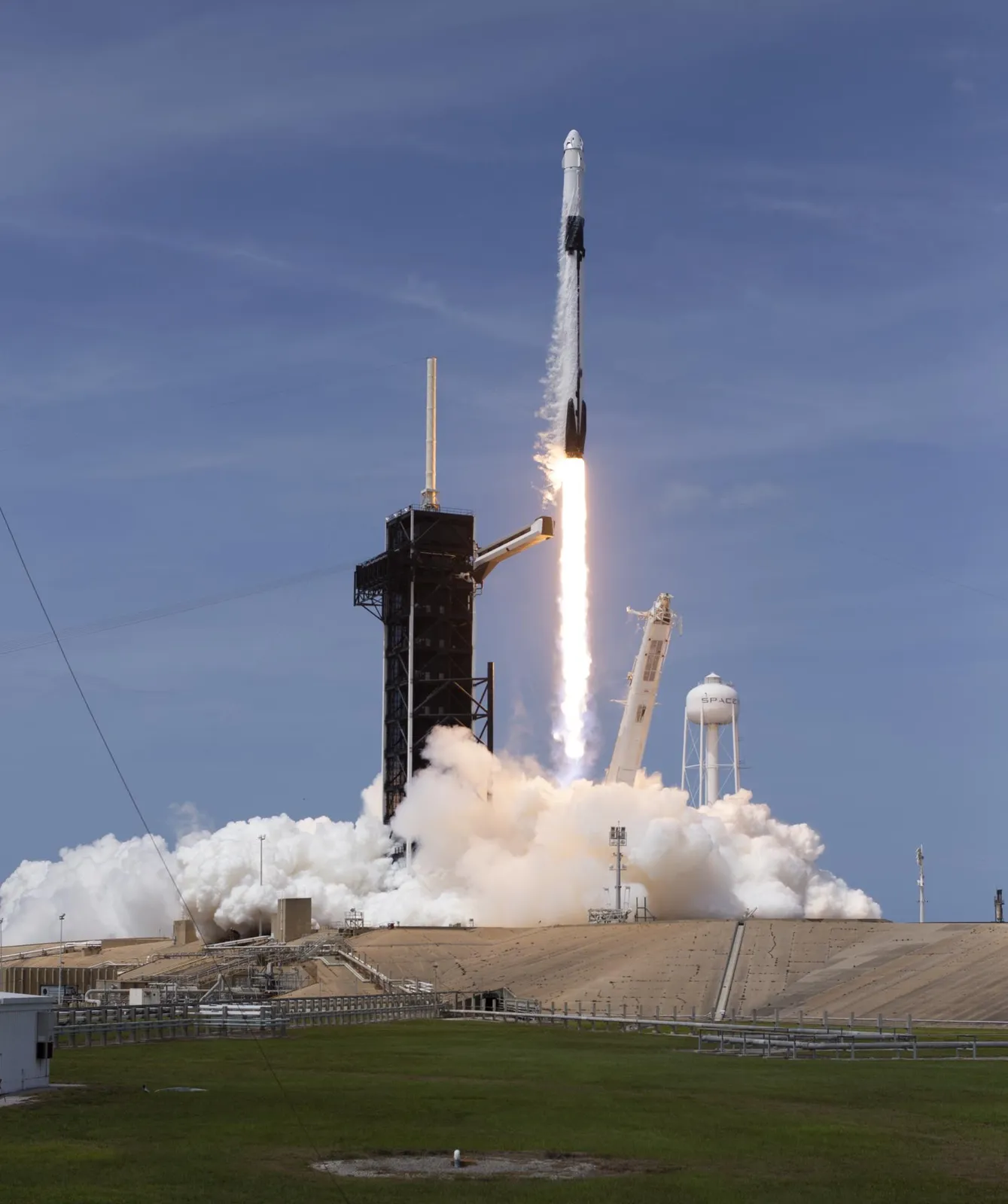
On November 24, 2021, a SpaceX Falcon 9 lifted DART off a foggy pad at Vandenberg Space Force Base in California. The spacecraft was deceptively simple: a box about the size of a vending machine, a camera called DRACO, an experimental ion engine, and two roll-out solar wings stretching more than 8 metres each.
Its target was a pair of asteroids that posed no threat to Earth at all — chosen precisely because they were safe to practice on.
T+10 months
Ten Months to a Speck
September 20, 2022 · 00:00 UTC
For ten months DART chased its target across the inner solar system, testing a NASA ion engine along the way. Didymos is only about 780 metres across; its moonlet Dimorphos, the actual target, is a mere 160 metres — a football stadium of rock orbiting a mountain of rock, some 11 million kilometres from Earth.
Until the final hours, both asteroids were nothing but a single unresolved point of light in DART's camera.
Impact −4 hours
On Its Own
September 26, 2022 · 19:14 UTC
No human could fly this. With a round-trip radio delay of over a minute and a closing speed of more than six kilometres per second, the last four hours belonged entirely to the spacecraft. An autonomous system called SMART Nav had to find Dimorphos, tell it apart from the larger Didymos beside it, and steer straight into it.
Dimorphos did not separate into its own resolvable dot until barely an hour before impact. From there, DART locked on and bore in.
Impact −90 seconds
The Last Pictures
September 26, 2022 · 23:12 UTC
In its final minutes, DRACO sent home a picture every second, broadcast live to a watching world. Dimorphos swelled from a grey blob into a distinct little moon, then into a landscape — a jumble of boulders and rubble filling the frame, a place no one had ever seen.
The last complete image was taken about two seconds before impact, from twelve kilometres up. The final image cut off mid-transmission as the spacecraft struck — a half-frame of rock, and then nothing.
Impact
Impact
September 26, 2022 · 23:14 UTC
At 7:14 p.m. EDT on September 26, 2022, DART slammed into Dimorphos at about 22,500 kilometres per hour. The telemetry simply stopped — and in the control room at the Johns Hopkins Applied Physics Laboratory, the loss of signal was the signal. They had hit it.
For the first time in history, a species had reached out and struck another world on purpose, to learn how to defend its own.
Impact +hours to weeks
A Comet Made by Hand
September 26, 2022 · 23:17 UTC
DART did not travel alone. A tiny Italian cubesat, LICIACube, had been released days earlier and swept past three minutes after impact, photographing a vast plume of rock and dust erupting from the asteroid. From Earth, Hubble and Webb watched too, as Dimorphos sprouted a glowing tail of debris that streamed out for thousands of kilometres — a small comet, made by human hands.
The impact had thrown off far more material than expected, and that ejecta gave the asteroid an extra shove all its own.
Impact +15 days
It Worked
October 11, 2022 · 00:00 UTC
Before the impact, Dimorphos circled Didymos once every 11 hours and 55 minutes. Two weeks of careful measurement revealed the new figure: 11 hours and 23 minutes. DART had shortened the little moon's orbit by about 32 minutes — and the bar for success had been a change of just 73 seconds.
Humanity had moved a world. Years later, ESA's Hera mission set out to visit Dimorphos and study the crater up close. The lesson of DART stands: if we find a dangerous asteroid in time, we are no longer helpless before it.
Sources: NASA — DART Mission · Johns Hopkins APL — DART
Answers come only from the DART mission record above.