Full mission transcript
Every chapter of New Horizons, in sequence.
T+00:00:00
The Fastest Goodbye
January 19, 2006 · 19:00 UTC
The mission began at a dinner table. After a session on Pluto at a science conference in May 1989, about a dozen researchers gathered at an Italian restaurant in Baltimore and decided the ninth planet deserved a visit — they called themselves the 'Pluto Underground.' NASA cancelled their idea repeatedly across the 1990s: Pluto Fast Flyby, Pluto-Kuiper Express, then a fresh cancellation in 2001. The proposal that finally survived, selected in November 2001, was Alan Stern's New Horizons.
At 19:00 UTC on January 19, 2006 — on the third attempt, after scrubs for high winds and a power outage — an Atlas V roared off Complex 41 at Cape Canaveral in its mightiest configuration, the 551: five solid boosters, a Centaur, and, for the first time on an Atlas V, a third stage, a STAR 48B. All of it to throw a piano-sized, 478-kilogram spacecraft as hard as a rocket has ever thrown anything. New Horizons left Earth at 16.26 kilometres per second — no spacecraft before or since has departed faster, though the record needs its caveats: Parker Solar Probe would later reach far higher speeds falling around the Sun, and Voyager 1 is still receding from the Sun faster, about 17 kilometres per second to New Horizons' 13.6 today. Nine hours after liftoff, New Horizons crossed the Moon's orbit — a distance that took Apollo three days.
Bolted inside the upper deck rode an ounce of Clyde Tombaugh, the man who discovered Pluto, in a two-inch aluminum canister — along with the 1991 29-cent stamp that needled the mission into being, 'Pluto: Not Yet Explored,' and a Florida quarter. Then came the irony that shadowed the whole voyage: seven months after launch, on August 24, 2006, 424 members of the International Astronomical Union voted in Prague to reclassify Pluto as a dwarf planet. The spacecraft was already hundreds of millions of kilometres along when its destination stopped being a planet.
Year 1
The Slingshot
February 28, 2007 · 05:43 UTC
Thirteen months out from Earth, New Horizons reached Jupiter — the fastest anyone had ever made the trip. At 05:43:40 UTC on February 28, 2007, it swept past at 2.3 million kilometres, and the giant planet's gravity did exactly what the mission designers had borrowed it for: the slingshot added roughly 4 kilometres per second, pushing the spacecraft to about 23 kilometres per second and cutting three full years off the cruise to Pluto.
The flyby was also a dress rehearsal with the best possible stand-in. Every instrument got a workout on a real planetary system: the churning Little Red Spot, the faint rings, the family of moons. Io stole the show — eleven volcanic plumes caught erupting at once, headlined by a fountain from the volcano Tvashtar rising some 330 kilometres above the surface. The LORRI camera's five-frame sequence of that eruption became the first movie ever made of a volcanic plume on another world.
Then the spacecraft did something almost nothing else in deep space had done before: it went to sleep. The years between Jupiter and Pluto would mostly be spent in hibernation — and that long quiet is the next chapter.
Years 2–9
The Long Sleep
December 7, 2014 · 02:53 UTC
For most of the journey, New Horizons was unconscious. From mid-2007 to late 2014 it hibernated for 1,873 days across 18 separate periods lasting anywhere from 36 to 202 days — instruments off, computers idling, spinning slowly for stability while it crossed a billion kilometres at a time. Once a week it sent a single beacon tone to the Deep Space Network: green for 'all is well,' red for 'wake me.' Once a year, around summer, the team roused it for a checkout, then tucked it back in.
The final wake-up call was set for December 6, 2014. The spacecraft was 2.9 billion miles out by then — so far that its radio report took 4 hours and 26 minutes to arrive, reaching Earth at 02:53 UTC on December 7. In the mission operations center at APL, the team celebrated to a recording of 'Where My Heart Will Take Me' that tenor Russell Watson had made specially for the occasion — a song played for the people, not the machine. New Horizons itself woke the way it always did: to an alarm clock, not music.
The cruise had one last scare in store. On July 4, 2015 — ten days from Pluto — the signal vanished at 1:54 p.m. EDT. For 81 minutes the spacecraft was silent while, three billion miles away, it diagnosed itself, swapped to its backup computer, and entered safe mode. The cause was a hard-to-detect timing flaw in the command sequence: the main computer had been compressing science data while simultaneously burning the flyby's command load to flash memory, and choked. Other missions ceded their Deep Space Network time, the team flew the recovery in three days, and science resumed July 7. The cost: 30 lost observations — less than one percent of the flyby plan. The heart of the mission was intact.
Year 9
The Heart
July 14, 2015 · 11:49 UTC
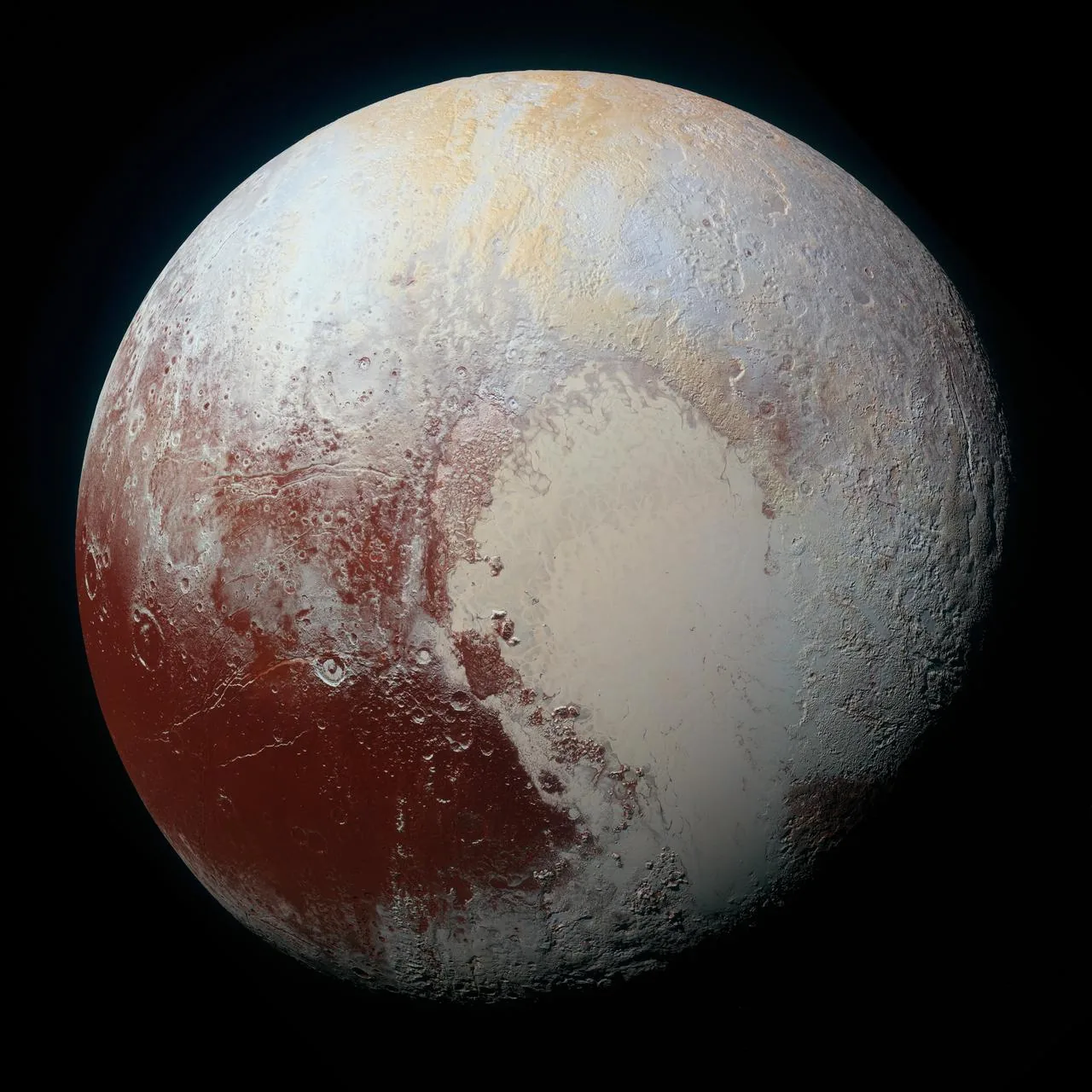
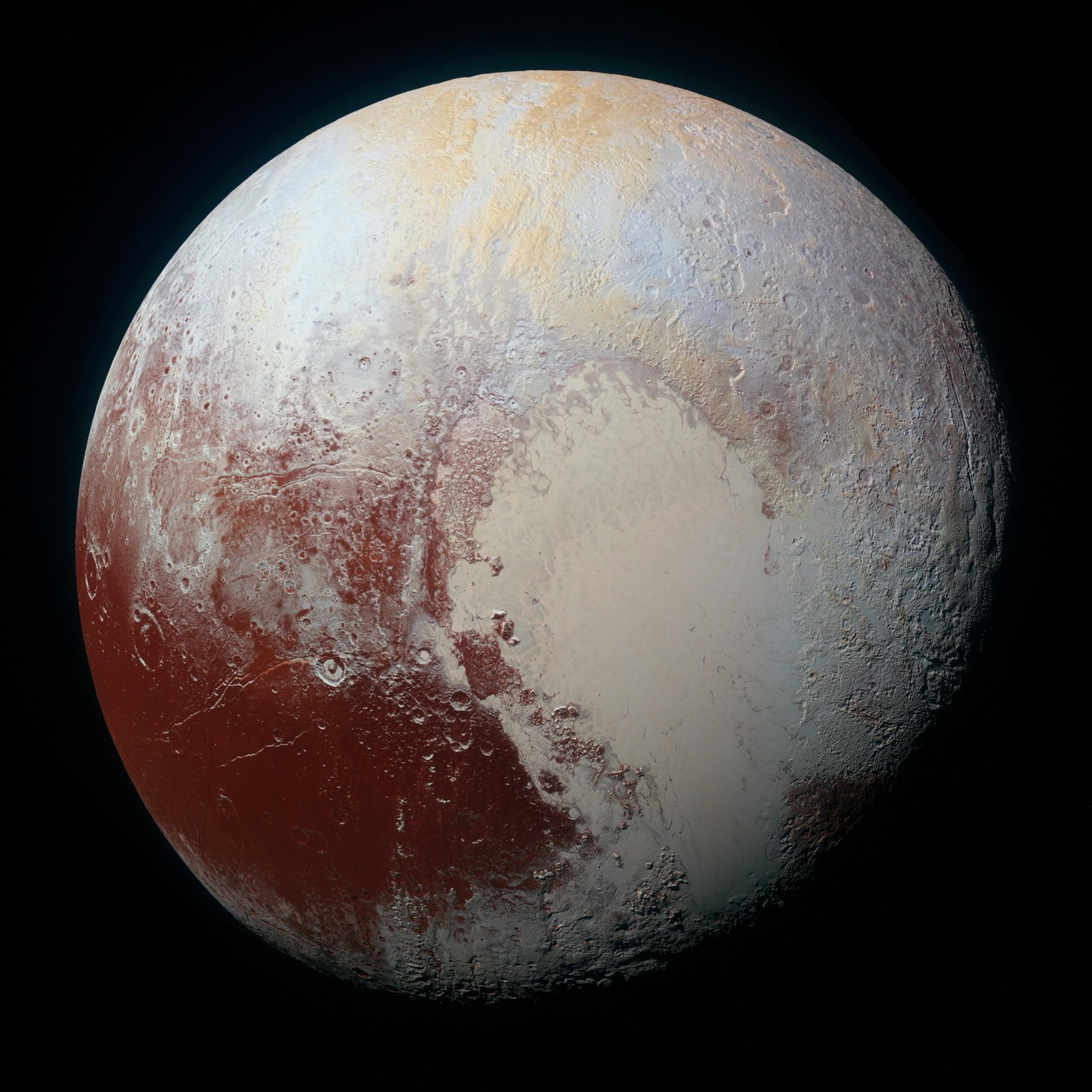
The heart showed up before the spacecraft did. In the approach images of early July 2015, a bright, lobed region emerged on Pluto's face, and the world fell for it instantly; the iconic full-disk portrait was taken on July 13, the day before arrival. The feature would be named Tombaugh Regio — informally at first, officially in 2017 — some 1,600 kilometres across, a heart named for the man whose ashes were flying past it.
At 11:49:57 UTC on July 14, 2015, New Horizons made its closest approach: 12,500 kilometres — 7,800 miles — above the surface, at 13.78 kilometres per second, passing within 28,800 kilometres of the big moon Charon. Earth was 4.77 billion kilometres away, four and a half light-hours. And the spacecraft said nothing. By design, it spent the flyby pointing its instruments at Pluto instead of its antenna at home — 22 hours of planned silence, with nine and a half years of work riding on one fifteen-minute status burst at the end of the day.
The signal reached the Deep Space Network station outside Madrid at 00:52:37 UTC on July 15 — still the evening of July 14 back home, 8:52:37 p.m. EDT. In the mission operations center at APL, Alice Bowman worked down her green-lit polls — 'in lock with telemetry,' subsystem by subsystem nominal — and the room came apart. 'We did it,' she said. NASA's release the next morning carried Alan Stern's larger framing: that New Horizons had completed what he called the first era of planetary reconnaissance — the survey, begun a half-century before, of every world the solar system was drawn with when the mission was conceived. You can hear the moment itself below; the chapter's quote is taken from that recording.
Control room · NASA/APL broadcast · July 15, 2015 - 00:52:45 UTC Bowman (MOM): Okay, we're in lock with carrier. Stand by for telemetry.
- 00:53:47 UTC Bowman (MOM): Okay, copy that. We're in lock with telemetry with the spacecraft.
- 00:54:44 UTC Bowman (MOM): Subsystems, please report your status as you get enough data.
- ≈00:55 UTC Autonomy (Pluto 1 net): Very happy to report nominal status. No rules have fired.
- 00:57:17 UTC Bowman (MOM): PI, MOM on Pluto 1. We have a healthy spacecraft. We've recorded data of the Pluto system, and we're outbound from Pluto.
- 00:58:40 UTC Bowman (MOM): This is just fantastic. Just like we planned it, just like we practiced. I mean, we did it. It's just great.
Years 9–10
A World, Revealed
October 8, 2015 · 00:00 UTC
The first close-up, released July 15, showed mountains — water-ice peaks first estimated at 3,500 metres and informally nicknamed Norgay Montes, for Everest's Tenzing Norgay. The IAU made the name official as Tenzing Montes in September 2017, and later mapping raised the peaks to 6.2 kilometres — the tallest on Pluto, standing beside the adjacent Hillary Montes. At 38 kelvins, water ice is the only plausible bedrock; on Pluto, it is the granite.
The western lobe of the heart turned out to be Sputnik Planitia: a nitrogen-ice glacier plain a thousand kilometres across with not a single crater — a surface less than about ten million years old, churning in slow convection cells. Candidate cryovolcanoes turned up too, the informally named Wright Mons, four kilometres tall and 150 across, and Piccard Mons — with evidence consistent with a subsurface ocean feeding them. Then, on October 8, 2015, NASA announced the image nobody had dared storyboard: looking back at a backlit Pluto, its atmosphere glowed blue — roughly twenty haze layers of sun-cooked organic particles called tholins, climbing more than 200 kilometres above the surface. Charon, 1,212 kilometres across, had its own surprises: a canyon system, Argo Chasma, and a dark red polar cap informally nicknamed Mordor Macula, painted by methane escaping from Pluto itself.
All of it came home through a straw. At distances like these the spacecraft's radio managed about 2,000 bits per second, and the flyby's haul — more than 50 gigabits — took 15 and a half months to downlink. The final segment arrived on October 25, 2016, crossing 5.5 billion kilometres in five hours and eight minutes. A dataset that would fit on a thumb drive had rewritten an entire world.
Year 13
Midnight at the Snowman
January 1, 2019 · 05:33 UTC
In the first hours of New Year's Day 2019, New Horizons threaded a flyby three times tighter than Pluto's — 3,500 kilometres at 05:33 UTC, at about 14.4 kilometres per second — past a Kuiper Belt object 43.4 astronomical units from the Sun, 6.5 billion kilometres out. It was, and still is, the most distant world ever explored. The best image, taken at 05:26 UTC from 6,700 kilometres, resolved details 135 metres across. Confirmation that the spacecraft had survived took 6 hours and 8 minutes to crawl home at light speed, arriving at APL at 14:29 UTC to a room that had stayed up all night — through a federal government shutdown, no less, with Johns Hopkins APL itself carrying the public broadcast.
The pictures showed a snowman: a 36-kilometre contact binary, a 21-kilometre lobe and a 15-kilometre lobe resting gently against each other. It is the most pristine, primordial object ever visited — two planetesimals that drifted together at walking pace four and a half billion years ago and simply stayed, frozen evidence for the gentle cloud-collapse picture of how solar systems assemble. Among the team that night was Queen guitarist Brian May — also an astrophysicist and a New Horizons collaborator on stereo imaging since 2015 — who premiered a single written for the flyby just after midnight.
The team's nickname for the target, 'Ultima Thule,' drew criticism for its co-option by Nazi-era mysticism, and in November 2019 the object received its formal name: Arrokoth — 'sky' in the Powhatan/Algonquian language — chosen in consultation with, and with the consent of, Powhatan elders. The sky people of the Chesapeake, where the spacecraft was built, named the farthest world ever touched.
Year 17
The Edge of Everything
September 29, 2023 · 00:00 UTC
The hardest fight of the mission's third decade happened on Earth. In 2023, NASA moved to end New Horizons' planetary mission — a budget decision worth roughly three million dollars a year, set against the only working spacecraft humanity has ever sent through the Kuiper Belt. The community pushed back hard: twenty-five mission leaders signed an open letter, and the National Space Society petitioned. On September 29, 2023, NASA reversed course: New Horizons would keep flying until it exits the Kuiper Belt, expected around 2028–29, led from its heliophysics division from fiscal 2025 — with the door explicitly open to another flyby if a reachable world turns up.
The hunt for that world is on. Surveys with Japan's Subaru Telescope, sifted by machine learning, have found 263 Kuiper Belt objects along the spacecraft's path — including eleven beyond what was thought to be the Belt's edge, hinting the Belt itself extends farther than anyone believed. None is yet reachable with the fuel aboard. Ahead lies a different boundary: the termination shock, where the solar wind slams to subsonic speed — possibly around 2027. Only the two Voyagers have ever crossed it; New Horizons would be the third spacecraft to do so, and the first carrying modern instruments.
The ledger that governs everything is power. The radioisotope generator that made 245.7 watts at launch was down to about 190 by 2019 and falls roughly 3.5 watts a year — around 165 watts now, by the team's estimates. Carefully rationed, it should keep the transmitters alive into the late 2030s, with hopes of stretching into the 2040s. The people in this picture — Alan Stern and Alice Bowman, at the moment Arrokoth's signal arrived — are still flying their spacecraft, a quarter-century in, toward the edge of everything.
Year 19
The Ashes of the Discoverer
August 7, 2025 · 08:12 UTC
Clyde Tombaugh was a 24-year-old farm boy from Kansas, hired to blink photographic plates at Lowell Observatory, when he found Pluto in February 1930. He spent the rest of a long life as an astronomer and teacher, and before he died in 1997 he made one request: that his ashes be sent to space. An ounce of them rides inside New Horizons' upper deck in a two-inch aluminum canister, its inscription written by Alan Stern — beginning, in the canister's own spelling, 'Interned herein.' Tombaugh flew past his own planet in 2015 — his children, Annette and Alden, were in the room at APL that night, and the heart was named Tombaugh Regio for their father the next day — then past Arrokoth in 2019. His are the farthest-traveled human remains in history, and they are not stopping.
On August 7, 2025, at 08:12 UTC, New Horizons entered hibernation once more — its longest sleep ever, beating its old record of 273 days, with wake-up planned for late June 2026: the spacecraft stirs almost exactly as this replay ships. Even asleep, three instruments keep recording the dust and charged particles of the outer heliosphere, around the clock. It is no longer a mission racing toward something; it is an outpost, drifting through territory no working spacecraft has ever measured.
No further target is confirmed. One day — in the late 2030s, perhaps the 2040s — the power will no longer carry a signal home, and New Horizons will simply continue: a derelict ambassador on a forever trajectory out of the solar system, carrying a postage stamp that holds the Guinness record for the farthest-traveled in history — 'Pluto: Not Yet Explored,' its errand long since run — a Florida quarter, and the ashes of the man who discovered the 'third zone' it will never stop crossing. Clyde Tombaugh found Pluto from a Kansas farm kid's patience with the night sky. The night sky is taking him home.
Sources: NASA — New Horizons 'Phones Home' Safe After Pluto Flyby (2015) · NASA — New Horizons to Continue Exploring Outer Solar System (Sept 2023) · NASA New Horizons Blog — Longest Hibernation Yet Begins (Aug 2025) · JHUAPL — Clyde Tombaugh's Memorial Canister Aboard New Horizons · NASA History — 15 Years Ago: New Horizons Launched to Pluto and Beyond
Answers come only from the New Horizons mission record above.
Continue your journey

The moment in history
Moment
New Horizons flies past Pluto
The moment in history
The mission file
Mission
New Horizons
The mission file
Experience it
World
Pluto
Experience it
From the same era
Experience
DART
From the same era

From the same era
Experience
Demo-2
From the same era
From the same era
Experience
James Webb
From the same era