Full mission transcript
Every chapter of James Webb, in sequence.
T+00:00:00
Launch
December 25, 2021 · 12:20 UTC
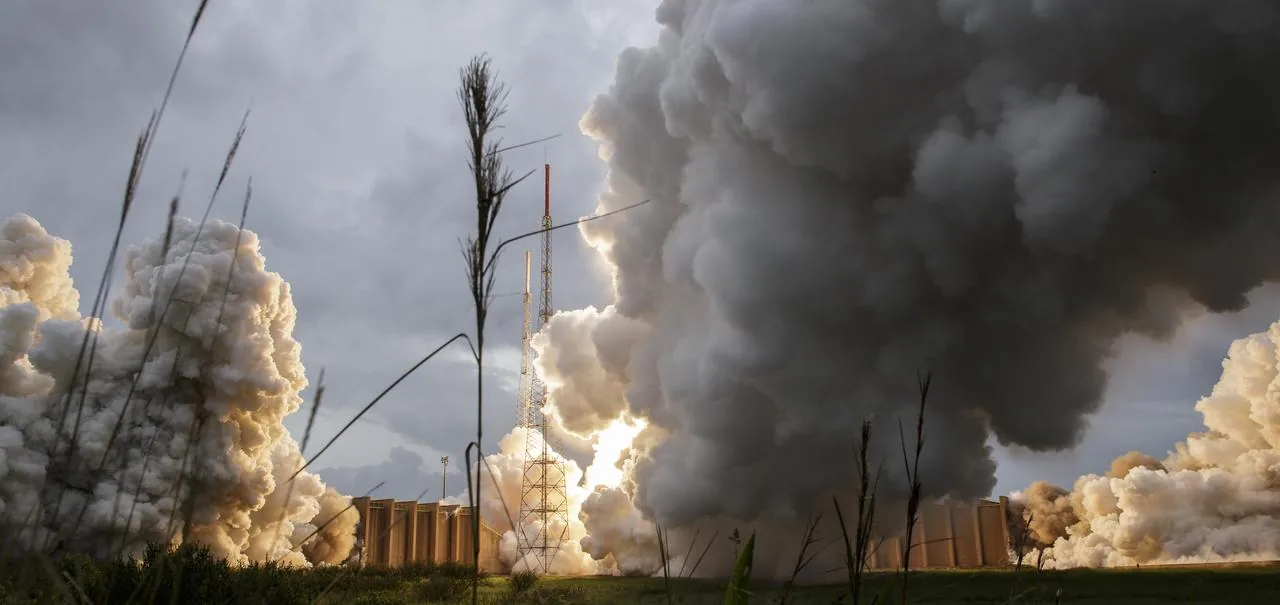
On Christmas morning 2021, an Ariane 5 lifted off from the Guiana Space Centre at Kourou, French Guiana, carrying the most expensive and ambitious science observatory ever built. JWST had been roughly 25 years and approximately $10 billion in development — a joint undertaking by NASA, ESA, and the Canadian Space Agency. The telescope represented the accumulated effort of thousands of engineers and scientists across three continents.
The launch trajectory was so precise that the planned propellant expenditure for trajectory correction maneuvers was far below projections, effectively extending Webb's mission life well beyond its 10-year design goal. Where engineers had budgeted propellant conservatively, the rocket's accuracy handed the mission decades.
Control room · NASA/Arianespace broadcast - ≈12:20:12 UTC Navias (NASA commentary): Liftoff, from a tropical rainforest to the edge of time itself — James Webb begins a voyage back to the birth of the universe.
- ≈12:47:28 UTC Navias (NASA commentary): We do have confirmation of observatory separation. The James Webb Space Telescope, amidst applause here in the mission control center, now taking its first steps in pursuit of cosmological discovery.
- ≈12:48 UTC Launch team (Jupiter loop): Fantastic pictures of this telescope... Go Webb!
- ≈12:50 UTC Navias (NASA commentary): A bit earlier than planned, but there is the solar array having been deployed. James Webb now has its array out as we stand by for a confirmation that it is power positive.
- ≈12:50 UTC Navias (NASA commentary): And there it is — there's your critical call: James Webb not only has legs, but it has power, as it begins its journey and the commissioning activities to follow.
- ≈12:58 UTC Nelson (NASA Administrator): This is a great day — not only for America, for our European and Canadian partners — but it's a great day for planet Earth.
T+3 days
The Unfolding
December 28, 2021 · 12:00 UTC
Webb was too large to fit inside any rocket fairing in its operational configuration — it launched folded like an origami sculpture and had to deploy itself over two weeks en route to its destination. The sequence involved 344 single-point failures: mechanisms that each had to work perfectly, exactly once, with no crew to intervene and no possibility of repair.
Nothing this complex had ever been deployed in space. Flight controllers in Baltimore monitored every step of the choreography — the pallet deployments, the sunshield mid-booms, the secondary mirror, the primary wing latches — each one a milestone that had never been rehearsed in the thermal and gravitational conditions of deep space. Every deployment succeeded.
T+10 days
The Sunshield
January 4, 2022 · 16:00 UTC
Webb's sunshield is five separate layers of a material called Kapton, each thinner than a human hair, that together span an area the size of a tennis court when fully tensioned. Its purpose is to separate two thermal worlds: the Sun-facing side runs near +85 °C, while the telescope side, shielded from every photon of solar and terrestrial heat, cools toward −233 °C — close to absolute zero.
That extreme cold is not a byproduct but a requirement. JWST's instruments are designed to detect infrared light from the first galaxies formed after the Big Bang — heat that has been redshifted by 13 billion years of cosmic expansion into wavelengths that would be drowned out by the observatory's own thermal glow if the telescope were any warmer. The sunshield is the reason Webb can see what it sees.
T+14 days
The Golden Mirror
January 8, 2022 · 18:00 UTC
Eighteen hexagonal beryllium segments, each coated with a microscopically thin layer of gold, unfolded and latched into position to form a primary mirror 6.5 metres across — the largest mirror ever launched into space. Beryllium was chosen because it is both rigid and remarkably light, and remains dimensionally stable at cryogenic temperatures where most metals would warp. Gold, applied at a thickness of about 100 nanometres, maximises reflectivity at the infrared wavelengths Webb is built to capture.
In the weeks that followed, fine-tuning actuators behind each segment adjusted their angles to within nanometres of the ideal parabolic profile. The result was a single coherent mirror with a light-gathering area more than six times greater than Hubble's.
T+30 days
Arrival at L2
January 24, 2022 · 19:00 UTC
Thirty days after launch, Webb fired its onboard thrusters in a precise insertion burn that placed it into a halo orbit around the second Sun–Earth Lagrange point, approximately 1.5 million kilometres from Earth on the night side of the planet. L2 is four times farther from Earth than the Moon — well beyond reach of any crewed spacecraft or servicing mission.
The Lagrange point is not a fixed location but a gravitational balancing point where a spacecraft can orbit the Sun in synchrony with the Earth, keeping Earth, Moon, and Sun perpetually in the same direction. This allows the sunshield to block all three heat sources simultaneously. Webb arrived, and its first 30 days of anxiety gave way to six months of meticulous mirror alignment and instrument calibration.
Control room · NASA teleconference - Jan 24, 2022 Parrish (commissioning manager): We're just really excited to announce today that Webb is officially on station at its L2 orbit... this is just capping off a remarkable 30 days.
T+199 days
First Light
July 12, 2022 · 14:30 UTC
On July 12, 2022, NASA released Webb's first full-colour science image: galaxy cluster SMACS 0723, a gravitational lens whose combined mass bends and amplifies light from galaxies far behind it. The result was thousands of galaxies visible in a patch of sky the apparent size of a grain of sand held at arm's length — the deepest infrared view of the universe ever captured to that date, showing light that left its source more than 13 billion years ago.
President Biden unveiled the image at the White House the previous evening; NASA Administrator Bill Nelson presented it as a view of the cosmos the world had never seen before. Four more first-light images followed within hours: the atmospheric spectrum of exoplanet WASP-96b showing clear signs of water vapour, the death throes of the Southern Ring Nebula, Stephan's Quintet in unprecedented infrared detail, and the Cosmic Cliffs of Carina — a star-forming region rendered as a mountainous landscape of gas and dust.
Ongoing
New Eyes on the Cosmos
July 13, 2022 · 00:00 UTC
Since first light, Webb has repeatedly rewritten our understanding of the early universe. It has confirmed candidate galaxies formed within a few hundred million years of the Big Bang, detected carbon dioxide and other molecules in the atmospheres of planets orbiting distant stars, imaged stellar nurseries like the Cosmic Cliffs of Carina Nebula in dust-piercing infrared detail, and probed the edges of our own solar system with a precision no previous observatory could match.
The propellant saved at launch means Webb's scientific life now extends beyond 20 years — a generational instrument that will outlast the careers of most of the scientists now using it. Where Hubble revealed the universe in visible light, Webb is reading its chemical biography in infrared: every cloud of gas, every distant galaxy, every alien atmosphere a sentence in a story that was always there, waiting for eyes capable of seeing it.
Sources: NASA — James Webb Space Telescope · Webb Space Telescope (STScI)
Answers come only from the James Webb mission record above.
Test yourselfMission debrief: 5 questions — ace it (80%+) to earn the Debrief Ace badge
Mission debrief1 of 5
Why must Webb's telescope side be kept near −233 °C?
Myths to bust
“JWST replaces Hubble.”
They complement each other and both operate today. Hubble sees mostly visible and ultraviolet light; Webb sees infrared — light too stretched-out and faint for Hubble. Together they cover far more of the spectrum than either alone.
“A powerful telescope works by zooming in, like binoculars.”
Telescopes are light buckets, not zoom lenses. Webb's 6.5-metre mirror collects over six times more light than Hubble's, letting it detect extremely faint objects — and because that light took time to travel, seeing farther also means seeing back in time.
Words that matter
- infrared
- — Light with wavelengths longer than red — invisible to our eyes, but we feel it as heat. Webb is built to see it.
- sunshield
- — Webb's five-layer, tennis-court-sized screen of thin Kapton film that blocks heat from the Sun, Earth, and Moon so the telescope can stay cold.
- L2 (Lagrange point)
- — A gravitational balance point about 1.5 million km beyond Earth where a spacecraft can orbit the Sun in step with Earth, keeping Sun, Earth, and Moon all in one direction.
- deep field
- — A long-exposure image of a tiny, seemingly empty patch of sky that reveals thousands of extremely distant galaxies.
- redshift
- — The stretching of light to longer, redder wavelengths as the universe expands — light from the first galaxies has been stretched all the way into the infrared.
Teach with thisReady-made lesson: JWST: Seeing the Invisible 40 minAges 11–14 · Ages 14–18
Launch in Classroom Mode Printable worksheetTelescopes & light · Free, no sign-up · NGSS MS-PS4-2, HS-PS4-5, HS-ESS1-2
Students will be able to
- Explain why Webb observes in infrared light and why that requires the telescope to be extremely cold
- Describe why Webb orbits the Sun–Earth L2 point 1.5 million km away instead of orbiting Earth like Hubble
- Analyze the engineering risk of the deployment sequence — 344 single-point failures with no possibility of repair
- Interpret what a deep-field image shows: thousands of galaxies whose light left them more than 13 billion years ago
Where to pause & what to say
1.344 ways to fail— at “The Unfolding”
Webb was too big to fit in any rocket, so it launched folded like origami and had to unfold itself over two weeks in deep space. Count the stakes with the class: the sequence had 344 single-point failures — mechanisms that each had to work perfectly, exactly once. No astronaut could fly out to fix a stuck latch; Webb was headed a million miles away. Ask students what they would do to prepare, then reveal the answer: years of testing on the ground, and the ability to shake, warm, or retry balky mechanisms remotely. Every single deployment succeeded.
- What does 'single-point failure' mean, and why is 344 of them scarier than one big risk?
- How do engineers build confidence in something that can only ever be tried once for real?
2.Eighteen golden hexagons— at “The Golden Mirror”
This is the largest mirror ever launched into space: 18 hexagonal segments of beryllium, each coated in a layer of gold about 100 nanometres thick, unfolding into a single 6.5-metre mirror. Ask why gold — it's not decoration. Gold is superb at reflecting infrared light, exactly what Webb hunts. Then hit the key idea: a telescope's power isn't 'zoom,' it's light-gathering. A bigger bucket catches more rain; a bigger mirror catches more light — over six times more collecting area than Hubble — so Webb can see things that are fainter and farther.
- Why do astronomers care about mirror area more than magnification?
- The segments were adjusted to within nanometres of a perfect shape. Why does a mirror need to be that precise?
3.Why park a million miles away?— at “Arrival at L2”
Thirty days after launch, Webb slid into orbit around L2, about 1.5 million kilometres from Earth — four times farther than the Moon. Ask the class why anyone would put a telescope where no repair mission can ever reach it. The answer is heat. At L2, the Sun, Earth, and Moon all stay on the same side of the spacecraft, so the sunshield can block all three at once. Behind it, the telescope cools toward −233 °C. Webb detects faint heat from the early universe — if the telescope itself were warm, it would be blinded by its own glow.
- What is the trade-off Webb's designers accepted by choosing L2 over an Earth orbit like Hubble's?
- Why would a warm telescope be useless for infrared astronomy?
4.A grain of sand full of galaxies— at “First Light”
On July 12, 2022, the world saw Webb's first deep field: galaxy cluster SMACS 0723. Hold a grain of sand at arm's length — that's how much sky this image covers, and it holds thousands of galaxies. Some of this light travelled more than 13 billion years to reach the mirror, so we see those galaxies as they were near the beginning of the universe. Every telescope is a time machine: it doesn't show what's out there now, it shows what was there when the light left. Let students just look for a minute before you say anything else.
- If a galaxy's light took 13 billion years to arrive, what are we actually looking at?
- Nearly every dot in this image is a whole galaxy. How does that change your sense of what 'empty' sky means?
Hands-on activity
How long does 'hello' take to reach Webb?
Webb orbits L2, about 1.5 million km from Earth. Use the light-delay tool to find how long a radio command takes to reach it (about 5 seconds one way). Compare with the Moon and Mars. Then discuss: why is 5 seconds fine for a telescope but a serious problem if a deployment goes wrong mid-motion?
Wrap-up discussion
- Webb cannot be repaired, while Hubble was serviced by astronauts five times. Was placing Webb at L2 worth that risk? Argue with evidence from the replay.
- Webb took roughly 25 years and $10 billion to build. How should we decide whether a science project of that size is worth it?
- Why is 'seeing invisible light' a fair summary of what makes Webb different from every telescope before it?
Continue your journey
The moment in history
Moment
James Webb Space Telescope releases first science images
The moment in history
The mission file
Mission
James Webb Space Telescope
The mission file
Build it yourself
Build it
Deep Space Optics Laboratory — build the Space Telescopes
Build it yourself
Build it yourself
Build it
James Webb — the digital twin
Build it yourself
From the same era
Experience
DART
From the same era
From the same era
Experience
Demo-2
From the same era