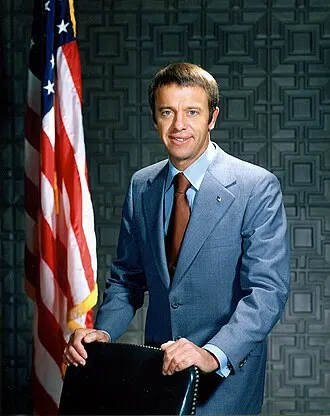
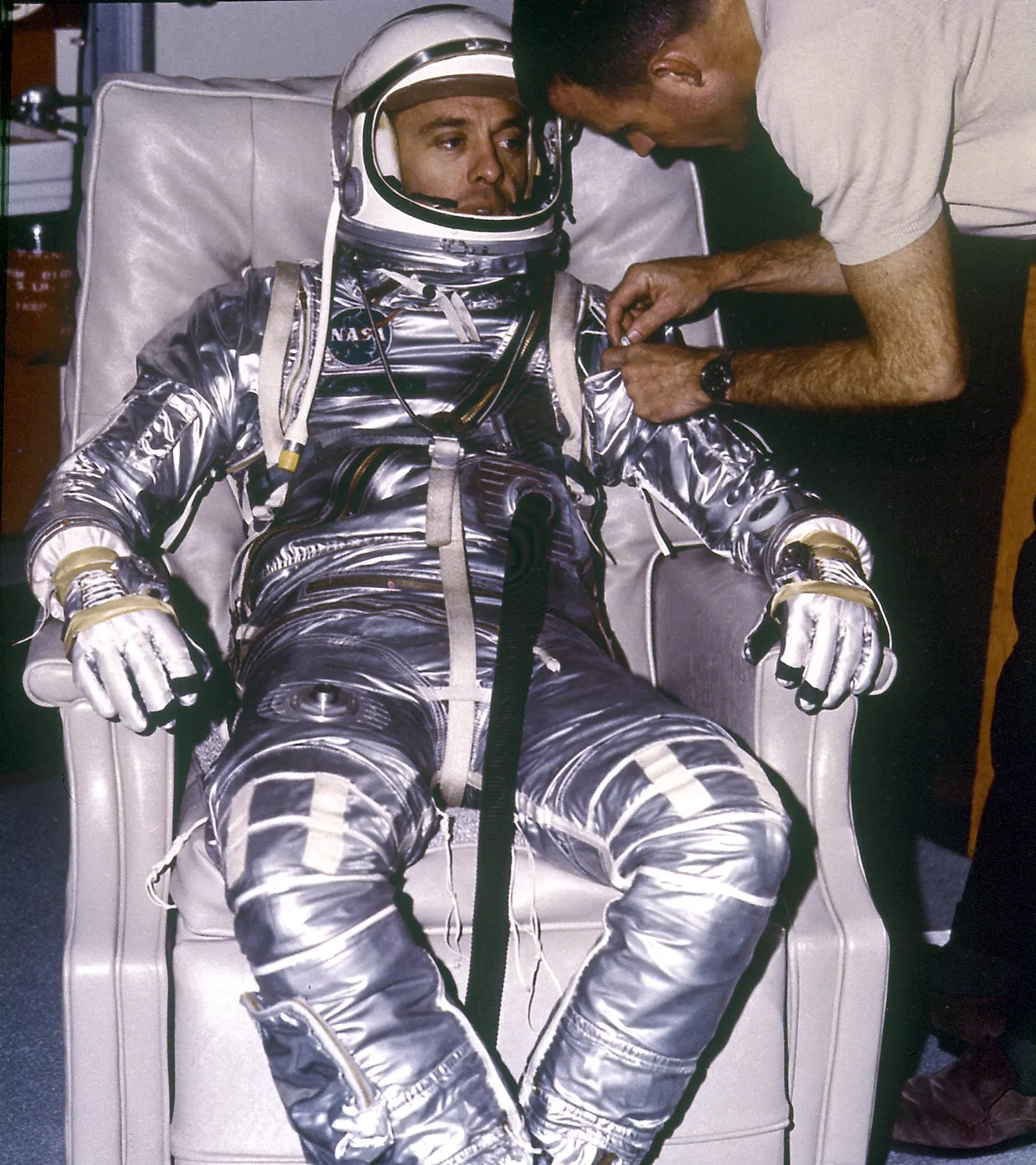
Alan Shepard lay on his back atop a Redstone rocket for more than four hours on the morning of 5 May 1961, through hold after hold, while an estimated 45 million Americans watched on live television. The Soviet Union had already flown Gagarin around the entire planet three weeks earlier, and the pressure on this fifteen-minute mission was continental. The bladder question got settled the undignified way, inside the suit. When yet another hold was called for rising pressure in the booster's liquid oxygen tank, Shepard finally snapped at the control room with the most famous demand in NASA history.
02 / 04
At 9:34 a.m. Eastern time the Redstone lifted off from Launch Complex 5 at Cape Canaveral. The flight was a fifteen-minute arc: Freedom 7 reached 116.5 statute miles of altitude, touched 5,134 miles per hour, and gave Shepard about five minutes of weightlessness before slamming him with roughly 11 g on reentry. Unlike Gagarin, who rode his Vostok largely as a passenger, Shepard took the controls, testing pitch, yaw, and roll by hand. He became the first human being to actually pilot a spacecraft in space.
03 / 04
Splashdown came 303 miles downrange in the Atlantic, where a Marine helicopter hauled capsule and astronaut to the carrier USS Lake Champlain. The whole flight, liftoff to splashdown, lasted 15 minutes and 28 seconds. It was enough. Twenty days later, President Kennedy stood before Congress and committed the United States to landing a man on the Moon before the decade was out, a goal staked on a quarter hour of suborbital flight time.
04 / 04
The capsule's name carried a quiet code: the 7 was simply McDonnell's production number for the capsule, and the Mercury Seven astronauts adopted it as a badge of unity on every flight that followed. Shepard himself was grounded by an inner-ear disease for most of the decade, then fought his way back to flight status and walked on the Moon in 1971 as commander of Apollo 14, the only Mercury astronaut ever to do so.
“
Why don't you fix your little problem and light this candle?
Alan B. Shepard Jr. · Mercury astronaut, to launch controllers during the final countdown hold
By the numbers
Launch
5 May 1961, 9:34 a.m. EST, Cape Canaveral LC-5
Flight duration
15 min 28 s
Peak altitude
116.5 statute miles (187.5 km)
Downrange distance
303 miles (488 km)
Maximum speed
5,134 mph (8,262 km/h)
Live TV audience
~45 million Americans
Why it mattered
Freedom 7 lasted barely a quarter of an hour, but it restored American confidence at the lowest point of the Space Race and proved NASA could put a human into space and recover him safely on live television, in the open, in front of the world. Shepard's turn at the controls established the American conviction that astronauts should be pilots, not passengers, a philosophy that shaped every US spacecraft through the shuttle era. Most consequentially, the flight's success gave President Kennedy the proof of competence he needed: twenty days later he asked Congress for the Moon.
▸Shepard waited so long on the pad, over four hours, that he had to urinate inside his spacesuit, with medics briefly powering down his biosensors to do it.
▸Unlike Gagarin, whose flight was almost fully automated, Shepard manually controlled his capsule's attitude, making him the first human to truly pilot a spacecraft.
▸The 7 in Freedom 7 was the capsule's factory production number, not a tribute to the Mercury Seven, but the astronauts kept the digit on every Mercury flight afterward.
▸Twenty days after this 15-minute flight, President Kennedy committed America to landing on the Moon within the decade.
▸Shepard was grounded by Ménière's disease for years afterward, then returned to walk on the Moon with Apollo 14 in 1971, where he famously hit two golf balls.