Before today, no one had left their spacecraft. After today, a human had floated free in the vacuum.
Scroll to begin
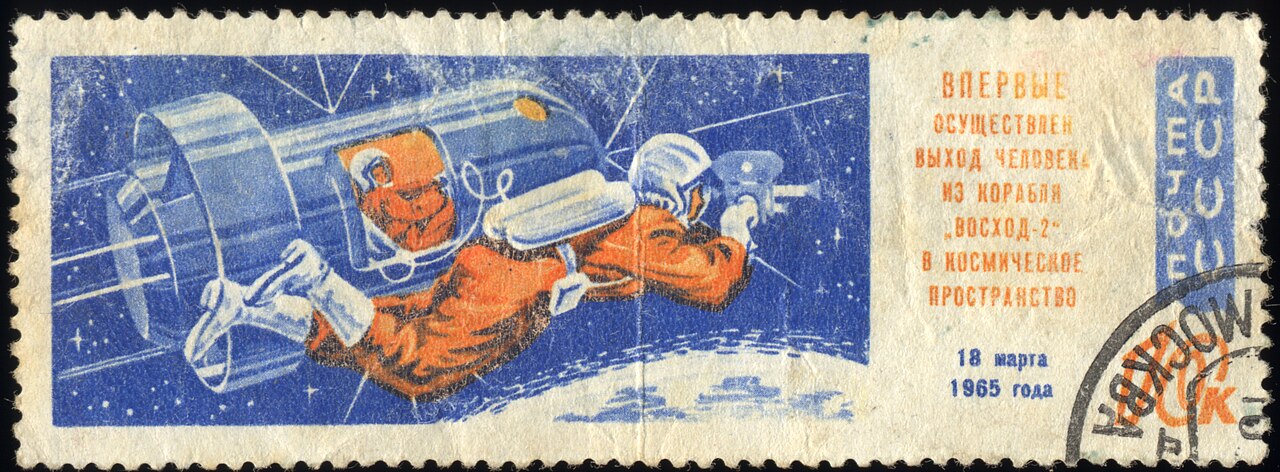
USSR Post, 1965 (public domain)
The world that day
3.1 billion
People on Earth
2
Nations to launch a human
0
Humans to walk on the Moon
0
Known worlds beyond the Sun
01 / 04
Ninety minutes after leaving Baikonur on 18 March 1965, high above north Africa, Alexei Leonov squeezed through a canvas airlock inflated like a tent against the hull of Voskhod 2, opened the outer hatch, and let go of the ship. For 12 minutes and 9 seconds he drifted at the end of a 5.35-metre tether, the first human being to float free in open space. By the time he passed over eastern Siberia, with orbital night approaching, the hard part had only begun.
02 / 04
The airlock itself was an admission of weakness: Voskhod's air-cooled electronics could not survive a depressurised cabin, so engineers attached an inflatable tube called Volga to the hatch, to be jettisoned after use. Outside, Leonov's Berkut suit ballooned in the vacuum until his fingers pulled away from his gloves and he could not fit back through the opening. Saying nothing to the ground, he bled his suit pressure from 0.40 down to 0.27 atmospheres, risking decompression sickness, hauled himself in head first against procedure, then somersaulted inside the narrow tube to close the hatch, drenched in sweat.
03 / 04
The voyage home nearly killed the crew twice more. The automatic retrofire system failed, and commander Pavel Belyayev performed the Soviet programme's first manual deorbit burn, overshooting the recovery zone. The service module then failed to separate cleanly, and the spacecraft gyrated wildly until the connecting straps burned away in the atmosphere. Voskhod 2 finally thumped down in deep snow in the taiga of the northern Urals, far from any road. Helicopters spotted the crew but could not land; the cosmonauts spent two freezing nights in wolf country before skiing out with a rescue party.
04 / 04
Moscow announced only triumph. State television had cut the live transmission when the trouble began, and the full story of the ballooning suit and the desperate landing stayed buried for decades. Leonov went on to command the Soviet half of the Apollo-Soyuz Test Project in 1975, greeting American astronauts in orbit with a handshake. Ed White's American spacewalk followed his by just eleven weeks; the race had never been closer.
“
I felt like a seagull with its wings outstretched, soaring high above the Earth.
Alexei Leonov · Cosmonaut, recalling the spacewalk in his memoir Two Sides of the Moon
By the numbers
Launch
18 Mar 1965
EVA duration
12 min 9 sec
Tether length
5.35 m
Suit pressure bled
0.40 to 0.27 atm
Landing
19 Mar 1965
Crew
2
Why it mattered
Voskhod 2 proved a human could leave a spacecraft, survive, and work in open space, the single capability on which moonwalks, satellite repairs, and the assembly of every space station would depend. It also delivered spaceflight's first hard lessons in suit design: pressure ballooning, overheating, and exhaustion became central engineering problems on both sides of the Cold War. Leonov's twelve minutes beat Ed White's American EVA by eleven weeks, keeping Soviet prestige aloft, but the mission's hidden brushes with disaster showed how thin the margins of the early space race really were.
▸The Volga airlock was inflatable, deployed like a tent outside the hatch, because Voskhod's air-cooled electronics could not survive having the cabin depressurised.
▸Leonov's suit ballooned so badly that he bled its pressure from 0.40 down to 0.27 atmospheres and re-entered the airlock head first, against procedure, somersaulting inside to close the hatch.
▸Soviet television cut the live broadcast when the trouble began; the full story of the near-fatal spacewalk stayed secret for decades.
▸After Belyayev's manual retrofire, the first in Soviet spaceflight, the crew landed in the snowbound Ural taiga and spent two nights among wolves before skiing out with rescuers.
▸An accomplished painter, Leonov carried coloured pencils on board and sketched the orbital sunrise, the first artwork made in space.