Over the Pacific on 3 June 1965, Ed White pushed himself out of Gemini 4's open hatch and into the sunlight, a small gas gun in his hand and the blue curve of Earth rolling beneath his boots. For 23 minutes he tumbled, glided, and laughed his way across the United States at orbital speed, photographed by commander James McDivitt through the window. When capsule communicator Gus Grissom finally ordered him back inside, White answered that coming in was the saddest moment of his life.
02 / 03
The spacewalk was improvised right to the edge. White's hand-held manoeuvring unit exhausted its compressed gas after roughly three minutes, leaving him to steer by twisting his body and tugging the 8-metre tether. The hatch had jammed when it was opened, and it jammed again when White tried to lock it; floating in their suits, the two astronauts wrestled it shut as darkness approached. Had the latch not caught, neither man could have survived reentry. A spare thermal glove slipped out during the exercise and sailed off into orbit, an early piece of space litter.
03 / 03
The EVA was only the opening act of America's first long-duration flight. McDivitt and White stayed up four days and 62 orbits, quadrupling the US endurance record and showing astronauts could function for the length of a lunar journey. Gemini 4 was also the first mission run from the new Mission Control Center in Houston, the room that would manage every American crewed flight through Apollo and beyond. On 7 June the capsule splashed down in the western Atlantic, where the USS Wasp recovered two exhausted, jubilant crewmen.
“
I'm coming back in... and it's the saddest moment of my life.
Edward H. White II · Gemini 4 pilot, mission air-to-ground loop
By the numbers
Launch
3 Jun 1965
EVA duration
23 min
Tether length
8 m
Orbits
62
Mission duration
4 days 1 hr 56 min
Splashdown
7 Jun 1965
Why it mattered
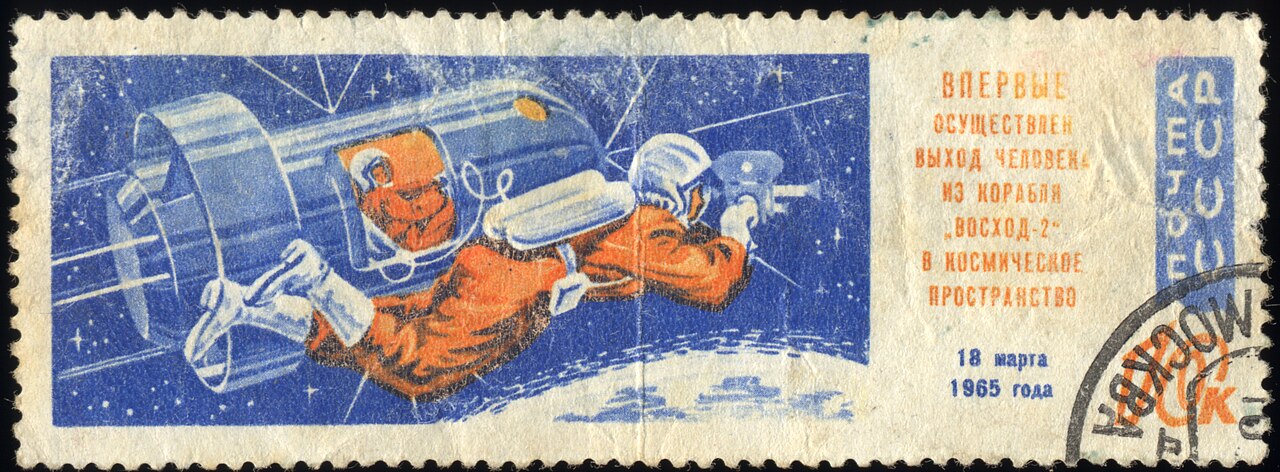
Gemini 4 gave the United States its answer to Leonov and, more importantly, the raw experience NASA needed for the Moon. White's struggle with the gas gun and the hatch revealed how deceptively hard working in space would be, lessons that led to the underwater training and handholds that made later EVAs routine. The four-day flight proved crews could endure a lunar-length mission, and the debut of Houston's Mission Control created the institution that has managed every American crewed flight since. After Gemini 4, NASA stopped chasing the Soviets and started overtaking them.
▸White's hand-held manoeuvring gun ran out of gas after about three minutes; for the rest of the EVA he steered by twisting his body and pulling on the tether.
▸A spare thermal glove floated out of the open hatch and drifted away, becoming one of the earliest pieces of accidental orbital debris.
▸The hatch latch jammed at both opening and closing; if the crew had failed to wrestle it shut, neither astronaut would have survived reentry.
▸Gemini 4 was the first mission directed from the new Mission Control Center in Houston, the room that went on to run every Apollo flight.
▸White carried a gold cross, a St. Christopher medal, and a Star of David with him outside the spacecraft.