Time Machine
You have arrived · The Moon Race
Salyut 1
first space station
April 19, 1971Baikonur CosmodromeOKB-1
Humanity's first space station reaches orbit.
NASA
The world that day
3.6 billion
People on Earth
2
Nations to launch a human
6
Humans to walk on the Moon
0
Known worlds beyond the Sun
The station that rose from Baikonur on a Proton rocket on 19 April 1971 carried the wrong name on its hull. It had been called Zarya, meaning dawn, until a readiness review ten days before launch, when managers renamed it Salyut, partly because the Soviets had learned China was developing a spacecraft of the same name, and partly because Zarya was already the radio call sign of their own flight control center. There was no time to repaint the hull. So the world's first space station reached orbit one week after the tenth anniversary of Gagarin's flight, wearing a name it no longer carried.
Salyut weighed about 18.4 tonnes and offered roughly 99 cubic metres of habitable volume, with workstations, scientific equipment including the Orion 1 ultraviolet telescope, and a planned six-month operational life. Getting people inside proved harder than building it. Soyuz 10 arrived in late April 1971, but its docking mechanism never achieved a hard seal; after five and a half hours attached to the station, its three disappointed cosmonauts flew home without ever opening the hatch.
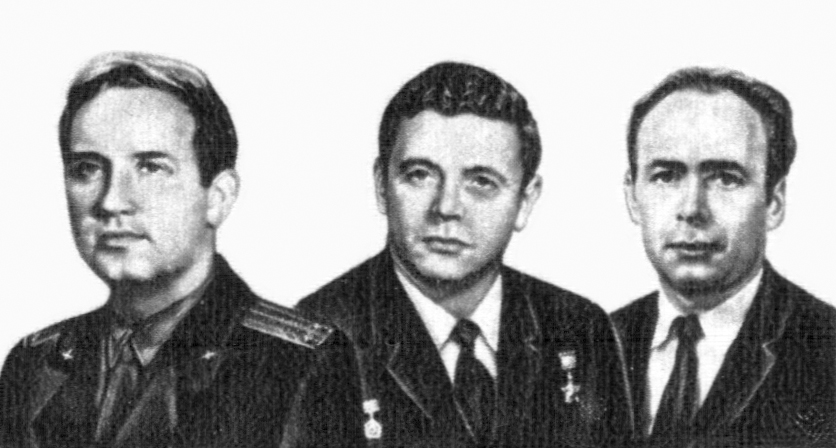
Soyuz 11 succeeded in June. Georgi Dobrovolski, Vladislav Volkov and Viktor Patsayev lived and worked aboard for more than three weeks, the longest human spaceflight yet flown, operating the telescope and running experiments, before their return ended in tragedy when their capsule depressurized before reentry. No crew ever visited Salyut again. Controllers commanded the empty station into a destructive reentry over the Pacific on 11 October 1971, 175 days after launch, but the idea it proved, a long-duration laboratory in orbit, has outlived it by more than half a century.
By the numbers
- Launch
- 19 Apr 1971, Proton rocket, Baikonur
- Mass
- approx. 18.4 t (40,620 lb)
- Habitable volume
- approx. 99 m³ (3,500 cu ft)
- Crewed occupancy
- 23 days (Soyuz 11 crew)
- Time in orbit
- 175 days
- Deorbit
- 11 Oct 1971, over the Pacific Ocean
Why it mattered
Salyut 1 turned spaceflight from a series of voyages into a place to live. It began the unbroken lineage of orbital habitation that runs through the later Salyuts, Mir and the International Space Station, whose Zvezda module still carries the basic hull architecture of 1971. After losing the Moon race, the Soviet program found in stations an arena it would dominate for two decades, and the station era it opened, with its rhythms of resupply, handover and long-duration research, became the heart of human spaceflight.
- The station was renamed from Zarya to Salyut just ten days before launch, both because China was developing a spacecraft of the same name and because Zarya was Soviet mission control's own call sign; the old name stayed painted on the hull.
- It launched one week after the tenth anniversary of Gagarin's flight, a deliberate echo of the era it opened.
- The first crew to reach it never got inside: Soyuz 10 soft-docked but could not achieve a hard seal, and after 5.5 hours attached its cosmonauts had to fly home.
- Salyut carried Orion 1, the first astronomical telescope ever operated by a crew aboard a space station.
- The ISS's Russian Zvezda service module traces its design lineage directly back to this 1971 station.
Keep travelling
People also explored

From the same era
Moment
Lunokhod 1 — first wheeled rover to operate on another body
From the same era

From the same era
Moment
Venera 7 — first soft landing on another planet
From the same era
From the same era
Moment
Soyuz 11 — first and only deaths in space
From the same era

From the same era
Moment
Apollo 15 — first crewed Lunar Roving Vehicle drive
From the same era