On 20 August 1977 a Titan IIIE-Centaur rose from Cape Canaveral carrying Voyager 2, the spacecraft that would visit more worlds than any machine before or since. In one of spaceflight's small ironies it launched sixteen days before Voyager 1, which would overtake it on a faster path; the twins were numbered by their order of arrival at Jupiter, not their departure from Earth. Both were racing to exploit a piece of celestial luck: an alignment of Jupiter, Saturn, Uranus and Neptune that occurs roughly once every 176 years, letting a single spacecraft slingshot from giant to giant.
02 / 03
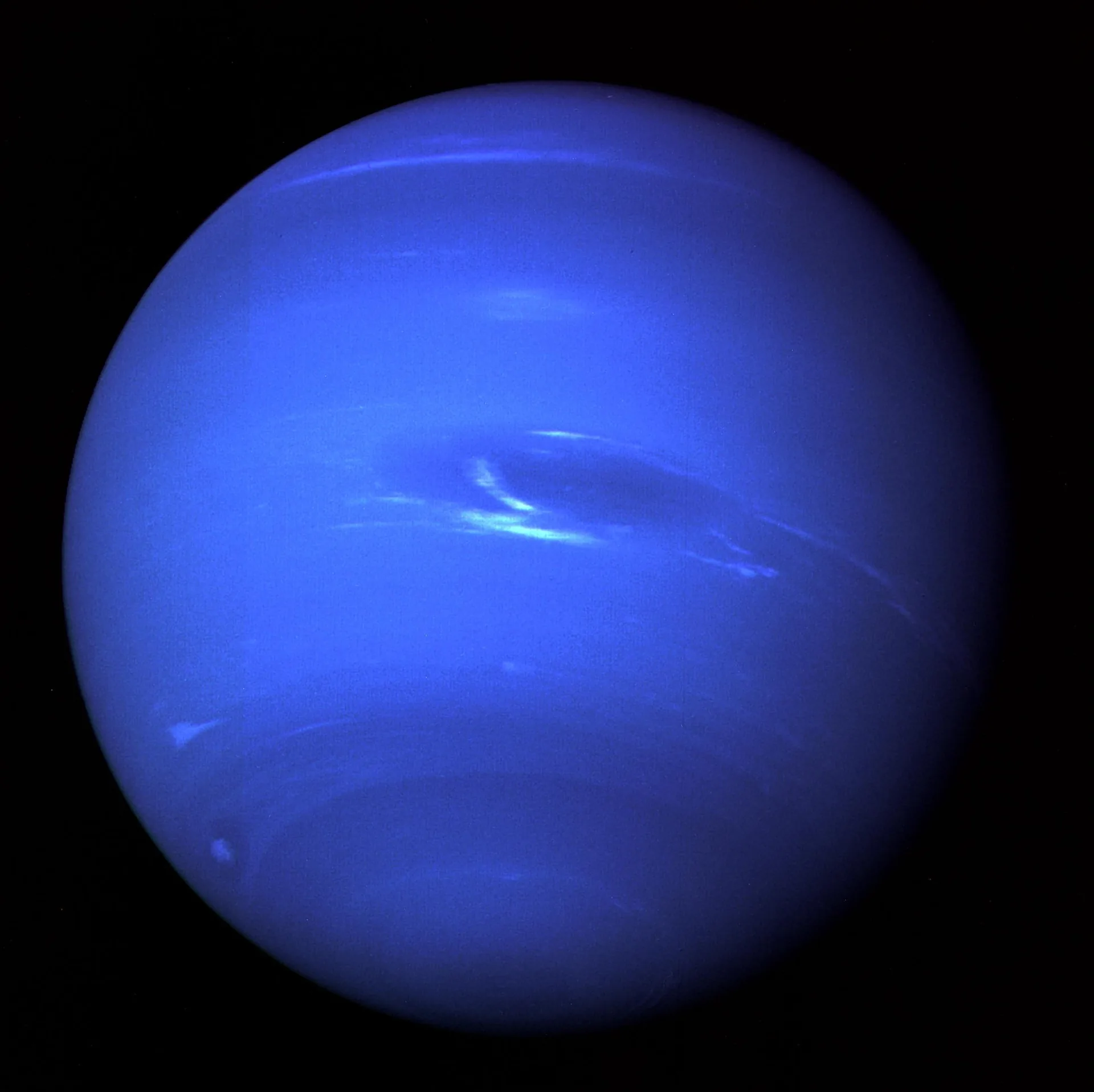
The tour unfolded over twelve years. Jupiter came on 9 July 1979, Saturn on 25 August 1981. Then came the part no other spacecraft has ever repeated: Uranus on 24 January 1986, a sideways-tilted world where Voyager 2 discovered ten new moons, and Neptune on 25 August 1989, where it skimmed over the cloud tops, found the Great Dark Spot, and caught geysers of nitrogen erupting from the frigid moon Triton. Almost four decades later, Voyager 2 remains the only spacecraft ever to have visited the two ice giants, and the only one to have flown past all four giant planets.
03 / 03
The mission refused to end. On 5 November 2018, more than 18 billion kilometres from home, Voyager 2 felt the solar wind die away around it and crossed the heliopause into interstellar space, six years behind its twin. Crucially, its plasma science instrument still worked, while the equivalent on Voyager 1 had failed back in 1980, so Voyager 2 returned humanity's first direct plasma measurements of the boundary as it crossed. Nearly half a century after launch, running on the dwindling warmth of its plutonium generators, it is still out there, whispering data home across more than a light-day of emptiness.
“
I think we're all happy and relieved that the Voyager probes have both operated long enough to make it past this milestone.
Suzanne Dodd · Voyager project manager, NASA Jet Propulsion Laboratory, December 2018
By the numbers
Launch
20 Aug 1977, Titan IIIE-Centaur, Cape Canaveral
Spacecraft mass
722 kg
Jupiter / Saturn flybys
9 Jul 1979 / 25 Aug 1981
Uranus / Neptune flybys
24 Jan 1986 / 25 Aug 1989
Entered interstellar space
5 Nov 2018, ~18 billion km from Earth
Power source
3 radioisotope thermoelectric generators
Why it mattered
Voyager 2 completed the reconnaissance of the solar system's giant planets in a single mission and remains, decades on, the sole source of close-up data for Uranus and Neptune, planets that anchor whole categories of exoplanets discovered since. Its gravity-assist Grand Tour validated the trajectory techniques that underpin every modern outer-planets mission, and its longevity rewrote expectations of what spacecraft engineering could endure. By crossing the heliopause with working instruments, it converted the boundary of the Sun's influence from theory into measured reality, and its continued operation nearly fifty years after launch makes it a benchmark for every long-duration mission that follows.
▸Voyager 2 launched sixteen days before Voyager 1; the twins were numbered by who would reach Jupiter first, not who left Earth first.
▸The mission rode a planetary alignment that occurs roughly once every 176 years; the previous opportunity came when Thomas Jefferson was president.
▸It is still the only spacecraft ever to have visited Uranus and Neptune, where it discovered ten new moons at Uranus alone.
▸At Neptune's moon Triton it found active nitrogen geysers erupting on one of the coldest surfaces in the solar system.
▸When it crossed into interstellar space in 2018, its still-working plasma instrument captured boundary measurements its twin could not, because Voyager 1's equivalent had failed in 1980.