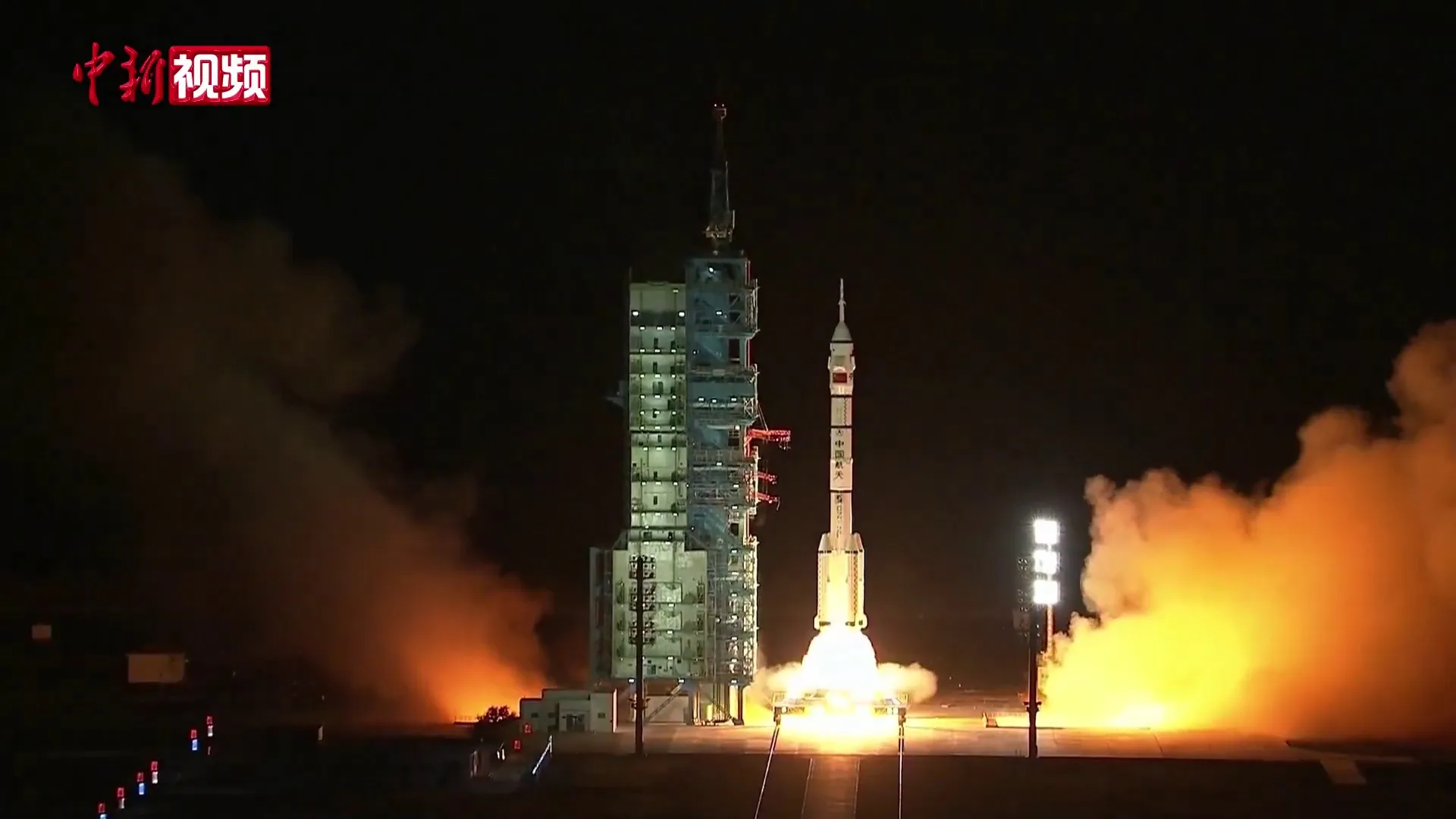
China News Service (中国新闻社) / CNSA, CC BY 3.0, via Wikimedia Commons
The world that day
8.1 billion
People on Earth
3
Nations to launch a human
12
Humans to walk on the Moon
5,500
Known worlds beyond the Sun
01 / 04
At 1:31 a.m. local time on 29 May 2025, still 28 May in universal time, a Long March 3B climbed out of the mountain valleys around Xichang and threw a probe clear of Earth's gravity. Tianwen-2, the second mission in China's 'Questions to Heaven' planetary series after the Mars mission Tianwen-1, was leaving to chase one of the strangest objects in the sky: 469219 Kamoʻoalewa, a body just tens of metres across that loops through space as a quasi-satellite, shadowing Earth's orbit around the Sun for centuries.
02 / 04
Kamoʻoalewa, named from a Hawaiian creation chant, may not be an ordinary asteroid at all. Spectral studies suggest its surface resembles lunar rock, and researchers have proposed it is a fragment of the Moon itself, possibly blasted free by the impact that carved the young crater Giordano Bruno. If so, China's probe is flying out to retrieve a piece of the Moon that escaped, a sample that could be checked directly against Apollo and Chang'e rocks.
03 / 04
The plan is the most ambitious small-body campaign yet attempted. After rendezvousing with the asteroid about a year after launch, Tianwen-2 will map it with eleven instruments, then try to collect on the order of 100 grams of regolith, using the touch-and-go technique proven by Hayabusa2 and OSIRIS-REx and, for the first time anywhere, an anchor-and-attach method that drills the spacecraft onto the surface of the tumbling body.
04 / 04
The sample capsule is due back at Earth in late 2027, but the mothership's journey will only be half done: it will then slingshot onward for a years-long cruise to 311P/PANSTARRS, an active main-belt comet expected around 2035. By June 2026 the spacecraft had closed in on Kamoʻoalewa and begun its approach operations, putting China on the threshold of joining Japan and the United States as the only nations to bring asteroid material home.
“
The Tianwen-2 mission represents a significant step in China's new journey of interplanetary exploration.
Shan Zhongde · Head of the China National Space Administration
By the numbers
Launch
29 May 2025, 1:31 a.m. Beijing time (28 May UTC)
Rocket / site
Long March 3B, Xichang Satellite Launch Center
Target
469219 Kamoʻoalewa, an Earth quasi-satellite tens of metres across
Sample goal
≈100 g of regolith
Sample return
Planned late 2027
Extended mission
Comet 311P/PANSTARRS, around 2035
Why it mattered
Tianwen-2 marks China's graduation from lunar sample return, achieved with Chang'e 5 and Chang'e 6, to full small-body exploration, a discipline previously owned by Japan and the United States. Success would make China the third nation to return asteroid material and the first to anchor a spacecraft to an asteroid's surface, while potentially settling whether Earth's quasi-moon is a fragment of our own Moon. The mission's two-target architecture, asteroid sample return followed by a main-belt comet rendezvous, signals a planetary program planning in decades, and it sets up the comparison samples scientists need to trace how material moves between the Earth, the Moon, and near-Earth space.
▸Kamoʻoalewa may be a piece of the Moon itself, possibly thrown into space by the impact that formed the Giordano Bruno crater, so the mission may effectively be a second kind of lunar sample return.
▸Tianwen-2 will attempt the first 'anchor-and-attach' sampling in history, drilling itself onto the asteroid, where OSIRIS-REx and Hayabusa2 only touched and went.
▸The target is a quasi-satellite, one of a handful of objects that loop alongside Earth for centuries without ever being captured into true orbit.
▸Dropping its sample capsule at Earth in 2027 is only the halfway point: the spacecraft then flies on for roughly seven more years to an active main-belt comet.
▸By June 2026, a year after launch, tracking showed the probe arriving in Kamoʻoalewa's vicinity to begin mapping ahead of the sampling attempt.