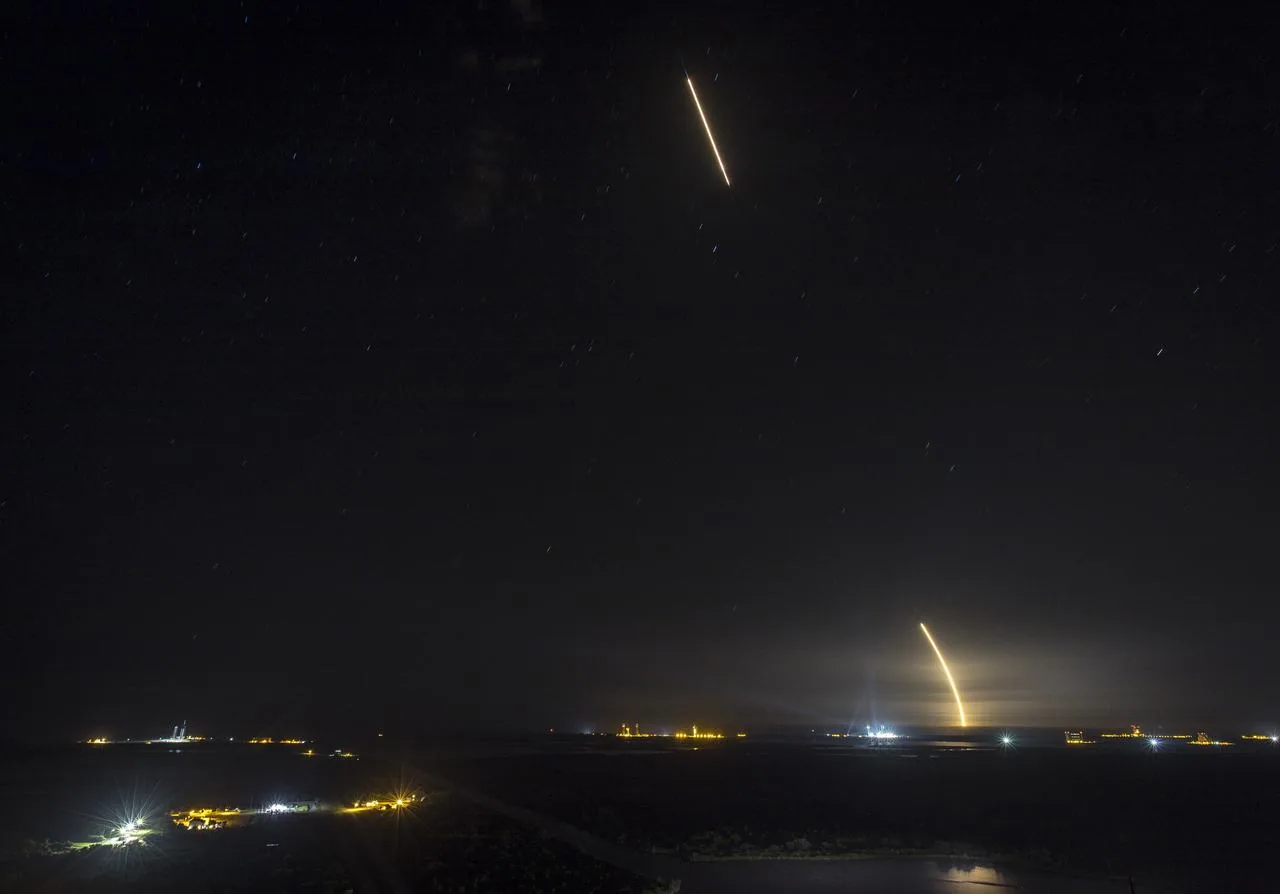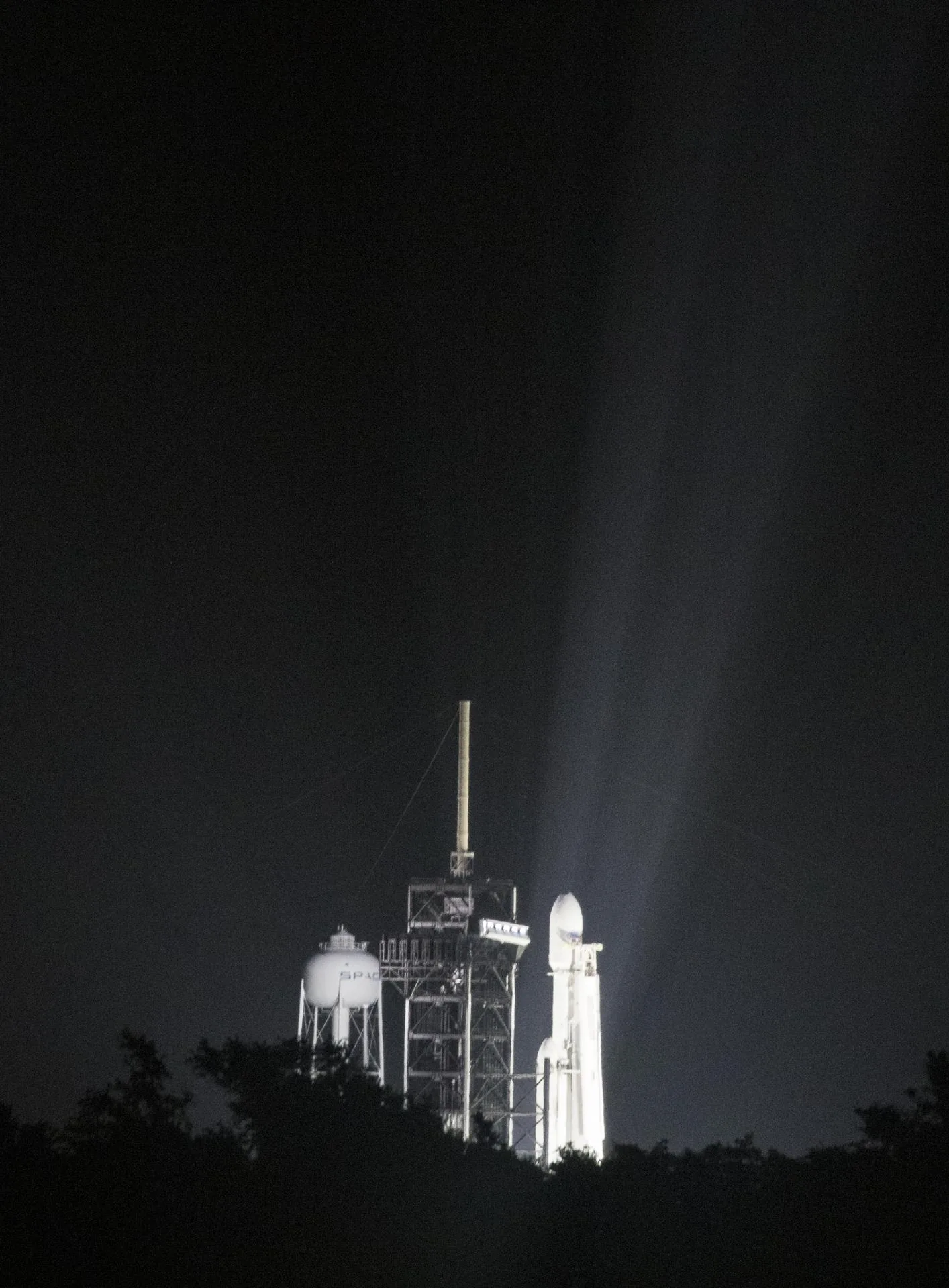
When a rocket launches, you're watching one of the most impressive engineering achievements humanity has ever produced. And yet the underlying physics — the reason rockets can leave Earth at all — is surprisingly simple. It comes down to three things: Newton's laws, chemistry, and the mathematics of throwing stuff overboard really fast.
This guide explains how rockets work, from the moment the engine ignites to the moment a spacecraft reaches orbit, without requiring any prior knowledge of physics or engineering.
The Core Idea: Action and Reaction
Sir Isaac Newton's third law of motion states that for every action there is an equal and opposite reaction. This is the entire operating principle of a rocket engine.
When you push against the ground, the ground pushes back and you move forward. A rocket engine works the same way — except the rocket pushes against exhaust gas instead of solid ground. The engine burns propellant, creating extremely hot, high-pressure gas. That gas is expelled out the back of the engine at tremendous speed. The reaction to that expulsion pushes the rocket forward.
Crucially, a rocket does not need anything to push against. This is the fundamental difference between a rocket and an airplane engine. Airplane engines work by pushing air backward — they need an atmosphere to function. Rockets carry all their own propellant (both fuel and the oxidizer needed to burn it) and create thrust entirely from the reaction force of expelling exhaust gas. This is why rockets work in the vacuum of space, where there is no air at all.
The key measure of rocket engine efficiency is specific impulse (Isp) — essentially how much thrust you get per unit of propellant mass consumed per second. Higher Isp means more efficient use of propellant. This matters enormously because propellant is heavy, and in rocketry, mass is the enemy.
The Rocket Equation: Why Space is Hard
Here is the fundamental challenge of spaceflight, expressed by the Tsiolkovsky rocket equation (published in 1903):
Delta-v = Isp × g₀ × ln(initial mass / final mass)
In plain English: the change in velocity a rocket can achieve depends on how efficiently its engine burns propellant (Isp) and on the ratio of its initial mass (full of propellant) to its final mass (empty of propellant).
To reach low Earth orbit, a rocket needs to achieve a velocity of approximately 7.8 km/s (about 28,000 km/h), plus overcome gravity losses and aerodynamic drag during ascent — so in practice, you need about 9–10 km/s of delta-v.
The problem: rocket propellants, for all their energy, are not very efficient by this measure. A rocket using liquid hydrogen and liquid oxygen (one of the most efficient chemical propellants) has an Isp of about 450 seconds. To achieve the velocity needed for orbit with a single-stage vehicle, more than 85% of the vehicle's initial mass must be propellant. That leaves only 15% for the rocket structure, engines, and payload — your satellite or spacecraft.
This is why rockets are so large and why payload fractions are so small. A Falcon 9 weighs 549,000 kg at launch. Its payload to low Earth orbit is about 22,800 kg — about 4% of its launch mass. Everything else is propellant, structure, and engines.
How a Rocket Engine Actually Works
Liquid-Fueled Engines
Most high-performance rockets use liquid propellants stored in separate tanks — fuel in one tank, oxidizer in another. The most common combinations are:
- RP-1 (refined kerosene) + liquid oxygen (LOX): Used by SpaceX Falcon 9 (Merlin engine), Soviet/Russian engines (RD-180), and many others. Dense, storable, energetic. The black smoke you see in RP-1 launches is carbon soot.
- Liquid hydrogen (LH2) + liquid oxygen: Used by NASA's Space Launch System (RS-25 engine), the European Ariane 5/6 (Vulcain engine), and the Space Shuttle Main Engines. Highest specific impulse of any operational propellant combination (~450s), but LH2 is cryogenic and extremely low-density — tanks must be enormous.
- Liquid methane + liquid oxygen: Used by SpaceX Raptor engines (Starship), Rocket Lab's Archimedes engine. Good compromise between RP-1's density and LH2's Isp. Also potentially manufacturable on Mars from CO₂ and water, which is why SpaceX chose it.
In a liquid-fueled engine, propellants are pumped from tanks into a combustion chamber using turbopumps — essentially turbine-driven pumps running at tens of thousands of RPM. The propellants ignite in the combustion chamber, creating combustion gases at temperatures of 3,000–3,500°C and pressures of 100–300 atmospheres. These gases expand through a nozzle, accelerating to several km/s as they exit the engine.
Solid-Fueled Motors
Solid rocket motors (SRMs) mix fuel and oxidizer into a solid propellant grain that is cast directly into the motor casing. Once ignited, they burn continuously until the propellant is exhausted — you cannot throttle or shut down a solid motor. The Space Shuttle solid rocket boosters, NASA SLS boosters, and most military missiles use solid propellant.
Solids are simpler (no pumps, no separate tanks), can be stored for years ready to fire, and produce very high thrust. Their main disadvantages are lower efficiency (Isp around 260–270s) and lack of controllability.
Staging: The Clever Solution to the Rocket Equation Problem
Given the brutal mass requirements of the rocket equation, engineers developed an elegant solution: staging. Instead of carrying an empty tank and engine all the way to orbit, you jettison them once the propellant is burned.
A two-stage rocket works like this:
- The first stage ignites at liftoff, burning most of the propellant. When the first stage tank is empty, it separates and falls away.
- The second stage ignites. It is now carrying only itself and its payload — it has shed the mass of the now-empty first stage. This allows it to efficiently accelerate the remaining payload to orbital velocity.
The famous "staging" event visible in most rocket launches — the flash and separation that occurs 2–3 minutes after liftoff — is this jettisoning of the first stage. SpaceX Falcon 9 is a two-stage rocket. Saturn V was a three-stage rocket. SLS is effectively a two-stage rocket with strap-on solid boosters.
SpaceX's innovation with the Falcon 9 and Starship is recovering and reusing the first stage — landing it propulsively after separation, refurbishing it, and flying it again. A Falcon 9 first stage has flown as many as 23 times. This dramatically reduces the cost of each launch because the most expensive component (the first stage with 9 Merlin engines) is not thrown away.
From Launch Pad to Orbit: The Ascent Profile
A rocket's journey to orbit is not a straight-up path. It follows a gravity turn:
- Liftoff and vertical climb: The first few seconds, the rocket climbs straight up to clear the launch pad and gain initial altitude.
- Pitch-over / gravity turn: The rocket begins tilting toward the horizon. This is counterintuitive — why fly sideways? Because orbit is not about altitude; it's about speed. To reach orbit, the rocket must achieve horizontal velocity of ~7.8 km/s. It must fly largely sideways to accelerate to this speed.
- Max-Q: The moment of maximum aerodynamic pressure, typically around 1–1.5 minutes after liftoff at 12–15 km altitude. Engines may throttle back slightly to reduce structural stress.
- Stage separation: The first stage separates. The second stage ignites.
- Main engine cutoff (MECO) and second engine cutoff (SECO): Once the spacecraft reaches orbital velocity and altitude, the engines shut down. The spacecraft is in orbit — falling continuously around Earth at exactly the right speed to keep missing the planet below.
This last point is crucial and often confusing: orbit is not the absence of gravity. At 400 km altitude, Earth's gravity is about 88% as strong as at the surface. Orbiting objects experience essentially full gravity — but they are falling forward fast enough that Earth's surface curves away beneath them at the same rate they fall. Orbit is a continuous state of falling around the planet.
What Determines How High You Go?
Once in orbit, a spacecraft's path is determined by its velocity:
- Low Earth orbit (LEO): 160–2,000 km altitude, ~7.8 km/s orbital velocity. The ISS orbits at 408 km at 7.66 km/s, completing one orbit every 92 minutes.
- Medium Earth orbit (MEO): 2,000–35,786 km. GPS satellites orbit at ~20,200 km.
- Geostationary orbit (GEO): Exactly 35,786 km altitude, orbital period exactly 24 hours — the satellite stays fixed over one point on Earth. Communications satellites live here.
- Lunar orbit: The Moon orbits at ~385,000 km average distance.
To move to a higher orbit, you fire engines to speed up — counterintuitively, this raises your orbit. To lower an orbit, you slow down. This is why rockets destined for geostationary orbit don't point toward GEO; they launch to a lower parking orbit first, then fire an upper stage to transfer to GEO.
The Numbers That Make It Impressive
- A SpaceX Falcon 9 produces 7.6 million Newtons of thrust at liftoff — about 1.7 million pounds of force from 9 Merlin engines burning 600 kg of RP-1 and LOX per second
- SpaceX's Starship/Super Heavy produces about 74 MN (16.6 million pounds) of thrust — the most powerful launch vehicle ever flown
- A rocket must reach 11.2 km/s (escape velocity) to leave Earth's gravity well entirely; orbital speed is lower because you're still gravitationally bound but in a stable path
- The Saturn V, which sent Apollo astronauts to the Moon, weighed 2.8 million kg fueled and generated 34.5 MN of thrust from its five F-1 engines
Key Takeaways
- Rockets work by Newton's third law: exhaust gas expelled backward creates forward thrust — no air required
- The rocket equation sets brutal mass requirements: most of a rocket's weight is propellant
- Staging solves this by jettisoning empty tanks, allowing more efficient acceleration of remaining mass
- Orbit is not about going up — it's about going sideways fast enough to keep falling around the planet
- The most efficient propellants are cryogenic liquids (LH2/LOX); practical compromises include RP-1 and methane
- Reusable first stages (Falcon 9, Starship) are revolutionizing launch costs by recovering the most expensive hardware
The rocket equation is pitiless. But human ingenuity has found ways to work within its constraints, and the result is that we now routinely launch thousands of kilograms to orbit, land rockets on drone ships, and are building vehicles capable of sending people to Mars. Not bad for 120 years since the Wright Brothers.