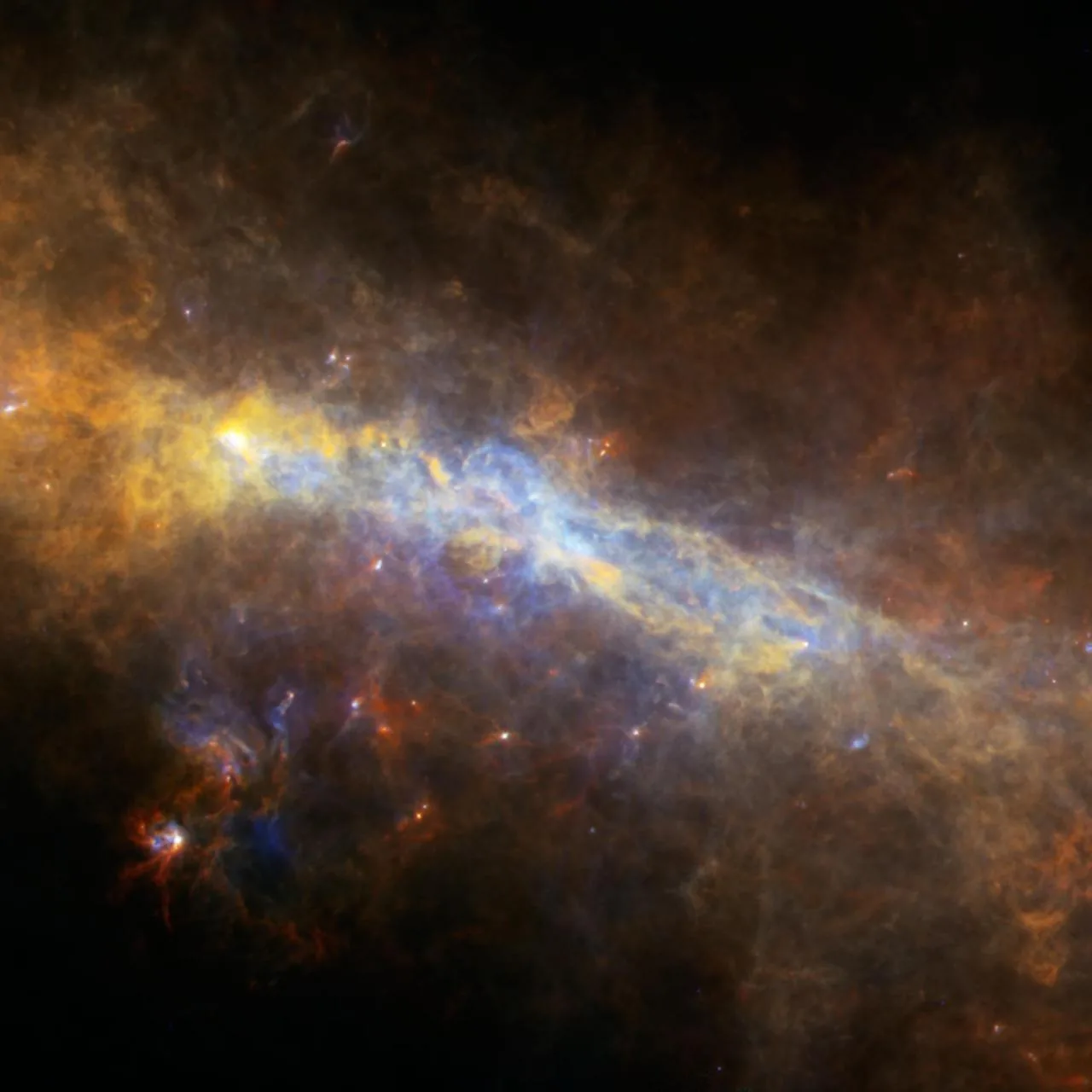
On a clear, dark night -- far from city lights -- you can see it with your naked eyes: a pale, luminous band stretching across the sky from horizon to horizon. The ancient Greeks called it "galaxias kyklos" -- the milky circle. We call it the Milky Way, and it is our home.
But what you see with your eyes is only a tiny, edge-on glimpse of something vast beyond ordinary comprehension. The Milky Way is a barred spiral galaxy spanning roughly 100,000 light-years across, containing somewhere between 200 and 400 billion stars, and harboring a supermassive black hole at its center. You live inside it. Every star you see in the night sky is a neighbor within this same colossal structure.
Let me give you the full tour.
The Shape of Home
If you could somehow travel millions of light-years away and look back at the Milky Way from the outside, you would see a magnificent barred spiral galaxy. A central bulge of densely packed, mostly older stars would glow with a warm yellowish light. Extending from that bulge would be a stellar bar -- an elongated structure of stars stretching about 27,000 light-years from end to end. And sweeping outward from the ends of that bar would be the great spiral arms, traced by bright blue young stars, glowing nebulae, and lanes of interstellar dust.
The galaxy is not just a flat disk, though. The disk itself is remarkably thin compared to its width -- about 1,000 to 2,000 light-years thick, compared to 100,000 light-years across. Surrounding the disk is a roughly spherical halo of old stars, globular clusters, and (most importantly) dark matter, extending hundreds of thousands of light-years in every direction.
The major spiral arms include the Perseus Arm, the Scutum-Centaurus Arm, the Sagittarius Arm, and the Norma Arm. Our Sun sits in a minor structure called the Orion Spur (also known as the Orion Arm or Local Arm), located between the Perseus and Sagittarius arms, roughly 27,000 light-years from the galactic center.
This is a rather unremarkable address by cosmic standards -- the suburbs of a fairly typical spiral galaxy. But it is ours.
The Heart of the Galaxy: Sagittarius A*
At the very center of the Milky Way lurks Sagittarius A* (Sgr A*), a supermassive black hole with a mass of about 4 million times that of our Sun. We cannot see it directly in visible light -- the galactic center is hidden behind thick clouds of dust and gas -- but radio, infrared, and X-ray observations have revealed its presence and nature in stunning detail.
For more than two decades, astronomers tracked individual stars orbiting Sgr A*, watching them whip around the invisible mass at thousands of kilometers per second. One star, called S2, completes a full orbit in just 16 years, reaching speeds exceeding 7,600 km/s (about 2.5% the speed of light) at its closest approach. The orbital data confirmed beyond doubt that a compact object of 4 million solar masses occupies the center -- and the only known object that massive and that compact is a black hole. Andrea Ghez and Reinhard Genzel shared the 2020 Nobel Prize in Physics for this work.
Then, in May 2022, the Event Horizon Telescope gave us the first image of Sgr A* -- a glowing ring of superheated gas surrounding the black hole's shadow. It was breathtaking: a direct look at the gravitational heart of our galaxy.
Despite its enormous mass, Sgr A* is currently fairly quiet -- it is not actively consuming large amounts of material. Compared to the blazing quasars powered by supermassive black holes in other galaxies, our central black hole is practically napping. But there is evidence that it was more active in the past, and it could flare up again if a substantial cloud of gas wanders too close.
Our Stellar Neighborhood
The Sun orbits the galactic center at a speed of about 230 kilometers per second, completing one full orbit in roughly 225-250 million years -- a period sometimes called a galactic year. Since the Sun formed 4.6 billion years ago, it has completed approximately 18-20 orbits around the galaxy.
Our immediate stellar neighborhood is relatively well-mapped. The nearest star system is Alpha Centauri, a triple system about 4.37 light-years away. The nearest solo star is Proxima Centauri, a small red dwarf that is the third component of the Alpha Centauri system, at 4.24 light-years. Within about 10 light-years, there are roughly a dozen known star systems, most of them dim red dwarfs invisible to the naked eye.
The Sun sits within a region called the Local Bubble -- a cavity in the interstellar medium about 1,000 light-years across, thought to have been carved out by supernova explosions over the past 10-20 million years. The interior of this bubble is filled with hot, low-density gas, and many of the bright stars visible in our night sky -- including those in Orion and Scorpius -- sit along its walls.
The Milky Way's Family: Satellite Galaxies
The Milky Way does not exist in isolation. It is orbited by a retinue of smaller satellite galaxies, gravitationally bound companions that range from substantial to tiny.
The two most prominent are the Large and Small Magellanic Clouds (LMC and SMC), visible as fuzzy patches in the southern hemisphere sky. The LMC, at about 160,000 light-years away, is a substantial galaxy in its own right, containing perhaps 30 billion stars. It is actively forming stars and hosts the Tarantula Nebula, one of the most vigorous star-forming regions in the entire Local Group of galaxies.
Beyond the Magellanic Clouds, the Milky Way has dozens of known dwarf satellite galaxies -- small, faint collections of stars that orbit within our galaxy's dark matter halo. These include the Sagittarius Dwarf Elliptical Galaxy, which is currently being torn apart and absorbed by the Milky Way's gravitational tides. Streams of its stars have been traced wrapping around our galaxy like ribbons. This is galactic cannibalism in action, and it has been a recurring theme throughout the Milky Way's history. Our galaxy has grown, in part, by consuming its smaller neighbors.
The Dark Matter Halo
The visible stars and gas of the Milky Way are embedded in a vast, invisible dark matter halo that extends far beyond the disk of stars -- perhaps 600,000 light-years or more in radius. This halo contains roughly 10 to 20 times more mass than all the visible matter combined, making dark matter the dominant component of our galaxy by mass.
We cannot see the dark matter halo directly, but its gravitational influence is unmistakable. The rotation curve of the Milky Way -- how fast stars and gas orbit at different distances from the center -- remains flat far beyond where it should decline if only visible matter were present. This is the same signature that Vera Rubin observed in other galaxies in the 1970s, and it tells us that the Milky Way is embedded in a massive cocoon of invisible matter.
The total mass of the Milky Way, including its dark matter halo, is estimated at about 1 to 1.5 trillion solar masses. The visible stars contribute only a fraction of that. We live, quite literally, in a galaxy that is mostly invisible.
Collision Course: The Andromeda Encounter
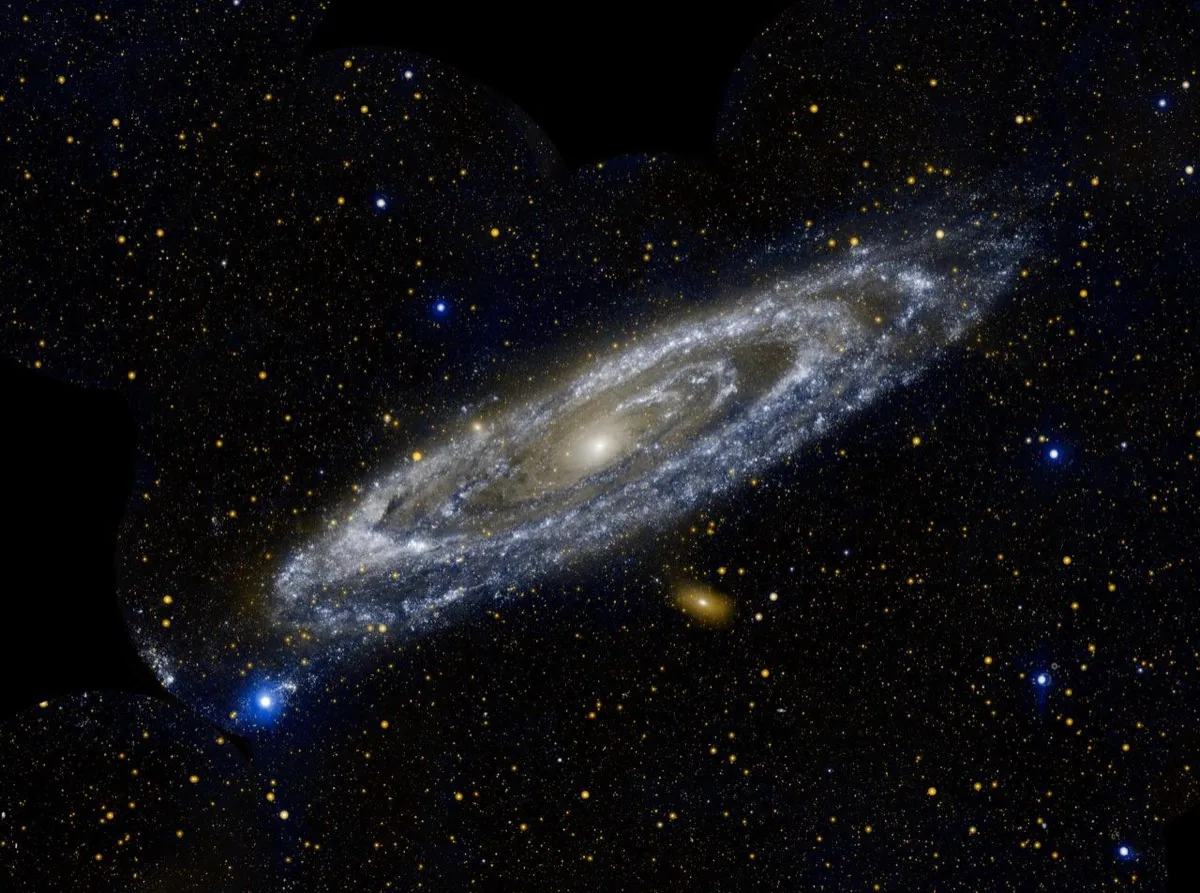
The Milky Way's nearest large galactic neighbor is the Andromeda Galaxy (M31), a spiral galaxy slightly larger than our own, located about 2.5 million light-years away. It is the most distant object visible to the naked eye -- a faint, fuzzy smudge in the constellation Andromeda.
And it is heading straight for us.
The Milky Way and Andromeda are approaching each other at about 110 kilometers per second, drawn together by their mutual gravitational attraction. In approximately 4.5 billion years, the two galaxies will collide and begin a long, complex process of merging. Computer simulations show that the galaxies will make several close passes, with their spiral structures being dramatically distorted by tidal forces, before eventually settling into a single, larger elliptical galaxy -- sometimes nicknamed "Milkomeda" or "Milkdromeda."
Before you panic: this collision will be almost entirely harmless to any solar systems that exist at the time. Stars within galaxies are so widely spaced relative to their size that actual stellar collisions will be extraordinarily rare. The Sun (if it is still shining -- it will be near the end of its life by then) will likely be flung onto a new orbit within the merged galaxy, but it will not be struck by anything.
The night sky, however, will be spectacular. As Andromeda approaches, it will grow from a tiny smudge to a vast spiral filling half the sky. After the merger, the familiar band of the Milky Way will be gone, replaced by the diffuse glow of an elliptical galaxy -- a fundamentally different kind of stellar city.
A Galaxy Worth Knowing
The Milky Way is not the biggest galaxy, or the brightest, or the most active. It is, by cosmic standards, a fairly ordinary barred spiral. But it is ours. Every atom in your body was forged in the nuclear furnaces of stars that lived and died within this galaxy. The iron in your blood came from a supernova. The calcium in your bones was made in the death throes of massive stars. You are, in a very real and literal sense, made of Milky Way material.
Understanding our galaxy is not just an exercise in mapping distant stars. It is an exercise in understanding where we come from and what kind of cosmic environment has made our existence possible. The Milky Way has provided the raw materials, the energy, and the stability needed for a small rocky planet in the Orion Spur to develop oceans, atmospheres, and eventually, minds curious enough to look up and ask: what is all this?
That band of light across the sky is not just beautiful. It is home. And the more we learn about it, the more extraordinary that home turns out to be.